
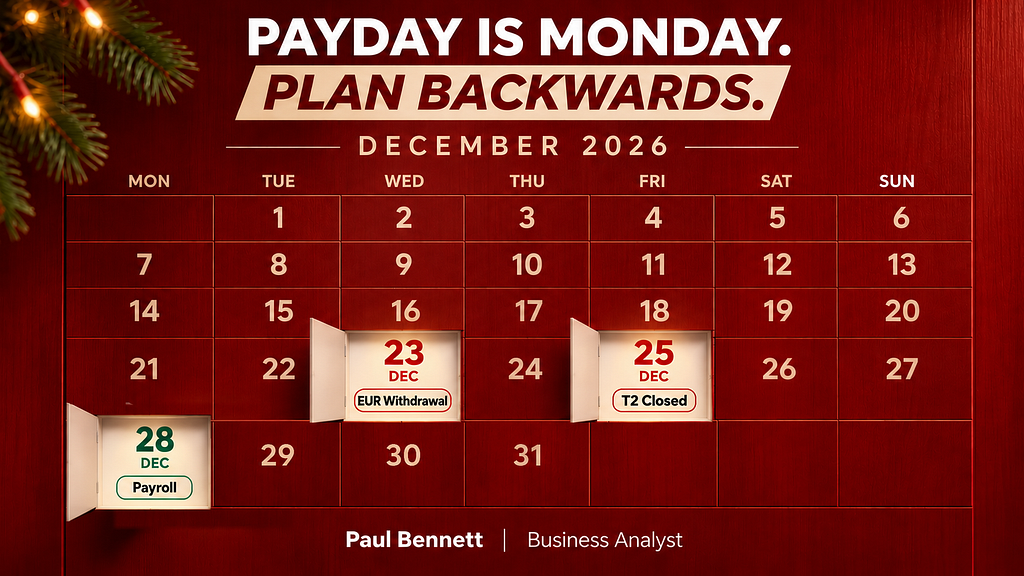
December 28 looks like a perfectly ordinary Monday. Until you put it on a payroll calendar and realise Christmas is right in the way.
I know payroll planning is particularly relevant for many businesses ahead of the holidays, so I thought I’d work through an interesting hypothetical case.
A software company invoices its clients in USDC and pays its engineers in Germany and Spain in euros. Revenue arrives throughout the month, but salaries need to reach employees on a fixed date. How often should the company convert its USDC, and when should the money leave its account?
Start With Payday and Work Backwards
I’d build the calendar around the payroll date, allowing two business days for conversion and the subsequent SEPA transfer. That’s a planning buffer rather than a guarantee, accounting for potential processing delays and banking cutoffs.
Some companies might automate part of this process. zerohash On & Off Ramp, for example, provides API infrastructure for crypto-to-fiat conversion, quote execution and withdrawals through supported payment rails, including SEPA.
A software company could integrate these operations into its treasury system and schedule them around its internal payroll deadlines.
Six Dates I’d Mark in the Calendar
T2, the Eurosystem’s real-time gross settlement system, has six annual closing days:
January 1Good FridayEaster MondayMay 1December 25December 26
On May 28, 2026, the ECB announced its roadmap for extending T2 operating hours.
While SEPA Instant already operates around the clock, not every corporate off-ramp or payroll arrangement follows the same schedule. I’d still check the entire payment route before relying on holiday processing.
Why December 23 Goes Into My Calendar
Our software company’s payroll is scheduled for Monday, December 28. Here’s how I’d plan that week:
December 23: Convert USDC and initiate the EUR withdrawal before the relevant cutoff.December 24: Confirm that the payroll account has been funded.December 25–27: Christmas holidays and the weekend.December 28: Payday.
If Christmas Eve processing is restricted or payroll instructions require earlier approval, I’d move the withdrawal forward.
The Reverse Payroll Calendar: planning USDC-to-EUR conversion around payroll deadlines and T2 closing days. Hypothetical scenario
For businesses managing conversion and fiat payments through one provider, OpenPayd On/Off Ramp offers conversion via an API, dashboard or OTC desk, alongside multi-currency accounts and access to SEPA and SEPA Instant through its wider financial infrastructure. I’d check the processing deadlines for both conversion and bank transfers. They don’t necessarily follow the same timetable.
One Withdrawal or Four? A €15 Difference
WhiteBIT On/Off-Ramp offers institutional clients EUR deposits and withdrawals via SEPA for a fixed €5 fee, more than 90 EUR trading pairs, including USDC/EUR, and individual deposit and withdrawal limits. For businesses working with multiple currencies, its separate USD On/Off-Ramp also offers a base conversion fee of 0.10% and a fixed $54 SWIFT fee.
Using the €5 SEPA withdrawal fee in our example:
One monthly withdrawal: €5.Four weekly withdrawals: €20.Difference: €15.
That’s excluding conversion costs and other applicable charges.
Now imagine a monthly payroll of €100,000. A 1% adverse currency movement on the equivalent unconverted USDC balance could reduce its euro value by roughly €1,000. That’s a figure I’d pay considerably more attention to.
How Much USDC Would I Keep Between Paydays?
Converting monthly shortly before payday means holding more dollar exposure against a euro liability. Converting weekly and keeping the proceeds in euros gradually reduces that exposure but adds more transactions for the finance team to manage.
For a company with tight cash flow, I’d consider converting part of the upcoming payroll throughout the month. A business with sufficient euro reserves or dollar-denominated expenses might prefer to retain more USDC as working capital.
When choosing an off-ramp provider, I’d compare conversion costs, transaction limits, settlement times and automation options.
The €15 difference is easy to calculate. Deciding how much currency exposure to carry and when to move the money takes a little more thought. And if payday is December 28, I’d much rather have that conversation on December 1 than on Christmas Eve.
Disclaimer: This is not financial or investment advice. Do your own research before making any decisions. Use at your own risk.
Counting Backward From Payday: A Payroll Calendar Built Around an On/Off-Ramp was originally published in Coinmonks on Medium, where people are continuing the conversation by highlighting and responding to this story.