
When people talk about security in Web3, private keys usually dominate the conversation.
Keep your seed phrase safe. Don’t sign suspicious transactions. Verify contract addresses. Don’t connect your wallet to random websites.
These are important precautions, but from a developer’s perspective, they cover only part of the problem.
A Web3 application can have perfectly secure smart contracts and still expose its users through compromised API keys, leaked session tokens, poorly implemented wallet authentication, insecure backend configurations or improperly handled authorization.
The wallet isn’t necessarily the weakest point.
Sometimes, it’s everything built around it.
A wallet signature isn’t just another login
Wallet-based authentication has made it possible to authenticate users without traditional passwords. But the way signatures are handled matters considerably.
A common implementation uses Sign-In with Ethereum (SIWE), where a user signs a structured message to prove ownership of an address.
The signature itself doesn’t necessarily expose the private key. However, an authentication system that doesn’t properly validate the signed message can introduce serious vulnerabilities.
Consider what a login message should establish:
Who is requesting authentication?Which domain is the user authenticating with?What is the intended audience?Is the message tied to a specific nonce?Is the message still valid?Is the signature being reused?
A signature without proper contextual validation can become an authentication vulnerability.
For example, if an application accepts previously used authentication messages, it may allow replay attacks. An attacker who obtains a valid authentication payload and signature could potentially reuse them if the server doesn’t enforce nonce consumption and appropriate validation.
This is why verifying a signature alone isn’t sufficient.
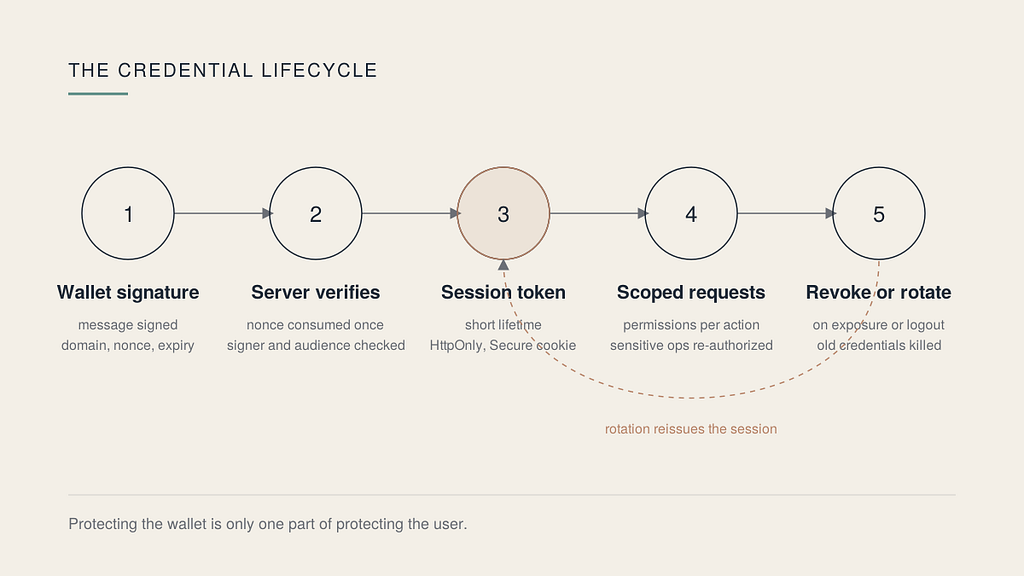
The backend must verify the message’s content, signer, domain, expiration and nonce against its own authentication rules.
Signatures, session tokens and API keys are different security boundaries
One thing that can easily get overlooked when building a Web3 application is that not every credential serves the same purpose.
A wallet signature proves that a particular message was signed by a key. A session token grants access to an application within the permissions defined by that application. An API key may grant access to an external service.
These credentials shouldn’t be treated interchangeably.
Once a wallet signature is verified, the application might issue a session token. That token becomes the credential used for subsequent requests.
If it is stolen, an attacker may not need access to the user’s wallet at all.
Depending on the permissions attached to the session, they could potentially access private data, perform actions on the user’s behalf or manipulate application-level operations.
This is where traditional backend security becomes just as important as blockchain security.
Session tokens should have limited lifetimes, secure storage, appropriate rotation and revocation mechanisms.
Sensitive operations should also require additional authorization where appropriate rather than relying solely on an existing session.
The problem with storing secrets where they don’t belong
Frontend applications are often connected to several services: RPC providers, analytics platforms, APIs, cloud services and authentication systems.
During development, it can be tempting to put API keys directly into frontend environment variables, assuming that environment variables make them secret.
They don’t.
In frameworks such as Next.js, environment variables exposed to client-side code, including those prefixed with NEXT_PUBLIC_, are bundled into the frontend and can be inspected by users.
The same applies to secrets embedded in JavaScript bundles, configuration files or public repositories.
A key that is exposed to the browser should be treated as publicly accessible.
This doesn’t mean every frontend API key is inherently dangerous. Some providers intentionally issue public keys and rely on domain restrictions, quotas or other controls.
But privileged credentials should never be exposed through the client.
A better approach is to keep sensitive credentials on the server, restrict their permissions, rotate exposed keys and monitor their usage.
And if a key has already been exposed, deleting it from the source code isn’t enough. It needs to be revoked or rotated.
Session keys make Web3 UX better, but introduce new risks
Smart accounts and session-key mechanisms can make Web3 applications significantly more user-friendly.
Instead of asking users to approve every interaction through their wallet, applications can grant limited permissions to session keys.
For example, a gaming application might allow a session key to perform certain actions for a limited period without requiring the user to approve every transaction individually.
The convenience is real.
But the design of these permissions is equally important.
A session key should not automatically inherit the full authority of the primary wallet.
Its permissions should ideally be constrained by:
Allowed contract addresses.Allowed functions or operation types.Spending limits.Expiration periods.Chain-specific restrictions.Revocation mechanisms.
These restrictions need to be enforced by the account’s authorization logic, not merely by the frontend.
If an application relies on frontend checks to prevent a session key from performing unauthorised operations, those checks can be bypassed.
The actual security boundary must exist where the permissions are enforced.
What I would check before shipping a Web3 application
Credential security isn’t a single implementation or library. It’s a collection of decisions made across the application.
Here are some areas that deserve attention before a Web3 application goes into production.
1. Authentication verification
Validate signatures server-side.Verify domain, nonce, expiration, chain context and message contents.Ensure nonces are single-use.Never treat a wallet address alone as proof of authentication.
2. Session management
Use short-lived sessions where appropriate.Secure cookies with HttpOnly, Secure and appropriate SameSite settings.Implement session invalidation and rotation.Revalidate authorization for sensitive actions.
3. Secrets management
Never expose privileged API keys, private keys or service credentials in client bundles.Use secret-management systems or secure server-side environment configurations.Restrict credentials by permission and environment.Rotate credentials when exposure is suspected.
4. Smart account permissions
Limit session-key authority.Enforce permissions at the account or contract level.Include expiration and spending limits.Design revocation as part of the authorization model.
5. Dependency and infrastructure security
Audit dependencies and lockfiles.Protect CI/CD secrets.Restrict deployment permissions.Monitor authentication anomalies and API usage.Review access to production environments.
None of these measures guarantees that an application will be secure. But together, they reduce the number of places where a compromised credential can become a serious incident.
Security isn’t limited to the private key
Web3 has changed how users interact with financial systems, applications and digital assets.
But the applications we build still rely on familiar security mechanisms: authentication, authorization, session management, API access, infrastructure and trust boundaries.
The blockchain may be immutable. The systems surrounding it aren’t.
A compromised session, leaked API key or incorrectly validated signature can create consequences that have nothing to do with breaking cryptography or exploiting a smart contract.
I think developers need to look at the complete credential lifecycle, from the moment a user authenticates to the permissions an application grants, how those permissions are maintained and how they can be revoked.
Protecting the wallet is only one part of protecting the user.
The rest of the application deserves the same attention.
Your Wallet Isn’t the Only Credential Worth Protecting was originally published in Coinmonks on Medium, where people are continuing the conversation by highlighting and responding to this story.