
What the $292 billion contraction actually says about where onchain dollars go, and why the Sky Savings Rate did not flinch.
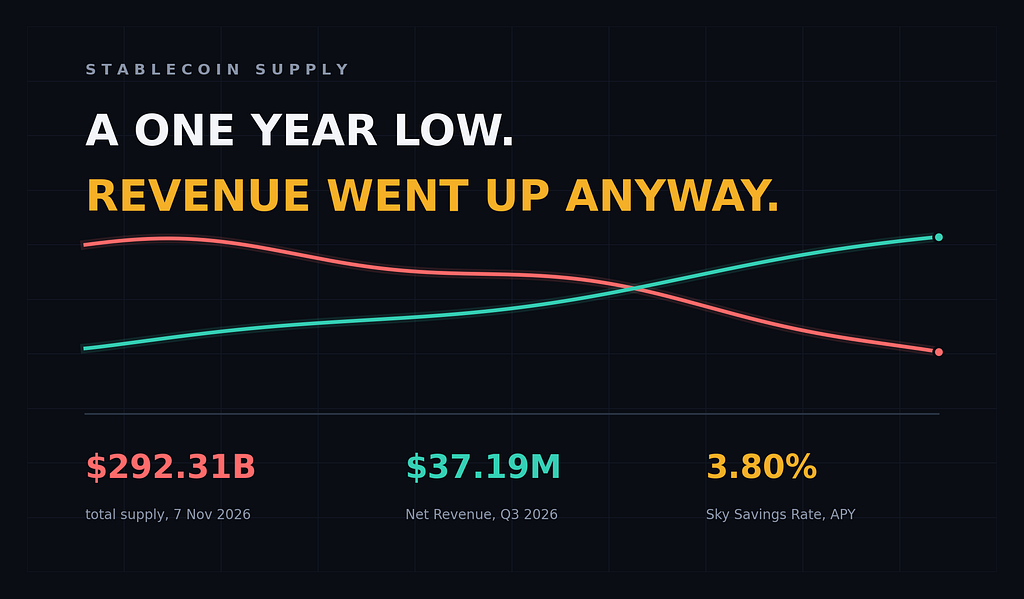
Supply fell to a 13 month low. Net Revenue climbed to its sixth straight positive quarter. The two lines have not moved together for a while.
On 7 November 2026, the stablecoin market quietly set a record nobody wanted.
Total stablecoin supply fell to $292.31 billion. That is the lowest reading since 24 September 2025, and the steepest one-week contraction since the week Terra collapsed in May 2022.
$6.66 billion of onchain dollars. Gone in seven days.
Now the part most headlines skipped. Nothing broke.
USDT traded at $0.99892. USDC at $0.99945. Both issuers redeemed at par, all week, without a hiccup.
The dollars did not run. They walked out the front door, and the door worked exactly as designed.
If a high street lender processed ten straight days of heavy withdrawals without missing a payment, it would put that in the annual report. In stablecoins, it barely got a headline.
Meanwhile, Sky Protocol closed its sixth consecutive quarter of positive Net Revenue.
That gap is the story.
What does a one year low in stablecoin supply actually measure?
Supply counts tokens outstanding. It is a liquidity gauge, not a health gauge.
Here is the 2026 shape of it, from DefiLlama’s daily series:
Peak of $315.54 billion on 17 May 2026$292.31 billion on 7 November, a 13 month lowDown $15.03 billion over 30 days, from $307.33 billion on 8 OctoberTen consecutive down days starting 29 OctoberRolling seven day change negative for 29 straight days
Scale matters more than the headline. That $6.66 billion is 2.28% of the outstanding base.
The comparable week in May 2022 erased 17.36%, in a run on collateral nobody could verify.
One was a solvency event. This is a drain.
There is a second number worth holding onto. Dollar-pegged stablecoins now equal about 19.5% of Bitcoin’s market value, up from 14.3% a year ago. The stablecoin base shrank. Bitcoin shrank faster.
Eight readings tell the whole year. The May peak, the October slide, and the 7 November print that broke below every level since September 2025.
Why is stablecoin supply shrinking in November 2026?
Two reasons. Neither one is a peg problem.
Trading demand cooled. Bitcoin closed at $75,969 on 5 November, roughly 29% below where it sat a year earlier.
US spot Bitcoin ETFs lost about $1.2 billion in the same week. When prices fall, sideline cash gets redeemed instead of parked.
Idle dollars got expensive. Three month Treasury bills yield around 4.1%. A token that pays nothing costs you that spread every single day you hold it.
The GENIUS Act sharpened the maths. It bars permitted payment stablecoin issuers from paying yield to holders in any form, and it takes effect in January 2027.
Jason Dehni, co-founder of BlackOpal, put it to CoinDesk this week: GENIUS did not kill yield. It moved it one layer up.
Sit with that sentence. It explains the entire chart.
Where did the money actually go? Follow the yield, not the headline
The weekly scoreboard looks ugly until you read it properly.
USDT fell $3.10 billion to $177.00 billion. USDC fell $1.31 billion to $70.60 billion. Between them, roughly two thirds of the drop. USDS fell $864 million. USD1 fell $357 million. BUIDL fell $249 million.
Then the two exceptions. USDe added $400 million. RLUSD added $270 million.
Eight of the ten largest stablecoins shrank. The two that grew both give their holders something beyond a peg.
That is not a coincidence. It is repricing.
The week of 31 October to 7 November, token by token. The only two green bars belong to tokens that pay their holders.
Capital is not leaving onchain finance. It is rotating out of tokens that sit still and into structures that put dollars to work.
Tokenized Treasuries and credit vaults kept growing through a year when payment supply flatlined, and the tokenized Treasury market crossed $7 billion onchain in June, up from roughly $1 billion in January 2025.
The dollars did not vanish. They changed jobs.
How did Sky Protocol revenue rise while stablecoin supply fell?
Sky Frontier Foundation published the Sky Ecosystem Q3 2026 Quarterly Report on 29 October. For the three months to 30 September:
Gross Protocol Revenue: $99.29 million, up 14.2% year over yearNet Revenue: $37.19 million, up 11.8% from Q2, the sixth straight positive quarterNet Revenue margin: widened from 31.0% to 37.5%Total expenses: $62.10 million, down 16.0% from Q2Protocol Collateral: $11.41 billion, up 25.3% year over yearSky Reserves: $85.08 million, after $28.47 million was added during the quarterAnnualised Gross Protocol Revenue run rate: $397.2 millionRevenue minus expenses. The margin widened because the cost line moved further than the top line.
Expenses fell faster than revenue. There is nothing clever about that, which is rather the point.
Revenue attributable to the Sky Agent Network contributed $52.65 million, 53.0% of the total.
And the honest footnote, because you deserve it: Gross Protocol Revenue was down 7.4% from Q2.
A contracting market does show up in the top line. What it did not do was break the margin, and it did not touch the reserves build.
sUSDS supply tells the same story from the other side. It closed Q3 at $4.52 billion, up 118% year over year, then climbed to $4.72 billion by 21 October before the November drawdown pulled it back with the rest of the market.
What is the Sky Savings Rate, and why did it hold through the drawdown?
The Sky Savings Rate is the rate paid to holders of sUSDS. Sky Governance sets it by onchain vote.
On 7 October 2026 it was raised to 3.80% APY, and it has stayed there through the worst stablecoin week of the year.
The mechanics take three lines:
Supply USDS, receive sUSDSsUSDS accrues value programmatically, with no lockups and no exit feesConvert back to USDS whenever you want
Getting in is equally unglamorous. Peg Stability Modules let you convert major stablecoins into USDS at a strict 1:1 ratio, directly with the protocol rather than against another trader, which removes the slippage that normally taxes size.
The funding is the part most explainers skip. The Sky Savings Rate is not paid out of one lending market or one borrower.
It is funded from revenue generated across the Sky Agent Network, a set of independent capital allocators including Spark, Grove, Obex and Osero that access USDS liquidity under governance-set risk parameters and deploy it into diversified strategies.
Diversified funding is why a rate survives a bad week.Where the rate comes from. Not one borrower, not one lending market, and not a promise.
Right now the live dashboards show the Sky Savings Rate at 3.80% APY against roughly $13.8 billion in total collateral, with USDS backed by a surplus of collateral you can verify yourself rather than wait for an attestation.
The institutional signal hiding underneath a shrinking market
Four dates from the last ten weeks. None of them appear on the supply chart.
11 September: Standard Chartered initiated research coverage of SKY23 September: Galaxy added $100 million of sUSDS to its corporate treasury and approved sUSDS as eligible collateral across a lending book averaging $1.4 billion1 October: S&P Global affirmed a B- rating with a stable outlook7 October: Moody’s assigned Sky Protocol a B3 counterparty risk rating with a stable outlook, the first rating Moody’s has issued on any stablecoin protocolTen weeks of credit and balance-sheet milestones that never showed up in a supply number.
Sky Protocol is currently the only stablecoin protocol rated by both agencies.
Both ratings sit in speculative grade. Moody’s flagged the capital position as a material credit weakness, and pretending otherwise would be useless to you.
But a rating is not a verdict. It is legibility.
Allocators who need a recognised credit scale before they can size a position now have two of them, which is a standard no other stablecoin protocol meets today.
There is a related point the industry keeps leaving on the table. A week of heavy redemptions processed at par is a stress test that passed in public, with every settlement visible onchain while it happened.
Issuers keep treating it as bad news, because the scoreboard only counts supply.
What sUSDS and USDS holders should watch next
$300 billion. A close back above it would end the current decline.$291.68 billion. A print below it sets a new 2026 low.The Sky Savings Rate. Variable and governance-set, so check the live rate rather than this post.Sky Reserves against the $150 million medium term solvency target. $85.08 million was reached at Q3 close.Whether yield-bearing stablecoins keep growing while payment tokens shrink. That is the cleanest read on where onchain dollars want to live.
If you want the full picture rather than the headline, the quarterly reports and monthly updates live on Sky Ecosystem Insights, and the parameter votes themselves are public on the governance portal.
The uncomfortable question
The industry measures itself by supply. Supply just hit a 13 month low. The protocols that make dollars productive kept earning through it.
So which number is actually telling you something?
My honest read: supply is a sentiment gauge wearing a fundamentals costume. It tracks appetite for sitting in cash, not the health of the rails underneath.
You might disagree, and I would rather hear that than not. If you redeemed last week, tell me in the comments where the money went. If you supplied into a savings rate instead, tell me why.
Stablecoin Supply Hit a One Year Low. Protocol Revenue Went Up Anyway. was originally published in Coinmonks on Medium, where people are continuing the conversation by highlighting and responding to this story.