
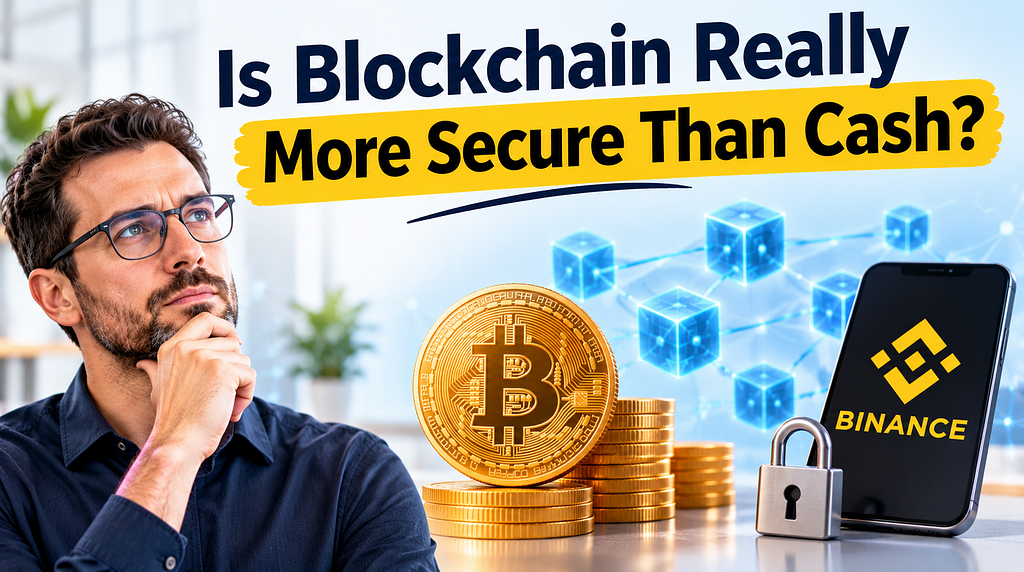
The ledger itself is tough to tamper with. The people and platforms around it are another story.
Blockchain Is Hard to Hack. So Why Did $6.4 Billion Just Walk Out of Binance?AI Generated Image
Imagine sending money over the world without needing a bank to say yes. The payment is written on a shared computer record checked by a group of computers and kept safe with codes. It sounds really safe.. If someone takes your secret code your money might vanish before you even know what happened.
This is the problem with blockchain. The technology behind it can make records of transactions hard to change but the money built on it still has dangers that regular banks deal with in different ways.
So is blockchain safer than cash or normal banks? The answer depends on what you mean by safe.
1. Blockchain Makes Transaction Records Hard to Change
banks usually keep track of money moves through their own computers. They check payments run databases and control who can use accounts.
Blockchain works differently. Of one database many blockchain systems share copies of the transaction record across computers called nodes.
Each payment is put into a block and special codes link each block to the other. If someone tries to change a payment the codes after it get messed up.
The National Institute of Standards and Technology (NIST) says blockchain is a shared record that’s hard to change and shows if something is wrong.
This doesn’t mean it’s impossible to change. It means it’s really tough in big and safe networks.
Why it matters:
A shared record helps people check the history without depending on one companys database.
2. Decentralization Takes Away a Single Place to Fail
A problem with systems is that they depend on one main place, like a bank. If that place has a problem like a break-in or a crash people can’t get help.
A blockchain network with people in places can be stronger because theres no one server that holds all the information.
Bitcoin uses a way called proof-of-work. People called miners try to add blocks and the rules make changing past blocks very expensive.
Being spread out doesn’t always mean safe. Smaller networks may have fewer people checking. Some blockchains use a few people to control the system. A network can also have mistakes in the code arguments about how to run or people trying to trick the system.
The real benefit comes from sharing control not just saying something is decentralized.
3. Codes Help Keep Digital Money Safe
Cash is protected by safety. You keep bills in a wallet, a safe or a bank account. Digital money uses codes to control who can use the money.
A wallet for crypto usually. Manages the secret codes needed to send money. The public address can be shared to get money. The secret code must be kept safe.
This way people can check that a payment was made by the person without seeing the secret code.
But there’s a problem: your secret code isn’t like a password.
If someone takes it they can move your money. If you lose it and don’t have a plan you might never get your money back.
Blockchain keeps the records safe. It can’t make sure the person with the code is the owner.
4. Clear Records Make It Easier to Find Fraud
Many blockchains let anyone see the history of payments. This is something regular cash can’t do.
Investigators can follow where money goes see patterns and sometimes match the wallet addresses to people with more clues.
The FBIs Internet Crime Complaint Center says crypto payments are written forever on shared records. This can help find where the money went. Finding who owns a wallet may take more work.
This is important: clear records don’t mean no one can hide. They also don’t mean every wrong payment can be stopped.
A clear history can help,. It can’t undo a payment or find a criminal automatically.
5. The Main Problem: Crypto Payments Can’t Be Stopped
Banks have ways to stop some payments report fraud and check if someone used your account. Depending on the method and where you live you might get help to get your money back.
Most crypto transfers are different. Once a payment is in a blockchain, its usually. Can’t be stopped like a bank chargeback.
The FBI warns that crypto payments are often hard to reverse and can move fast across countries.
The amount of this problem is big. The FBIs 2025 Internet Crime Report, released in April 2026 said than 181,000 crypto complaints and over $11 billion in losses in the US.
These numbers include scams and fraud not that the blockchain itself was broken. In cases people are tricked accounts are stolen or fake sites are used instead of breaking the blockchain.
6. So Is Blockchain Really Safer?
Blockchain has security features:
codes that check transactions, shared records and strong resistance to changes.
These can be useful, for payments owning things and moving money around the world.
Banks also offer help that many crypto systems don’t like fixing lost access checking for fraud and following rules to keep people safe.
The best choice depends on the danger you are trying to avoid. Blockchain may protect better against some types of changes. A bank may offer better help if you lose access or report a problem.
Maybe the important thing is that good tech and safe money habits are not the same. A blockchain can keep every payment the one that sends your savings to a scammer.
Is Blockchain Really More Secure Than Cash? was originally published in Coinmonks on Medium, where people are continuing the conversation by highlighting and responding to this story.