
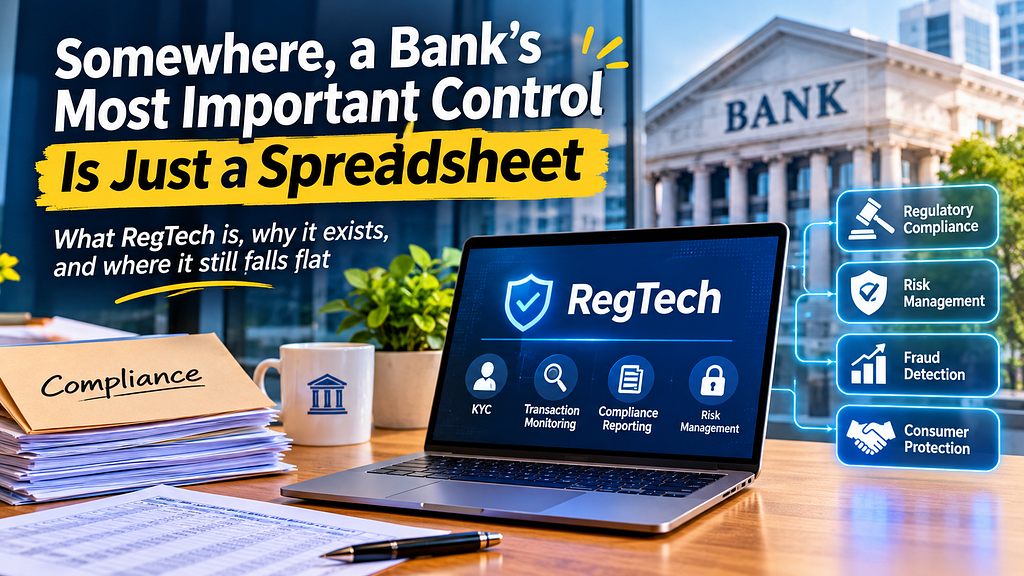
What RegTech is, why it exists, and where it still falls flat
Ask anyone who has worked in bank compliance about “the spreadsheet,” and watch their face. They know exactly which one you mean.
Every institution has at least one. Someone built it years ago as a quick fix. It was meant to be temporary. Now it feeds a report that goes to a regulator, and the person who understood its formulas left in 2021.
I find this weirdly fascinating, because it explains why an entire industry called RegTech exists.
Image Generated by ChatGpt
What RegTech actually means
Regulatory technology. Software that helps companies follow rules without burying their staff in paperwork.
That’s the whole idea. It checks who your customers are, watches transactions for odd behavior, tracks changes in the law, and fills in the reports regulators ask for. Boring on paper. Not boring when you see what happens without it.
The label caught on after 2008. The financial crisis led to a wave of new regulation, and banks suddenly had to prove, in detail and all the time, that they were behaving. The first response was to hire more people. That worked until it didn’t. Rules multiplied faster than anyone could be trained to read them.
You’ve already used it
Most people have, without knowing.
Remember opening a bank account on your phone, snapping a photo of your passport, then taking a selfie? That’s identity verification, known in the industry as KYC, short for “know your customer.”
Remember a card getting declined abroad because the payment looked strange? That’s transaction monitoring.
Remember the cookie pop-up on every website? That comes from privacy law. Under GDPR, companies can be fined up to 4% of their global annual turnover, which is why plenty of them take consent very seriously. Tools that manage it are RegTech too.
So it’s everywhere, quietly doing its job.
Why the old way breaks
Think about how compliance used to work in practice. One person reads a new regulation. Another decides what it means. A third edits an internal policy. Someone else checks whether the real systems match the policy. Then the rule changes and everyone starts over.
Each step relies on a human being attentive on a Tuesday afternoon. People are great at judgment and bad at repetition. Mistakes creep in, and in finance a mistake can mean a very large fine. Banks around the world have paid billions over the years for failures in anti-money-laundering and sanctions controls. A fair number of those weren’t schemes. They were gaps, a rule said one thing and a system did another.
RegTech tries to close that gap.
Where it genuinely helps
Onboarding is the easy win. Checks that used to take days now take minutes, and the paperwork trail is cleaner.
Transaction monitoring is the other big one. Older systems threw up mountains of false alarms, and analysts spent their days clearing harmless activity. Smarter models try to separate noise from real risk so people can look at what matters.
Then there’s tracking regulatory change. Software can scan a new rule and point to the internal policies it touches. Instead of “someone should read this 300-page document,” you get a short list with reasons.
Reporting is similar. Regulators want specific formats by specific dates, and automating that removes a lot of copy-and-paste misery.
The part the vendors skip
I’m not going to pretend this is all upside.
Models learn from history, and history contains bad decisions. If past data treated certain customers unfairly, a model can repeat that unfairness at scale. Somebody gets flagged, nobody can say why, and the person on the other end never finds out.
That’s the black-box problem. Regulators now expect firms to explain their decisions, and “the algorithm decided” isn’t an explanation. It’s a red flag.
Dashboards can also lull people. A screen full of green lights feels like safety. It isn’t proof of compliance. I’ve seen the same trap in other fields: once a tool says everything is fine, people stop asking questions.
And then there’s the dull, expensive reality of integration. Plenty of banks run core systems that are decades old. Connecting new software to them is slow, costly, and rarely as smooth as the demo.
What to watch next
Generative AI is the obvious one. Teams are testing it to summarize and compare dense regulatory text. It’s useful for a first pass. It’s also risky, because a confident wrong answer in compliance can cost real money, so a qualified person still has to check the output.
Another is regulators adopting technology themselves, sometimes called SupTech. If supervisors get better data tools, firms will need better tools to match.
And the circle keeps widening. Insurance, health data, crypto, and now AI itself are all picking up regulation. Anywhere rules and risk meet, someone will build software for it.
Back to the spreadsheet
Here’s what I think the real promise is, and it’s less dramatic than the headlines.
RegTech won’t replace compliance professionals. The good ones spend their best hours on judgment calls: Does this pattern look right? Should this be escalated? What did the regulator actually mean? Software that clears the repetitive work gives them more time for those questions.
The spreadsheet isn’t the villain, by the way. It’s a symptom. Somebody needed a solution, nothing better was available, and so they built one. RegTech is the grown-up version of that same instinct, with audit trails and proper monitoring.
If you’re a founder, developer, analyst, or just curious about where money meets technology, it’s worth a closer look. It isn’t glamorous, and I think that’s part of the opportunity. Few people are paying attention, and the problems are very real.
Have you ever had a card blocked or a verification photo rejected? Tell me about it in the comments. I’d like to know how it felt from your side.
Somewhere, a Bank’s Most Important Control Is Just a Spreadsheet was originally published in Coinmonks on Medium, where people are continuing the conversation by highlighting and responding to this story.