
I’d marked them as the likely hidden code. Of the 46 delegates that keep the hash, fewer than half are verified.
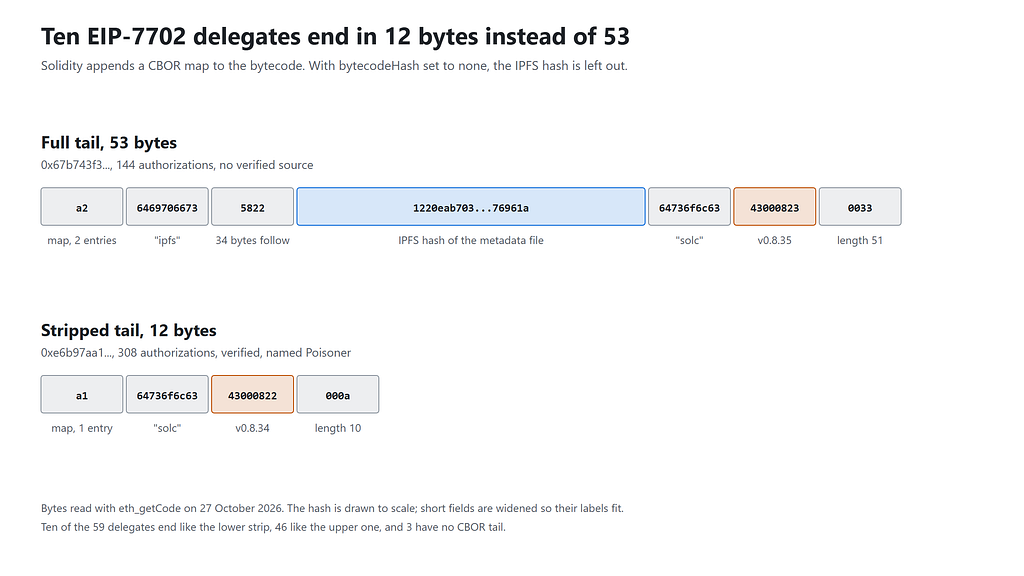
The most delegated contract in my EIP-7702 sample ends in these 12 bytes: a164736f6c6343000822000a. Most Solidity contracts built with default settings end in 53. The longer tail is a small CBOR map the compiler appends to the bytecode: an IPFS hash of the contract’s metadata file, the compiler version, and two bytes giving the map’s length. This one has the version and no hash.
On 8 September I pulled every EIP-7702 authorization from a 200-block window on Ethereum mainnet, 1,178 of them, and read the bytecode of the 59 contracts they delegated to. Nine of those authorizations pointed at the zero address, which is how an account undelegates, so 1,169 went to real code. When I went back over the 59 on 11 October, ten had the short tail. I left a note beside them: no metadata hash, so maybe nobody meant the source to be found.
What the 12 bytes still say
Read as CBOR, a1 opens a map with one entry, 64 says a four-byte string follows (solc), and 43 says a three-byte value follows: 00 08 22, which is version 0.8.34. The last two bytes, 00 0a, give the length of everything before them, ten. So the compiler version survives. What’s gone is the hash that would let anyone fetch the exact metadata file, the one that lists every source file’s own hash and the compiler settings. In solc that’s a single setting, metadata.bytecodeHash set to none, and Foundry exposes it as bytecode_hash.
The last bytes of two EIP-7702 delegates. Both record the compiler version; only one carries the metadata hash.
Checking the note
Today I asked Blockscout’s API whether each of the 59 has verified source, and asked Sourcify the same. Nine of the ten stripped contracts are verified on Blockscout. Of the 46 that kept the full hash, 21 are. The other three have no CBOR tail at all, and one of those is verified.
Counting authorizations instead of contracts widens the gap. In that September window, 369 of the 371 authorizations to stripped delegates went to a contract with published source. For the full-hash contracts it was 324 of 774, about 42%.
59 delegate contracts from one 200-block window in September, verification read on 27 October.
The one stripped contract with no source, 0xbaa66503…, drew two authorizations. The second most delegated contract in the whole sample, 0x67b743f3… with 144, carries a full IPFS hash and has no verified source on either service. Neither does 0x912518c2… with 96. Three unverified contracts of 2,140 bytes each carry the same IPFS hash, so they’re one build deployed three times.
Who strips it
The nine verified ones carry six contract names: Uniswap’s CaliburEntry at three addresses, Alchemy’s SemiModularAccount7702 at two, two TokenPocket delegators, UniversalGaslessDelegate, and the most delegated contract of all, with 308 of the window’s authorizations, whose verified source names it Poisoner.
The ten stripped delegates. Blockscout and Sourcify read 27 October; authorizations from the 8 September window.
Calibur’s foundry.toml and the one in Alchemy’s modular-account repository both set bytecode_hash = “none” as the project default. Neither file says why. Five of the ten addresses look mined: two start with eight zeros, one with 0x0000fb7702, one with 0x69007702, and one starts 0x77021100 and ends 0000. The metadata hash changes whenever a comment or a file path changes, even when the compiled code doesn’t, and an address found by searching CREATE2 salts depends on the exact bytecode. Dropping the hash ties the bytecode to the code alone. That’s my reading of the reason, not something either project says.
What Sourcify makes of them
Sourcify answered for eight of the stripped contracts, and all eight came back as match, none as exact_match. Of the full-hash contracts it has, 13 of 17 are exact. Sourcify’s docs say an exact match rests on the metadata hash in the deployed code agreeing with the recompiled one, which is how it proves the source files are byte for byte the ones the author compiled. With no hash in the bytecode there’s nothing for that check to hold on to, so I’d expect every stripped contract to stop at match, whoever wrote it.
What this doesn’t show
The authorization counts come from one 200-block window in September, so they say which delegates were busy then. Verified means Blockscout’s flag and Sourcify’s record as I read them on 27 October. I didn’t check Etherscan, which wants an API key, and a contract could be verified there and nowhere else. I also tried two public IPFS gateways for the hashes on the unverified contracts and both refused the requests, so I can’t say whether any of those metadata files exist somewhere.
Ten EIP-7702 delegates strip their metadata hash. Nine of them publish their source was originally published in Coinmonks on Medium, where people are continuing the conversation by highlighting and responding to this story.