
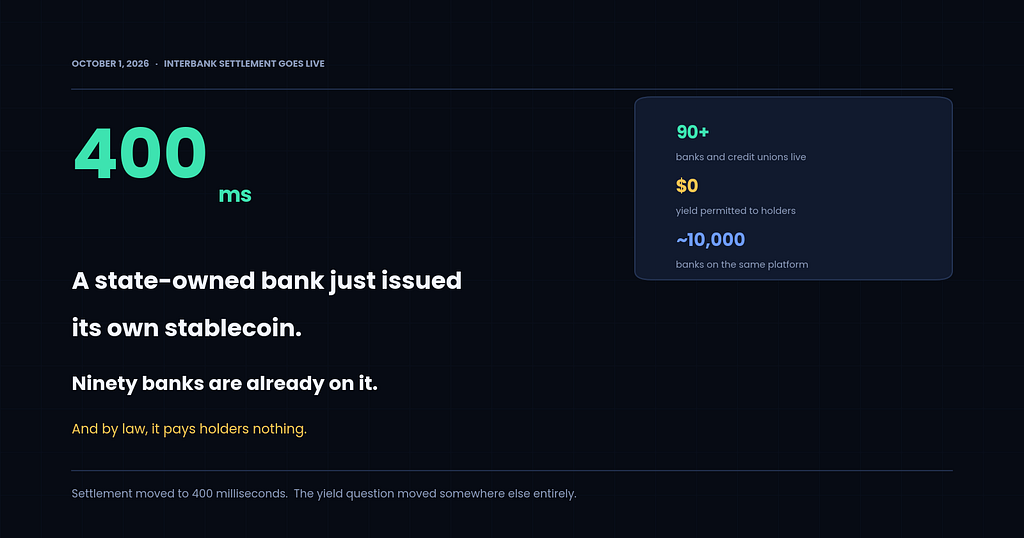
The first live bank issued stablecoin settles in 400 milliseconds. By law, it also pays holders nothing. That gap is the whole story.
Settlement moved to 400 milliseconds on October 1, 2026. The yield question moved somewhere else entirely.
On October 1, 2026, a bank founded in 1919 beat Wall Street to live stablecoin settlement.
Not JPMorgan. Not Citi. The Bank of North Dakota.
Its dollar token now moves money between more than 90 banks and credit unions in roughly 400 milliseconds.
Transfers that used to sit overnight in an ACH batch now clear before you finish this sentence.
And by law, it pays the people holding it nothing.
That second fact barely made the coverage. It is the more interesting one.
What Is a Bank Issued Stablecoin, and What Exactly Went Live in North Dakota?
A bank issued stablecoin is a dollar token minted by a chartered bank, fully reserved, built for settlement rather than return. Here is what shipped:
Fiserv’s digital asset platform went into production on October 1, 2026.The first live use case is Roughrider Coin, the Bank of North Dakota’s dollar-backed stablecoin.VersaBank, an OCC-chartered bank, issues the token and handles minting, burning, custody and reserves.Fireblocks supplies the tokenization infrastructure. Transactions settle on Solana.More than 90 participating banks and credit unions can use it for bank-to-bank transactions.
The detail worth noticing is not the chain. It is the distribution.
Those institutions reach Roughrider Coin through Commercial Center, the same Fiserv portal they already use for interbank money movement.
No new vendor, no new login, no migration project. Fiserv has said the platform can extend to its roughly 10,000 other bank clients.
A small irony: the Bank of North Dakota is the only state-owned bank in the US, founded in 1919 to serve farmers the big banks ignored.
A century later it runs the first production stablecoin rail in American banking.
Infrastructure rarely arrives with a launch party. It arrives through a login people already have.
Twelve months from one state bank announcing a coin to twenty-one global banks committing to build one.
Why Are Twenty-One Global Banks Suddenly Racing to Issue a Dollar Token?
North Dakota is not an outlier. It is simply first.
On September 1, 2026, twenty-one financial institutions including Bank of America, Citi, Goldman Sachs, Wells Fargo, UBS and Deutsche Bank committed to forming a company to issue a US dollar stablecoin, targeting market in the first half of 2027.
Alongside that, JPMorgan, Bank of America, Citi and Wells Fargo are building a shared tokenized deposit network through The Clearing House, while the BankChain Alliance organises thousands of smaller lenders across 39 state banking associations.
None of this is curiosity. It is defence.
A US Treasury advisory council flagged the $6.6 trillion transactional deposit market as exposed to stablecoin substitution. Citi research puts potential deposit displacement at $182 billion to $908 billion by 2030.
When the thing eating your funding base is a token, you ship a token.
Why Can’t a Bank Issued Stablecoin Pay You Any Yield?
This is the part that gets skipped.
Section 4(a)(11) of the GENIUS Act says a permitted payment stablecoin issuer may not pay a holder any form of interest or yield, in cash, tokens or other consideration, solely for holding the coin.
Not capped. Not discouraged. Prohibited.
And it tightened. The OCC’s proposed rulemaking of February 25, 2026 added a rebuttable presumption that yield routed through an affiliate or related third party counts as the issuer paying it. The white-label workaround closed before most people noticed it existed.
So the design brief for every bank issued stablecoin sold to US persons is now fixed:
One-to-one reserves in high-quality liquid assetsMonthly attested disclosureA licensed, supervised issuerZero yield to whoever holds the token
The issuer earns on the reserves. The holder earns faster settlement. That is the whole trade.
For a treasury desk pushing money between counterparties on a Tuesday afternoon, that is a perfectly good deal. For anyone holding a balance longer than an afternoon, it is a strange one.
The banking lobby fought hard for this outcome and said so publicly. A dollar that pays nothing does not pull deposits off a balance sheet.
Same dollar, two rulebooks. One is built to move, the other is built to work.
So Where Does Stablecoin Yield Actually Come From Now?
Not from the payment token. It migrates to a separate instrument with a separate rulebook. The market has already voted, and the numbers are blunt.
In Q1 2026, total stablecoin supply added only about $8 billion, the weakest quarter since late 2023.
Yet yield-bearing stablecoins grew 22% and contributed more than half of all net supply growth, roughly $4.3 billion of it.
sUSDS alone added over $2.5 billion in that single quarter, more new capital than the next four yield-bearing tokens combined.
Sit with that. In a flat market, the category that legally cannot be a payment stablecoin is where the money went.
The wider shift has the same shape. Onchain real-world assets excluding stablecoins passed $33 billion in July 2026, roughly four times their early-2025 level. Capital is not just moving onchain. It wants a return once it gets there.
Total stablecoin supply barely moved in Q1 2026. The yield-bearing slice did almost all the work.
How Does the Sky Savings Rate Work Across USDS and sUSDS?
Sky Ecosystem builds from the opposite end. Rather than a bank reserving dollars and keeping the return, the architecture separates the dollar from the yield. Three moving parts:
USDS is the base stablecoin. Fully backed, overcollateralized, and verifiable onchain rather than through a quarterly PDF.The Sky Agent Network is a set of independent capital allocators, including Spark, Grove, Keel, Obex and Osero, that access USDS liquidity under risk parameters set in public and enforced automatically. Their activity contributes to aggregate Sky Protocol surplus.The Sky Savings Rate is the rate Sky Governance sets from that surplus. You access it by holding sUSDS.
Supply USDS, receive sUSDS, and the position accrues continuously. No lockup, no maturity date, redeemable whenever you want.
Two things make the structure genuinely different. Every change to the Sky Savings Rate is proposed and voted onchain before it takes effect, in public. And holding sUSDS gives you access to the rate itself, not a claim on any single agent, borrower, pool or strategy.
The rate is variable and governance can move it either way. That is the honest framing, and it is published live on Sky Ecosystem’s own dashboards rather than asserted in marketing copy.
The dollar and the yield are two separate jobs, handled by two separate parts of the system.
Is Anyone Serious Actually Holding a Yield Bearing Stablecoin?
Fair question. Narratives are cheap, balance sheets are not.
Galaxy Digital (Nasdaq: GLXY) added $100 million of sUSDS to its corporate treasury in September 2026 and approved it as eligible collateral across a trading business carrying a $1.4 billion average loan book and over 1,600 counterparties.Clients who post sUSDS against a Galaxy loan keep accruing the Sky Savings Rate on the full position for as long as the loan runs. The collateral does not stop working.Sky Protocol entered Q3 2026 with $5.41 billion supplied through independent allocators into institutional tokenized funds, including anchor positions in BlackRock’s BUIDL and Janus Henderson’s JTRSY.sUSDS supply hit $5.52 billion at the end of Q2 2026, up 149% year on year.Sky Protocol recorded its fifth consecutive quarter of positive Protocol Surplus in Q2 2026, generating $107.35 million in Gross Protocol Revenue and a $33.29 million Protocol Surplus.
That last line carries more weight than it looks. A rate funded from recurring protocol revenue behaves very differently from one funded by an incentive budget that runs out.
Six numbers that are easier to check than to argue with.
Does a Bank Issued Stablecoin Compete With USDS, or Sit Beside It?
Mostly beside it, and the mechanics explain why.
Roughrider Coin moves a dollar between two banks as fast as possible. It is a rail, measured on latency and reach.
USDS and sUSDS are built for a dollar that has already arrived and now needs to do something.
The measure there is whether the rate holds up across cycles, and whether the collateral behind it can be checked by anyone at any time.
A treasurer does not have to pick one. Two different jobs, and the GENIUS Act has made it hard for one instrument to do both.
What Should You Watch Next in Bank Stablecoin Adoption?
Three signals worth tracking:
Volume, not announcements. Fiserv has not disclosed how much actually moves through Roughrider Coin. Most of the 90-plus institutions are in early adoption, not full reliance.Where idle balances settle. If bank tokens own the fast rail and yield lives in a separate wrapper, treasurers hold both. That split is the real adoption metric.The affiliate rule. If the OCC finalises the broad version, every rewards programme attached to a payment stablecoin gets redesigned.
The headline this month was a state bank beating Wall Street onchain. The quieter story is a split now baked into law: payment tokens are getting very good at moving dollars, and a different class of instrument is getting very good at putting them to work.
One settles. The other saves. Most balance sheets will hold both.
A real question: if your dollars sat on a rail that cleared in 400 milliseconds but paid you nothing, how long would you leave them there? Drop your answer in the comments, I read every one.
A State-Owned Bank Just Issued Its Own Stablecoin. Ninety Banks Are Already On It. was originally published in Coinmonks on Medium, where people are continuing the conversation by highlighting and responding to this story.