
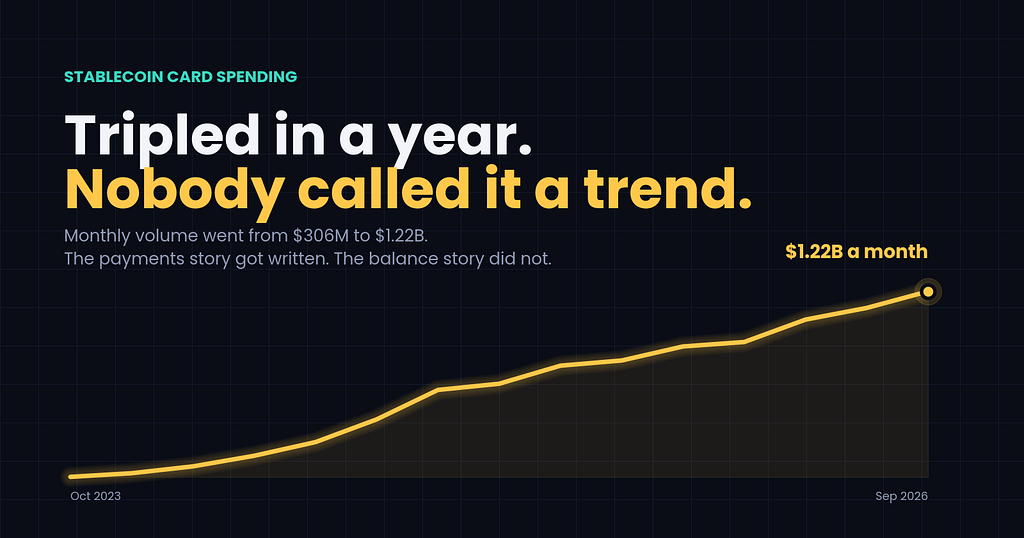
Monthly volume went from $306M to $1.22B. Everyone wrote the payments story. Almost nobody wrote the balance story.
Monthly stablecoin card spending, October 2023 to September 2026.
Nobody writes a headline about a balance.
We write about the swipe. A coffee bought with USDC in Lagos. A ride paid in USDT in Sao Paulo. Those make good copy.
But a card is not a swipe. A card is a balance that occasionally gets smaller.
And over the last twelve months, the balances sitting behind stablecoin cards quietly turned into real money.
Quick answer, for anyone who searched “stablecoin card spending”: monthly stablecoin card spending hit $1.04 billion in July 2026, roughly triple the $306 million recorded a year earlier, and $1.22 billion by September. Cumulative tracked spending has passed $10.9 billion. Dollar-backed stablecoins fund about 70% of it. The whole category is still only around 0.07% of the global card market.
How Fast Did Stablecoin Card Spending Actually Grow?
Faster than the coverage suggested, and from a base so small that almost nobody treated it as a trend.
The tracked monthly numbers for 2026:
January: $574MApril: $768MJuly: $1,038M, the first month above a billionSeptember: $1,224M, the third straight month above a billion
Three more figures worth holding onto:
Cumulative tracked card spending crossed $10.9 billion by late August 2026.July alone carried more than 10 million individual card transactions.Visa reported more than 160 stablecoin-linked card programmes live or in development as of June 2026.
Concentration matters here too. RedotPay alone generated $401.9 million of September volume, roughly 34% of the entire category, and says it now serves more than eight million users.
Ether.fi’s card did $100.3 million in July purchase volume, up from under $10 million two months after launch in 2025.
Nine months, one threshold crossed. The shape is the argument.
Why Did Nobody Call Stablecoin Card Spending a Trend?
Two reasons, and both come down to where people were looking.
First, tripling from a small base does not feel like news. It feels like a chart that was always going to go up and to the right.
Second, the growth is not happening where crypto media usually files copy from.
StraitsX, a Visa partner that helps other firms launch cards, reported gross transaction value on its rails grew roughly 600% in lower-income markets between March 2025 and February 2026, against about 150% in wealthier ones. Binance said average volume on its Brazil card climbed 80% in a year.
John Timoney of Rain put it plainly at Consensus Miami: stablecoin cards are under 1% of global card spend today, but some Latin American markets could reach double-digit share soon.
And what people are buying is boring in the best way. Food and retail were the largest spending categories on StraitsX’s rails. Groceries, ride-hailing, food delivery. Not trades.
The adoption is real. It is just happening in markets where a dollar balance is a hedge, not a hobby.
Which Dollars Are Funding the Swipe?
Mostly two of them.
USDC funded 50.8% of July 2026 card volume, up from roughly 48% a year earlier.USDT funded 20.3%, up from about 7%.The euro-backed EURe, which was as much as 88% of tracked card spending in early 2024, has fallen below 2%.
That last line is the quiet structural change nobody wrote up. The category started as a European experiment and became a dollar product.
Two dollar stablecoins now carry seven out of every ten card transactions.
What Is a Stablecoin Balance Actually Doing Between Swipes?
Here is the part the payments coverage skipped.
Every card needs a funded balance behind it. You do not spend $1.22 billion a month without holding considerably more than that across millions of wallets, waiting.
So ask the obvious question. What is that money doing on the other 29 days of the month?
For most stablecoin balances, the honest answer is nothing.
A plain stablecoin carries a fixed $1.00 face value.The reserve behind it usually sits in short-term government paper.That return accrues to the issuer, not to the holder.You hold the dollar. Somebody else holds the yield.
That was a tolerable trade when stablecoins were trading chips. It is a much stranger trade when stablecoins are your grocery money.
How Much Idle Stablecoin Capital Is Sitting Still Right Now?
Total stablecoin supply sat near $302.8 billion in September 2026. Card spending is running around $1.22 billion a month.
Run the division. Card spending is roughly 0.4% of outstanding stablecoin supply each month.
Analysts tracking stablecoin velocity have been blunt about the rest. Most supply is parked rather than circulating, and only a thin slice is held in yield-generating form.
The swipe is 0.4% of the story. The balance is the other 99.6%.
Yield-generating designs are still a thin slice of that base, under $5 billion by most counts, even though they drove more than half of net new stablecoin supply growth in the first quarter of 2026. Demand is clearly not the constraint. Distribution is.
The spending number is the one that gets written up. The 99.6% sitting behind it is the one that either compounds or does not.
What Is the Sky Savings Rate, and Why Should a Spending Balance Care?
This is where Sky Ecosystem fits into the picture.
Sky Ecosystem is a global savings and capital allocation network, and the mechanics are deliberately unglamorous:
USDS is the base stablecoin and the unit of account. You convert into it 1:1 through Peg Stability Modules, with no fees and no slippage.The Sky Agent Network, a set of independent allocators including Spark, Grove, Obex and Osero, competes for access to USDS liquidity under risk limits published in advance.Those allocators pay for that access, and their payments contribute to Sky Protocol revenue.A share of that revenue funds the Sky Savings Rate, a variable rate set by Sky Governance rather than by borrowing demand in any one market.sUSDS is how you hold it. Supply USDS, receive sUSDS, and the rate accrues programmatically. No lockup, no exit fee, redeemable on demand.
Sky Governance moved the Sky Savings Rate up in early October 2026, from 3.60% to 3.80%. It is variable by design, so check the live figure before quoting it anywhere.
sUSDS is currently the largest yield-generating stablecoin in the market. That matters less as a bragging right than as a liquidity fact.
Size is what lets a spending balance move in and out without slippage, which is the whole requirement for money you might need on a Tuesday.
Four steps from a spending dollar to a rate. No issuer subsidy anywhere in the chain.The dollar you spend from and the dollar that accrues do not have to be two different dollars.
Is Institutional Money Already Treating It This Way?
Yes, and it happened three weeks ago.
On 23 September 2026, Galaxy added $100 million of sUSDS to its corporate treasury and approved sUSDS as eligible collateral across its institutional trading business.
Read that as a signal rather than a press release. A trading desk does not put nine figures into a yield-generating stablecoin as an experiment.
It does it because the position stays liquid, the collateral is verifiable onchain, and the balance does something while it waits.
That is the same logic a card balance needs. Just with fewer zeros.
The numbers behind it are public rather than asserted: $14.15B in Total Protocol Collateral against $11.48B in stablecoin supply, all checkable on the dashboards before you believe a word of this post.
Four figures, all published, all moving. Verify before you quote.
What Could Break This Argument?
I would rather name the friction than pretend it is not there.
The rate is variable. Sky Governance can vote the Sky Savings Rate down as easily as up.Card programmes mostly do not settle in yield-generating tokens yet. Today the plumbing runs on USDC and USDT.Regulation is live. A US Senate draft proposed banning yield on idle stablecoin holdings outright, and European regulators have been weighing their own restrictions.Smart contract risk and governance risk do not disappear because a balance is convenient.Cards are a convenience product. Nobody adds a conversion step to buy coffee, which is why this only works if the yield-generating token is the default balance rather than an extra one.
None of that changes the structural point. It means the structural point is contested, which is the only kind worth writing about.
RedotPay projects the category reaches $50 billion a year by 2028. Whether that number lands or not, the balance question gets louder either way.
Stablecoin card spending tripled and the category barely blinked.
My read is that the spending is the visible half. The balance behind it decides whether any of this is actually better than the card already in your pocket.
Two questions, and I will reply to every answer. Would you hold a spending balance in a yield-generating stablecoin, or does the extra moving part kill it for you? And if you used a stablecoin card this year, what did you actually buy with it?
Stablecoin Card Spending Tripled in a Year and Nobody Called It a Trend was originally published in Coinmonks on Medium, where people are continuing the conversation by highlighting and responding to this story.