
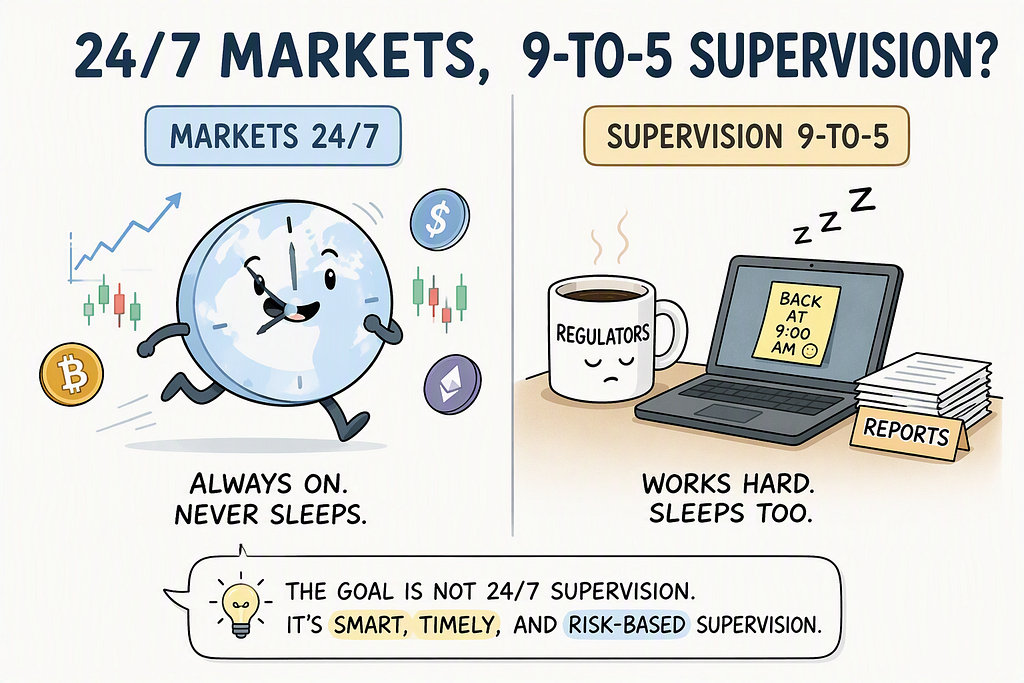
24/7 Markets, 9-to-5 Supervision? Supervisory information in an increasingly continuous financial system
Financial markets have always been organized around time. Exchanges have opening and closing hours, settlement takes place according to defined cycles, positions are valued at particular points in the day, and regulatory information is generally prepared for specified reporting periods. These arrangements have shaped not only how financial institutions operate, but also how they are supervised. If risks develop within reasonably familiar market and reporting cycles, periodic snapshots can provide supervisors with a meaningful picture of a firm’s financial condition and activities.
That assumption is becoming less comfortable.
Crypto markets provide the most obvious example of markets operating continuously, but the issue is becoming broader than crypto. Tokenisation, programmable assets, more automated collateral management and increasingly integrated payment and settlement infrastructure could gradually bring more continuous processes into regulated finance. The IMF’s recent work on tokenised finance, for example, discusses atomic settlement, continuous liquidity management and embedded compliance, while also pointing to implications for liquidity and systemic risk.
None of this means that every financial market will become fully 24/7. Nor does it mean that continuous markets necessarily require continuous regulatory intervention. The more interesting question, from a supervisory perspective, is whether the information architecture of supervision needs to evolve as the time structure of markets changes.
Put more simply: a market can increasingly operate in real time while supervision still sees much of it through periodic snapshots.
That gap is worth thinking about.
A snapshot can be correct and still miss the important part
Periodic reporting remains essential. A firm’s capital, liquidity, client assets, exposures and other financial positions need common reference dates so that they can be reviewed over time and compared across institutions. There is nothing inherently outdated about a snapshot.
But snapshots have an important limitation: they are much better at describing a state than explaining the events that produced that state.
Consider a simple example. A firm’s liquidity position may be normal at the beginning of the day and normal again at the end. Between those two points, however, the firm could have experienced significant outflows, liquidated assets, moved collateral, obtained additional funding and eventually restored its position. An end-of-day snapshot might be entirely accurate, while saying very little about the period during which the firm’s risk was greatest.
The same problem can arise with leverage, counterparty exposures, concentration and transaction activity. As financial processes become faster, a material risk may emerge, intensify and be resolved within the interval between two reporting points.
This creates what I see as an increasingly important distinction for supervisory data:
A snapshot tells us where the firm was. Event data can help explain how it got there.
The distinction sounds simple, but it has quite significant implications. If the supervisory question is only “what was the position?”, a periodic balance may be sufficient. If the question becomes “what happened, how quickly, in what sequence, and what else changed at the same time?”, the data model needs to look quite different.
Real-time markets do not necessarily justify real-time reporting
There is an obvious response to this problem: if markets become more real-time, perhaps regulatory reporting should become more real-time as well.
I do not think that conclusion necessarily follows.
The technical ability to collect more granular and frequent information does not automatically make supervision better. A supervisor receiving every transaction, collateral movement, wallet transfer, position change and system event from every regulated institution would undoubtedly possess more data. Whether that supervisor would possess more understanding is another matter.
In fact, the problem could simply move from information scarcity to information overload.
Supervisory attention is limited, and not every market event has regulatory significance. A large transaction may be entirely ordinary in context. A rapid change in an exposure may reflect a legitimate business activity. An unusual statistical pattern does not necessarily represent misconduct or even elevated risk. Streaming all available information to a regulator therefore risks creating a very sophisticated mechanism for producing noise.
For this reason, I think the more useful objective is not real-time reporting, but continuous supervisory awareness.
The difference is important.
Continuous supervisory awareness does not require a regulator to observe every event as it happens. Instead, it means having sufficient information and analytical capability to recognize when something material has changed and to bring that change to supervisory attention at the appropriate time.
Conceptually, the chain might look something like:
Data → Signal → Alert → Context → Judgement
Technology can support the earlier parts of this chain. Data can be processed continuously, indicators can detect specified changes and alerts can direct attention towards potentially significant developments. But an alert is not itself a supervisory conclusion. Context is needed to understand the business circumstances, and judgement is needed to decide whether the event requires further enquiry or action.
That distinction matters because it places technology in a supporting role rather than treating automation as a substitute for supervision.
The emerging challenge is deciding what matters
Once the objective changes from collecting everything to identifying what matters, the problem becomes more interesting.
What should generate a supervisory signal?
There is unlikely to be a universal answer. Relevant indicators would depend on the institution, its activities and the risks being supervised. Depending on the context, material changes in liquidity, leverage, concentration, large exposures, collateral positions, settlement failures, transaction patterns or operational conditions might warrant attention.
But individual thresholds may be only part of the answer.
One event in isolation can be difficult to interpret. A large transaction may not be particularly meaningful. A liquidity movement may reflect normal activity. An operational incident may have no financial consequence.
A large transaction occurring together with a sharp liquidity movement, growing concentration and an operational incident may tell a different story.
This points towards a more useful role for supervisory analytics: not simply identifying whether individual numbers cross predetermined limits, but identifying relationships among events and changes that together may justify attention.
Seen this way, the regulatory challenge is less about monitoring everything continuously and more about finding the right level of abstraction. Raw transactions sit at one end. Period-end regulatory returns sit at the other. Between them may be a useful layer of events, indicators and relationships that can help supervisors understand material changes without requiring them to consume the entire underlying data stream.
Faster finance is not automatically safer finance
There is another reason why the time dimension matters.
Much of the discussion around technological change in financial markets treats speed as an obvious improvement. Faster settlement reduces certain exposures. More rapid collateral movement can improve efficiency. Automation can remove manual processing and reduce delays.
These benefits are real, but speed can also change how risks behave.
The IMF’s 2026 work on tokenised finance makes a particularly interesting observation in this regard. It notes that traditional financial arrangements contain temporal frictions, including settlement and processing delays, which can allow exposures to be netted and liquidity to be mobilized. Tokenised arrangements can reduce some of these frictions, but liquidity demands can correspondingly materialize more immediately.
This suggests that we should distinguish between delays that are merely inefficient and timing arrangements that also perform an implicit risk-management function.
A delay may provide time to reconcile inconsistent records, obtain liquidity, investigate an exception or intervene before an action becomes irreversible. Removing unnecessary delays may clearly improve a market, but removing a temporal buffer without recognizing the function it performed can change the nature of the risk rather than simply eliminate it.
This is not an argument for preserving slow infrastructure. It is an argument for understanding what is being removed when infrastructure becomes faster.
And there is a supervisory consequence. If financial risk can emerge and propagate more quickly, supervisory information may also need to become more responsive. The objective is not necessarily for supervision to operate at the same speed as the market. It is to understand which risks require a faster supervisory response and which do not.
Perhaps the reporting model matters more than reporting frequency
For me, this leads to a more fundamental question about regulatory data.
When existing regulatory information is considered insufficiently timely, the intuitive response is often to increase reporting frequency. Quarterly reporting becomes monthly, monthly becomes weekly, and weekly can eventually become daily.
That may sometimes be appropriate. But it assumes that the existing information model is basically correct and that only the reporting interval needs changing.
In an increasingly continuous financial environment, that assumption deserves examination.
Rather than asking only,” How can the same return be submitted more frequently?”, it may be more useful to ask,” What do supervisors actually need to know between reporting dates?”
The second question produces a different set of information requirements. A supervisor may need to understand what changed, when it changed, how quickly the change occurred, which entities or instruments were involved, whether several exposures moved together, whether the movement was temporary or persistent, and whether an operational event was associated with the change.
These are not simply more frequent snapshots. They are information about events and relationships.
A future supervisory data architecture may therefore need several complementary layers. Periodic position data can continue to provide structured information about financial condition. Event data can describe material changes between those positions. Reference data can establish the identities and relationships between firms, instruments, accounts, wallets and other objects. Analytical indicators can identify significant movements, while alerts can direct attention towards situations requiring supervisory consideration.
This would be quite different from attempting to transform every regulatory return into a real-time feed.
The aim would instead be to use the appropriate information model for the supervisory question being asked.
From observing firms to observing processes
There is an additional implication that may become more important as finance becomes programmable.
Traditional supervision is understandably organized largely around regulated entities. Firms hold licenses, carry financial resources, maintain controls and submit returns. The institution is therefore a natural unit of supervision.
But increasingly automated financial infrastructure may require supervisors to understand processes that cross institutional boundaries as well.
A tokenised transaction, for example, may involve an issuer, an intermediary, a custodian, a settlement asset, a ledger and other technology or service providers. The relevant risk may not sit entirely inside any single participant. It can emerge at the interface between them.
The Bank of England’s current work on wholesale-market innovation similarly describes an increasingly interconnected payment and settlement ecosystem and a vision in which different forms of money, assets and technologies can interact.
In such an environment, supervisory awareness may increasingly depend not only on the state of individual firms, but also on the relationships and flows between firms, infrastructures and technologies.
This is closely related to the issue I explored in my earlier article, Transactions Without Infrastructure. A transaction can be technically visible while important institutional relationships around it remain difficult to observe. Continuous markets add another dimension to the same problem: even when the necessary information exists, its usefulness can depend on whether it reaches the supervisory process while it is still relevant.
AI adds another clock
AI makes this time problem even more interesting.
In May 2026, IOSCO published its Supervisory Toolkit for AI Use in Capital Markets, covering areas including governance and risk management, third-party dependencies, disclosure, recordkeeping and reporting, and indicators for monitoring AI adoption. The toolkit encompasses traditional machine learning, generative AI and emerging agentic AI techniques.
As financial institutions automate more decisions and operational processes, supervisors may increasingly face systems in which actions occur continuously and at machine speed.
This does not mean supervision itself should attempt to operate at machine speed. In fact, trying to do so may miss the point.
A more realistic model may involve machines helping humans determine where judgement is required.
This is a subtle but important distinction. The objective of supervisory technology should not simply be to make regulators faster. It should make regulatory attention more selective, better informed and more timely.
In that sense, the purpose of automation is not to remove the human supervisor from the loop. It is to make sure that the human enters the loop at the right point.
What this could mean for SupTech
SupTech is often associated with better dashboards, automated data collection, machine learning and more sophisticated analytics. All of these can be valuable.
But I think there is a larger opportunity.
The real value of SupTech may eventually lie in redesigning the information architecture of supervision, not simply applying new technology to the existing reporting architecture.
That would require difficult choices.
Which information genuinely needs to be reported periodically? Which events are sufficiently important to be captured earlier? Which indicators are reliable enough to trigger attention? How should events across different systems or entities be connected? At what point does an automated signal require human review? And perhaps most importantly, how do we prevent a system designed to reduce information overload from simply creating a new form of it?
These questions are more difficult than building another dashboard.
They are also, in my view, more important.
A perspective from regulators
Working in financial regulation makes these questions particularly relevant to me. Hong Kong operates as an international financial center connected across jurisdictions and time zones. Digital assets already demonstrate what continuously operating markets can look like, while tokenisation and increasingly automated financial infrastructure may gradually introduce similar characteristics into more traditional markets.
The appropriate response is unlikely to be simply to request more data, more frequently.
A more useful objective may be straightforward to state, even if it is difficult to achieve:
the right information, at the right level of detail, at the point when the risk matters.
This also places discipline on supervisors. Real-time data should not become an objective in itself. More granular regulatory information imposes costs on both industry and regulators. Each additional data requirement should therefore have a clear supervisory purpose.
Continuous supervisory awareness should ultimately mean more selective use of information, not indiscriminate collection of information.
That distinction will matter if the idea is to scale.
The supervisory clock does not need to match the market clock
The phrase “9-to-5 supervision” is deliberately provocative. Financial supervision, particularly in an international market, has never fitted neatly into office hours. Critical incidents already require escalation outside normal reporting and working cycles.
The real issue is therefore not whether supervisors work at night.
It is whether the information architecture of supervision remains too dependent on the reporting calendar when the activities being supervised are becoming more continuous.
That is a different problem.
And it suggests a different direction for supervisory technology.
The transition may not be: 9-to-5 supervision → 24/7 supervision
It may instead be: Periodic supervision → continuous supervisory awareness
The distinction leaves an important role for both technology and people. Technology can monitor information, recognize material changes and help direct attention. Supervisors can provide context, challenge explanations, connect events to broader risks and exercise judgement.
This is, to me, a more useful way to think about the next stage of SupTech.
The goal should not be a regulator that watches everything.
It should be a supervisory system that is able to recognize when something is worth watching.
A 24/7 market does not necessarily need a supervisor watching 24/7. It needs a supervisory system that knows when the supervisor should look.
The views expressed in this article are personal and do not necessarily represent those of any institution with which I am affiliated.
24/7 Markets, 9-to-5 Supervision? was originally published in Coinmonks on Medium, where people are continuing the conversation by highlighting and responding to this story.