
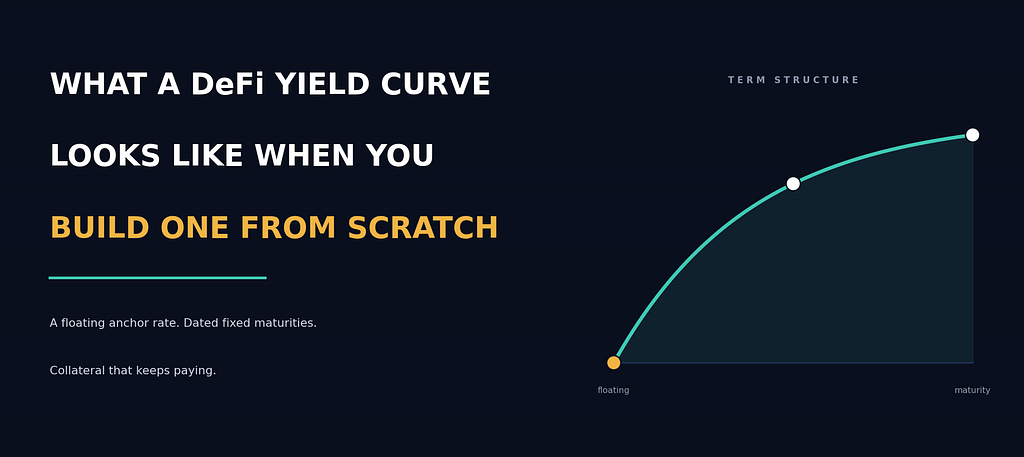
Onchain markets borrowed the word for years without earning it. In 2026, the three pieces finally showed up in the same place.
Three pieces make a term structure: a floating anchor, dated maturities, and collateral you can finance against.
Ask a bond desk to price a five-year loan and the first thing they reach for is a curve.
Ask onchain markets to do the same a few years ago and there was nothing to reach for. One floating rate per protocol. No maturities. No term.
The global fixed income market runs about $143 trillion on curves. The entire onchain lending market, roughly $54 billion of it, was running on scattered dots.
That gap started closing this year. Not with an announcement. With plumbing.
What Is a DeFi Yield Curve, and Why Did Onchain Markets Go Years Without One?
A DeFi yield curve is the term structure of onchain rates. What the same dollar earns at one month, three months, six months, a year.One number is a rate. A set of numbers across time is a curve.
Traditional markets get this handed to them. Governments issue debt at fixed maturities, so the curve draws itself.
Onchain had none of the ingredients:
No anchor rate that anyone agreed to price offNo dated instruments to plot against that anchorNo way to finance a position sitting on the curve
Researchers noticed before marketers did. A 2025 paper called crypto a bondless market and reverse-engineered curves out of options and futures, because nothing native existed.
Building one from scratch means building all three. Sky Ecosystem is one of the few places where all three now sit in the same system.
The anchor, the dated points and the financing leg. Miss one and you have a rate, not a curve.
Why Does Every Yield Curve Need an Anchor Rate Before Anything Else?
Every curve starts at the short end.
In Sky Protocol, that anchor is the Base Rate. It is the wholesale cost of capital that independent allocators pay to borrow USDS, and it is not spat out by a utilization formula.
It is set through Sky Governance, informed by collateral levels and the external rate environment.
Everything else hangs off it:
The rate paid to sUSDS holders sits a documented spread below the Base RateThe rate independent allocators receive sits a narrower spread below itInside that spread, part funds distribution and part is retained by the protocol
That is what a policy anchor looks like. One published decision, with the rest of the stack priced off it.
Sky Governance also moves it in public. In Q2 2026 it trimmed the Sky Savings Rate from 3.75% to 3.60% mid-quarter, calibrated to keep reserve accumulation on pace.
The live level always sits on the financial dashboard, never in a blog post.
How Does the Sky Savings Rate Work as the Floating Point on an Onchain Term Structure?
The Sky Savings Rate is the floating leg of the curve. Hold sUSDS and you hold it.
It is not a farm and it is not a promise. It is a governance-set rate funded from total Sky Protocol revenue: allocator fee payments, vault stability fees, tokenized treasury yield, peg module fees.
Scale matters, because a reference rate nobody holds is not a reference rate:
sUSDS closed Q2 2026 at $5.52B, up 149% year over year from $2.22BCumulative Sky Savings Rate distributions to holders crossed $250M on June 29, 2026Protocol Collateral stood at $14.15B in early October 2026, with USDS supply at $11.48B
Depth is what lets a rate act like a benchmark instead of a quote.
sUSDS grew 149% year over year and paid out more than $250M cumulatively. Depth is what turns a rate into a benchmark.
Where Do the Fixed Points on a DeFi Yield Curve Actually Come From?
A floating rate on its own is one dot. You need dated points.
Those came from yield tokenization. Split a yield-bearing stablecoin into a principal token and a yield token, and the principal token trades at a discount that encodes a fixed rate to a specific date. Buy the discount, hold to maturity, and the rate is locked.
sUSDS got its own maturities. The first fixed-rate market on it crossed $50M in TVL in under two weeks.
By late September 2026, the 26 November sUSDS principal token was quoting around 4.83% fixed, with $25M of size filling near 4.66% effective.
Plot that against the floating rate and something new appears. Two points. Different dates. Upward sloping.
The wider market is moving in the same direction:
Four fixed-rate lending venues launched or expanded between May and September 2026Coinbase shipped fixed-rate onchain borrowing to 110 million users in September 2026Across assets, principal tokens were paying 5% to 14% fixed to maturity as of 17 September 2026Fixed-rate lending is still only about $130M of a $54B onchain lending market, near 0.24%
That last line is the whole opportunity compressed into one number.
The floating Sky Savings Rate against a dated fixed sUSDS maturity. Two points, two dates, one curve.
What Turns a Yield Curve From a Chart Into a Market?
Charts are easy. Financing is hard.
A curve becomes usable the moment you can borrow against the paper sitting on it. In government bond markets that job belongs to repo. Repo is why the Treasury curve is infrastructure and not a picture.
Onchain got a version of that in September 2026. Galaxy Digital placed $100 million of sUSDS on its own balance sheet and approved sUSDS as eligible collateral across its institutional trading business, which serves more than 1,600 counterparties against an average loan book near $1.4 billion.
Galaxy called itself one of the first listed companies to hold sUSDS as treasury.
The detail most coverage skipped is the one that counts. Clients who pledge sUSDS keep earning the Sky Savings Rate on the full position for the life of the loan.
Collateral that keeps paying is how a yield curve stops being a chart and starts being a market.
Who Actually Generates the Yield Behind the Sky Savings Rate?
Nobody prints this. Somebody earns it.
The Sky Agent Network is a set of independent capital allocators that borrow USDS from Sky Protocol and put it to work.
Spark operates in lending markets. Grove handles institutional tokenized credit. Keel, Obex and Osero run their own mandates.
They are sovereign businesses, not subsidiaries. They borrow at the Base Rate, keep whatever spread they earn above it, and settle fees back to the protocol on a monthly cycle.
Those payments pool with the rest of protocol revenue, and Sky Governance calibrates the Sky Savings Rate against that total capacity, not any single strategy.
Two scale markers. Grove alone provides Galaxy with a $500 million warehouse facility.
And Sky Protocol holds anchor positions in tokenized funds from BlackRock and Janus Henderson.
No single counterparty sets the front of the curve. That is the design, not a side effect.
USDS goes out to independent allocators. Fees come back. Governance sets the rate. sUSDS holders receive it, and can still pledge it.
Do the Numbers Support a Stablecoin Benchmark Rate That Holds?
A rate only works as a benchmark if the thing paying it keeps paying.
From Sky Frontier Foundation reporting:
Q1 2026: $123.79M in Gross Protocol Revenue and $46.04M in Net Protocol SurplusQ2 2026: $107.35M in Gross Protocol Revenue and $33.29M in Net Protocol Surplus, a fifth consecutive positive quarterFirst half 2026: $231.66M in Gross Protocol Revenue, with $55.18M remitted to Sky Reserves at a 43.5% net marginProtocol Collateral up 45.5% year over year at Q2 close
A Grayscale analysis in June 2026 ranked Sky Protocol fourth among the highest revenue onchain applications globally.
Every figure above can be checked. The financial record sits on one dashboard, the onchain state on another.
A benchmark rate that cannot be audited is just marketing with a decimal point.Five consecutive positive quarters. The engine under the benchmark keeps running.
Is the Sky Savings Rate Becoming DeFi’s Reference Rate, or Not Yet?
This is where people oversell.
A reference rate is never declared. It gets adopted. The test is whether others price off it without being asked.
Evidence they are:
Fixed-rate venues now quote dated maturities against itA listed company holds the yield-bearing stablecoin as treasury and lends against itIndependent allocators price their own economics off the same anchor
Evidence they are not, yet:
No standard curve publisher exists for onchain ratesLiquidity thins out badly past twelve monthsMost onchain credit is still floating by default, priced off utilization
Both lists are true at once. Anyone showing you only one is selling something.
What Still Has to Be Built Before the Onchain Yield Curve Is Finished?
Three gaps, plainly stated.
Depth. $130M of fixed-rate lending is a rounding error next to $143 trillion of global fixed income.Tenor. The curve runs short. Multi-year onchain paper is still rare and thinly traded.Standardization. Different venues, different conventions, no agreed daily snapshot anyone can cite.Fixed-rate onchain lending is about 0.24% of the onchain lending market. That gap is the work.None of it is unsolvable, and all of it is unglamorous. Curves get built by plumbing, then everyone pretends they were always there.
If you want the inputs instead of the narrative, start with USDS, then sUSDS, then read the dashboards.
Now the part worth arguing about. If an onchain curve really does get built, what should the anchor be: a governance-set rate, a market-clearing rate, or something pinned to off-chain policy? Each one breaks in a different way. I have a view. I would rather hear yours first.
What a DeFi Yield Curve Looks Like When You Build One From Scratch was originally published in Coinmonks on Medium, where people are continuing the conversation by highlighting and responding to this story.