
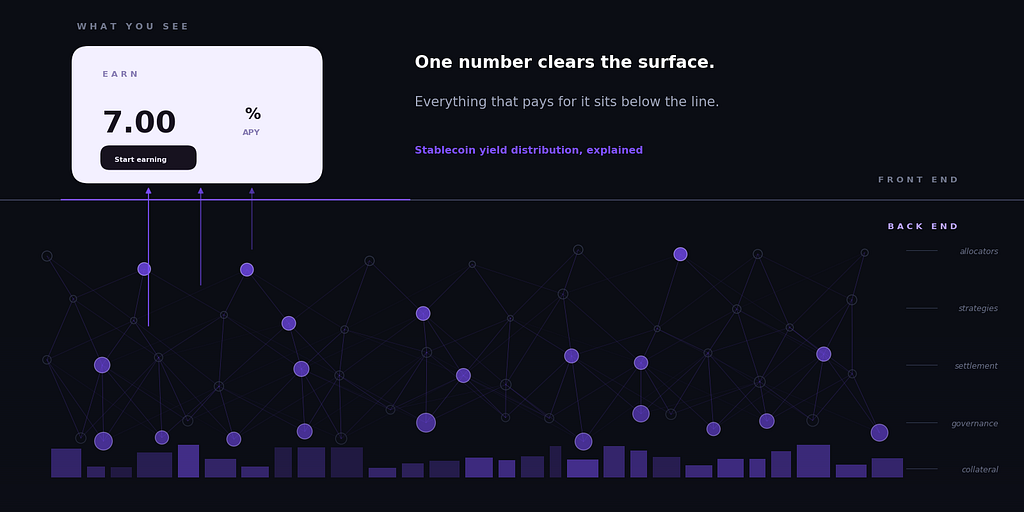
A plain explanation of stablecoin yield distribution, and why the app showing you a rate is almost never the thing producing it.
On 1 July 2026, Robinhood put an estimated 7% rate in front of roughly 28 million customers.
Robinhood did not generate that yield. The dollar token sitting in the app did not generate it either. Under US law, it is not allowed to.
The number came from a back end almost none of those users will ever open, name, or think about.
That gap, between the app you tap and the machinery that actually pays, is the quietest big story in stablecoins right now. It has a name: stablecoin yield distribution.
Stablecoin yield distribution is the process of routing a return produced by onchain capital allocation out to an end user through a consumer front end that did not produce it.
The front end owns the customer. The back end owns the collateral. In 2026 those are increasingly two different companies.
The prize is enormous and mostly untouched. The stablecoin market sits above $312B, and the overwhelming majority of it earns its holder nothing at all between transactions. Every fintech with a dollar balance in it has now noticed.
Why Did Stablecoin Yield Split Into a Front End and a Back End?
Short answer: the law split it.
Section 4(a)(11) of the GENIUS Act prohibits permitted payment stablecoin issuers from paying holders any form of interest or yield solely for holding the coin. Not in cash. Not in tokens. Not in anything.
The OCC has since proposed extending that prohibition to affiliates and related third parties, which would close the gap platforms use to label payouts as rewards rather than issuer yield. More than 40 banking associations lobbied for exactly that.
So the dollar became a payment instrument, full stop. The return had to be produced somewhere else and routed in.
That is the entire origin of the split. Everything after it is plumbing.
Three layers, three different answers to the same question about who may pay a holder.
Who Actually Generates the Yield Behind a Fintech Earn Button?
An allocation network does. Not the app.
Sky Ecosystem is one of the clearest working examples, because every layer of it is published. Sky Protocol is the onchain infrastructure.
The Sky Agent Network is a set of independent capital allocators that access USDS liquidity from it under risk parameters set in public.
The sequence is deliberately boring:
Sky Protocol issues USDS, a fully backed stablecoin, as the base unit of capitalIndependent Sky Agents borrow USDS at a governance-set wholesale rateAgents deploy it across credit, tokenised treasuries, lending markets and institutional strategiesAgent fees settle back each monthly settlement cycle, pooling with vault fees, real-world asset yield and peg module feesSky Governance then sets the Sky Savings Rate as a separate parameter, and sUSDS holders accrue it continuously
One detail matters more than the rest. The Sky Savings Rate is not a slice of any single allocator’s return. It is a governance-set output of the aggregate. No single counterparty, strategy or market decides it.
Five steps from borrowed liquidity to a rate inside somebody else’s app.
How Does the Sky Savings Rate Reach Someone Who Has Never Heard of It?
Through other people’s products. That is the whole distribution model.
Sky.money is the non-custodial gateway to Sky Protocol. In August 2026 it reported $7.1B across its product suite, with $4.92B of that in the Sky Savings RateSpark, an independent Sky Agent, runs savings vaults whose USD versions are backed by USDS, including a USDG vault live on Robinhood ChainOsero launched its consumer app on 18 August 2026, routing supplied USDC or USDT into sUSDS through vault infrastructure, with leverage and borrowing costs monitored by GauntletMantle moved a $200M vault product onchain with a strategy coordinated by Sky Agent Grove, carrying sUSDS exposureFive Sky vaults now run on Morpho, each accepting a specific stablecoin under a defined strategy and risk profile
Here is the part most people miss. The protocol budgets for this. A documented portion of the spread between the wholesale rate agents pay and the Sky Savings Rate users receive is a distribution reward, paid to agents and third parties for driving USDS adoption.
Distribution is a line item, not a favour.Different front doors, one back end. Reported figures, August to September 2026.
Why Are Fintechs Renting Yield Infrastructure Instead of Building It?
Because the thing they would have to build is a balance sheet, not a feature.
To produce a durable onchain rate yourself, you need:
Overcollateralised backing and a published collateral policyRisk parameters, exposure limits, and someone accountable for setting themAutomated settlement that works at 3am on a public holidayLiquidity deep enough that users can exit without slippageAudit history long enough that a compliance team signs off
Spark’s lead contributor framed the Robinhood integration as letting fintechs launch stablecoin earn products “without building liquidity infrastructure from scratch.” That one line is the business case for the entire back end.
Compare the two models by mechanism rather than by rate. An app that builds its own yield owns the credit risk.
An app that routes to a protocol owns the interface, and discloses whose risk it is passing through. Both are valid.
Only one is honest about where the money comes from, and only if the app says so.
What Do the Numbers Say About Where the Yield Actually Comes From?
Public ledgers, mostly. That is unusual, and worth sitting with for a second.
Sky Frontier Foundation reported Gross Protocol Revenue of $107.35M for Q2 2026, Net Protocol Revenue of $40.09M, and Net Protocol Surplus of $33.29M.
That was the fifth consecutive positive quarter. The first half of 2026 came to $231.66M gross.
Two quarters of published results from the layer that actually funds the rate.
At the time of writing, skyeco.com shows a Sky Savings Rate of 3.52% APY, $14.15B in Total Protocol Collateral and $11.48B in stablecoin supply.
The allocation detail is published too. As of 1 September 2026, Sky Agents held roughly $1.23B with Janus Henderson, $618.32M with BlackRock, $304M with Galaxy, $239.60M in PayPal USD and $220M with Anchorage.
Token Terminal data from 21 August placed Sky Protocol at $4.6B in the tokenised funds category, the largest single share of a $34.4B market.
The institutional side is moving in the same direction. In September 2026, Galaxy added $100 million of sUSDS to its corporate balance sheet and approved it as eligible collateral across its institutional trading business.
The same instrument that sits behind a consumer earn button is being posted as collateral by a Nasdaq-listed firm.
That is not a coincidence. It is what happens when the back end is legible enough to underwrite.
A fintech earn tab gives you one number. Behind this one, the ledger is open.
Is Embedded Stablecoin Yield Actually Safe for Ordinary Users?
It depends on what sits underneath, and most users are never shown that.
What is true of sUSDS specifically:
The rate is variable and governance-set. It moves when governance decides it shouldUsers retain non-custodial control at all times. No account, no custodian, no lockupIt is not a bank product and carries no insurance of any kindSmart contract risk, market risk and collateral risk are all real and all documented
And one risk the distribution model creates by itself: every extra wrapper adds another party setting the parameters, and another counterparty.
A user three apps deep can end up holding leverage they never knowingly agreed to.
The front end that onboarded them rarely explains this well, because explaining it well makes the product sound harder than the marketing says it is.
Q2 2026 made the point better than any argument could. One yield-bearing stablecoin lost roughly 54% of its supply while another gained over 63%, at broadly similar rates.
The difference was not the number. It was where the number came from, and whether holders believed it would last.The positions behind the rate are published at token level and updated continuously.
What Happens Next in Stablecoin Yield Distribution?
More of it, with better labelling.
Yield-bearing stablecoins peaked near $22.7B in March 2026, around 7.4% of a $320B stablecoin market. Small share. Fastest growth in the category.
In Q1 2026 they drove more than half of all net stablecoin supply growth. sUSDS alone added over $2.5B, more new capital than the next four yield-bearing tokens combined.
If the OCC rule lands as proposed, front ends will get more careful about what they call the payout. They will not get less interested in offering it. Distribution is where the customers are, and customers want a rate.
So, a question, and I want your actual answer in the comments.
When an app shows you a yield, should it be required to name who generated it and what backs it? Or is the interface allowed to be a black box, as long as the number clears?
I have a view. I am honestly not certain it is the right one.
The Fintech Front End and the Protocol Back End: How Onchain Yield Reaches Ordinary Users was originally published in Coinmonks on Medium, where people are continuing the conversation by highlighting and responding to this story.