
Pendle fixed yield explained, and why the largest market of its kind sits on top of a rate set by governance, not by a market.
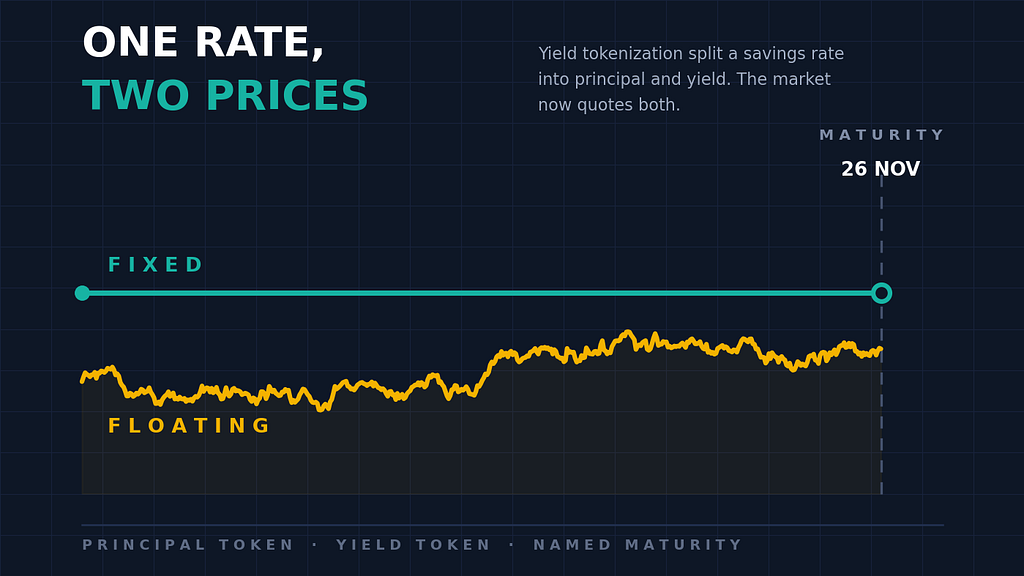
A floating rate drifts. A fixed one does not. The maturity date is where the two settle up.
A savings rate used to be something you accepted. In 2026 it became something you could price.
In June, a fixed-rate market opened on sUSDS. It drew $44.1 million in its first month.
By 19 August it held $81 million. No new token launched to make that happen. Somebody took an existing one and cut it in half.
That cut is the whole business of Pendle. And the rate sitting underneath the biggest of those markets is the Sky Savings Rate.
Most explainers stop at the mechanics. This one goes a step further and asks the question that actually decides whether a fixed rate is worth anything: what is paying it?
What is Pendle, and why does yield tokenization suddenly matter?
One token in, two claims out. PT buys the date. YT buys the yield.
Pendle is a yield-tokenization protocol. It has been running since 2021 and it does one thing properly. It takes a yield-bearing stablecoin or token and splits it into two separate, tradeable claims.
Principal Token (PT). The claim on your capital at a named maturity date.Yield Token (YT). The claim on every unit of yield that token produces until that date.
Hold both and you hold the original. Sell one and you have taken a view.
The scale is worth a line. DefiLlama put Pendle near $1.04 billion in total value locked across 12 chains in July 2026, well off its peak around $13.38 billion in September 2025.
Smaller, yes. Still somewhere between 50 and 60 percent of all onchain yield tokenization activity, with no competitor at scale.
The headline number is not the interesting part. This is: a floating onchain rate now has a forward price.
Pendle fixed yield explained: how one rate becomes two tokens
Here is the mechanic, without the jargon.
You supply sUSDS. Pendle wraps it into a standardised yield format.It mints PT-sUSDS and YT-sUSDS against a published maturity date, currently 26 November 2026.The PT trades below par. That discount is the return.Hold the PT to maturity, redeem at full value, and the gap you bought is the rate you set.The YT holder takes whatever the variable rate actually delivers. Better or worse.
If you have ever seen a zero-coupon bond, you already understand a principal token. Buy at 96. Redeem at 100. The four points are the yield.
The difference is that settlement runs onchain, on a published schedule, with nobody deciding whether to honour it.
A principal token is a date with a price attached. Everything after that is detail.
Worth naming the other side of the trade, because people forget it exists. Every fixed rate somebody locks is a variable rate somebody else bought.
The YT buyer is taking the view that the rate goes up. The PT buyer is taking the view that it does not, or simply that they would rather stop guessing.
Why did the largest fixed-rate stablecoin market form on sUSDS?
The rate is the last step in a chain, not the first.
Two reasons. Depth, and the kind of rate it is.
sUSDS is the largest yield-generating stablecoin in the market. Sky Frontier Foundation reported sUSDS supply at $5.52 billion at the Q2 2026 close, up 149 percent year over year, with cumulative yield distributions past $250 million since launch.
Depth alone does not create a term market, though. The second reason is much harder to copy.
The Sky Savings Rate is set by Sky Governance. It moves by vote, not by utilisation.
That makes it something a trader can reason about. You can form a view on a governance decision.
Forming a view on tomorrow’s borrow demand across a leveraged lending market is a completely different sport, and the fixed-rate markets built on those rates have mostly stayed thin for exactly that reason.
A market prices what it can reason about. That is the whole requirement, and most onchain rates fail it.
Where does the Sky Savings Rate actually come from?
From zero to roughly $82M in under four months, then something more interesting happened.
This is the part most Pendle explainers never reach. They cover the split and skip the source.
The Sky Savings Rate is not a marketing number. It is the output of a capital allocation network.
Independent allocators in the Sky Agent Network, including Spark, Grove, Keel, Obex and Osero, access USDS liquidity under parameters set in public.They deploy that liquidity into diversified strategies and pay Sky Protocol for the access.Those payments fund the rate. No payments, no rate.
The scale behind it, from SFF’s August 2026 update: Protocol Collateral of $11.10 billion, up 18.2 percent year over year, with Sky Agent vaults expanding from $5.63 billion to $6.06 billion inside a single month.
Sky Protocol generated $107.35 million in Gross Protocol Revenue and $33.29 million in Net Protocol Surplus in Q2 2026. That was the fifth consecutive positive quarter.
Institutions have been reading the same numbers. On 23 September, Galaxy added $100 million of sUSDS to its corporate balance sheet and approved it as collateral across its institutional trading business.
As of 1 September, allocations across the agent network included roughly $1.23 billion with Janus Henderson and $618 million with BlackRock.
A rate is only ever as good as the thing paying it. That is the sentence I would keep if you only keep one.
How big did the sUSDS fixed yield market really get?
The smallest line in the suite, and the one moving fastest.
The timeline is clean.
July 2026. $44.1 million in the first month, per SFF.19 August 2026. $81 million, sitting inside a $7.1 billion Sky Protocol product suite.Late September 2026. Pendle’s own newsletter quoted the PT-sUSDS 26 November market at 4.83 percent fixed, with $25 million filling at 4.66 percent effective.
Then the genuinely interesting thing happened.
PT-sUSDS became collateral. A PT-sUSDS to USDS market opened on Morpho in late July and reached $2.56 million by mid-August.
Holders can borrow against the position while the fixed rate keeps running underneath it.
That is the real tell. A rate stops being a product and starts being infrastructure the moment other people build on top of it without asking anyone’s permission.
What are the honest risks of locking an onchain rate?
No piece on fixed yield is complete without this section, and a surprising number of them skip it.
Fixed means fixed only to maturity. Exit early and the market price decides what you get, above or below where you entered.The rate is market-set, not governance-set. Nobody sets, controls or guarantees it. It is priced by whoever is trading that market on the day.Pendle v2 is separate code. It carries its own contract risk, stacked on top of whatever risk sUSDS already carries.Headline size is not exit liquidity. One September snapshot showed $82.00 million of market size against $3.47 million of pool liquidity. Size the position around the exit, not the headline.You can simply be wrong. If the variable rate climbs above your locked rate, you funded somebody else’s upside.
Locking a rate is a trade, not an upgrade. Anyone selling it as a free improvement is selling you something.
A floating rate with no maturity, plus dated fixed rates. That shape has a name.
Is this the start of a real onchain yield curve?
Line up what now exists.
A floating rate, set by governance, with no maturity.Dated fixed rates, set by a market, at published maturities.
That is a term structure. Arguably the first usable one in onchain dollars.
The timing is not a coincidence. The GENIUS Act takes effect on 18 January 2027, and it bars permitted payment stablecoin issuers from paying holders any form of interest or yield for simply holding the coin.
Yield does not vanish when a rule like that lands. It relocates. Out of the payment layer, into instruments built to carry it.
And once yield has to live somewhere specific, pricing it stops being a niche activity and starts being market structure. Term markets are what that looks like in practice.
One data point on where the weight already sits. On 21 August, Token Terminal ranked Sky Protocol first in its own tokenized-funds category, at $4.6 billion of a $34.4 billion total, ahead of Securitize, Circle, Franklin Templeton and Ondo.
What this means if you hold USDS or sUSDS
Holding USDS keeps you liquid with no rate exposure at all.Holding sUSDS keeps you on the variable rate. Liquid, no maturity to manage, exit whenever.Buying a PT trades that flexibility for a known number on a known date.None of these is better than the others. They answer different questions.
The real question is not which rate is higher today. It is whether you know when you need the money back.
Know the date, and a term market is useful. Do not know it, and locking is an expensive way to be early.
The part worth arguing about
Pendle did not invent a new yield. It made an existing one legible, and legible things get priced.
Here is what I keep going back and forth on. Does a governance-set rate make a better benchmark than a market-set one, or a worse one?
One moves slowly and can be reasoned about. The other is honest in real time and brutal about it.
I lean one way. I am not especially confident about it.
Tell me in the comments which one you would build a curve on, and why. If you have held a PT through a maturity, I would rather hear that than another explainer.
You can check every protocol figure in this piece against Sky Ecosystem’s own reporting before you argue with me.
Pendle Turned Savings Rates Into a Tradeable Market was originally published in Coinmonks on Medium, where people are continuing the conversation by highlighting and responding to this story.