
Affirmations, “good vibes only” and why none of it worked for me. What did work was less glamorous.
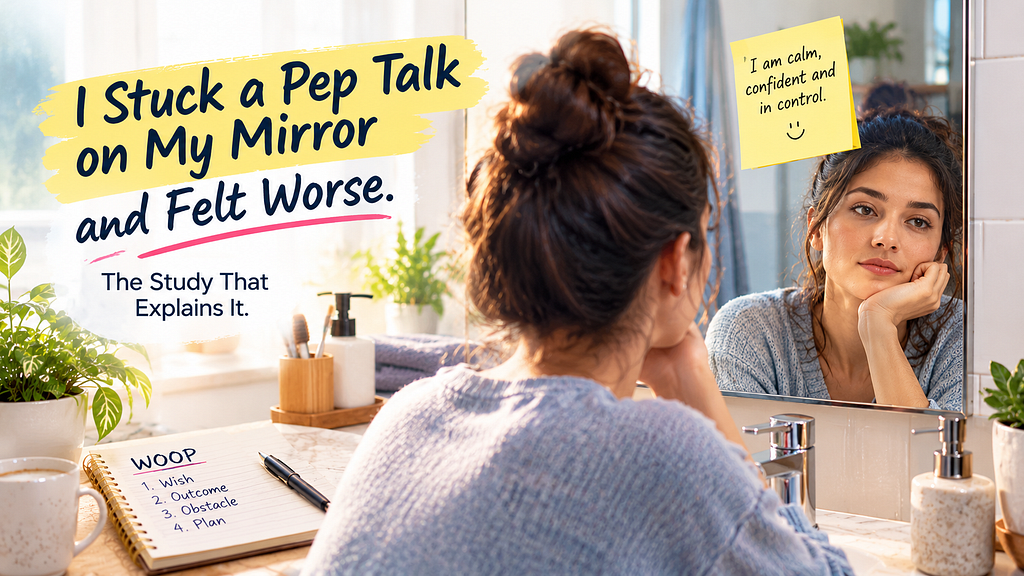
There’s a sticky note I still remember. Yellow, slightly crooked, stuck to the bathroom mirror above the tap. It said: I am calm, confident and in control.
I wrote it during a bad stretch. Work was a mess, I was sleeping badly, and somebody on a podcast had said that your thoughts create your reality. So every morning I read the note out loud while brushing my teeth. Mumbling, mostly. Toothpaste everywhere.
Three weeks in, I felt worse. Not a crash, just this annoying extra layer: now I can’t even do positivity right.
I almost quit the whole idea of “thinking positive” then and there. Glad I didn’t, because the reason it flopped turned out to be pretty interesting.
Image Generated by ChatGpt
The study that made me feel less crazy
Back in 2009, Joanne Wood and her team ran an experiment on positive self-statements. You know the type. “I’m a lovable person.” They had people repeat them and then checked how everyone felt.
People who already liked themselves got a small boost. People who didn’t, the ones who actually need a boost, felt worse afterward than the group who just sat there.
I read that and laughed out loud, honestly. That was me and my sticky note. If you tell yourself something you don’t believe, your brain doesn’t go “oh nice, thanks.” It pushes back. It hands you a list of reasons you’re wrong. You end up more aware of the distance between the sentence and your actual Tuesday.
So if affirmations have never worked for you, that’s not a character flaw. It might just be how minds work.
Optimism isn’t a mood. It’s a way of explaining things.
Martin Seligman, who basically built the modern study of optimism, noticed something that changed how I think about this. Optimists don’t have easier lives. They have the same flat tires and awkward emails as everyone else. The difference is the story that comes after.
Picture botching a presentation. One version of the story: I’m bad at this, I always will be, and everyone saw. Another version: That went badly. I rushed the slides. Next time I’ll start earlier.
The second version isn’t happy. Nobody’s grinning. It’s just smaller and more accurate, and it leaves a door open.
I now try to catch myself around 11pm, when the dramatic stories get loudest, and ask: is this a fact, or is this a story? It’s usually a story. A fairly convincing one, but still.
The unsexy thing that actually got me moving
Gabriele Oettingen, a psychologist at NYU, spent years studying what happens when people picture their goals going perfectly. Her results are a bit annoying if you love daydreaming: people who only fantasized about success tended to put in less effort. The brain gets a little taste of the win and relaxes. Like buying running shoes and feeling like you’ve basically run.
What she came up with instead is called WOOP. Four steps, five minutes, a pen:
Wish. Pick one thing you want. Small and real.Outcome. Picture it going well for a minute.Obstacle. Ask what in you might get in the way. Not your boss, not the weather. Your own habits.Plan. One sentence. If [obstacle], then I will [action].
I tried it on a boring task I’d avoided for months: phoning my landlord about a dripping pipe. My obstacle was dread, plain and simple. My if-then line was: if I catch myself opening my phone instead, I’ll dial the number first and scroll after.
I called that afternoon. Four minutes. Pipe got fixed on Thursday.
Did a psychology exercise transform my life? No. But it got one annoying thing done, which a month of sticky-note speeches never did.
Okay, but good moods do matter
I don’t want to be the guy who trashes positivity completely. There’s real research that feeling good helps.
Barbara Fredrickson studied how positive emotions seem to widen what we pay attention to. When you’re anxious, your attention narrows to the problem and nothing else. When you’re a little calmer, you notice more: other options, other people, other ways through.
So no, a good mood won’t fix your rent. But it can make the thinking a bit easier. That’s a small claim, and I trust small claims.
A handful of small habits, none of them magic
Three good things, specific ones. Before bed I jot down three. “Family” is too vague to feel anything. “My brother sent a ridiculous voice note and I laughed on the train” works. Seligman’s group tested a version of this exercise, and people who did it for a week reported feeling happier for months. I skip some nights. Most nights is fine.
Talk to yourself like you’d talk to a friend. Kristin Neff’s research on self-compassion links it to resilience more reliably than self-esteem. Next time you mess up, say out loud what you’d tell a friend who did the same. Harder than it sounds.
Put the worst case on paper. Then write what will probably happen. The worst case nearly always shrinks once it’s outside your head.
Look at your inputs. If you spend an hour scrolling bad news and then wonder why you feel grim, that’s not a mindset problem. That’s what you fed yourself. I cut my late-night scrolling and noticed the difference within about a week.
So what is positive thinking, really?
If someone made me define it now, I’d say it’s the belief that you can cope when things don’t go well, plus the willingness to do the next small thing anyway.
That’s a quieter promise than a mirror note. It doesn’t make bad days disappear. But it holds up when everything goes sideways, and that’s when you need it.
Try this today
Pick the one thing you’ve been avoiding. Take five minutes with a pen. Skip the affirmations and name your real obstacle, then write one if-then sentence.
Come back and tell me how it went. I read every comment, even the grumpy ones.
I Stuck a Pep Talk on My Mirror and Felt Worse. Here’s the Study That Explains It. was originally published in Coinmonks on Medium, where people are continuing the conversation by highlighting and responding to this story.