
The onchain private credit size everyone quotes is mostly a filing cabinet. Here is the number that actually trades, and what it tells you about stablecoin yield.
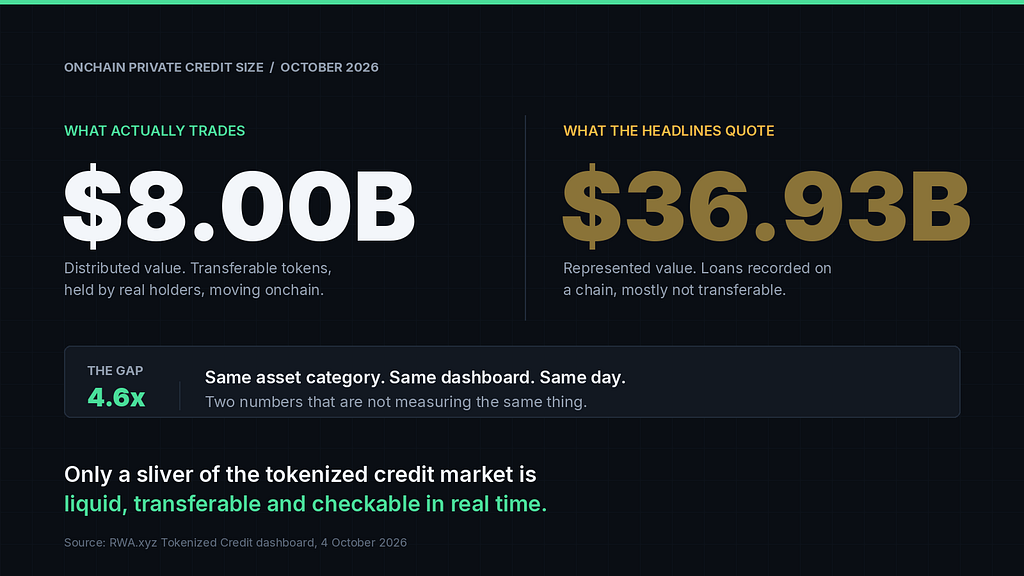
Onchain private credit size, 4 October 2026. The number that trades and the number that gets quoted are not the same number.
Open the RWA.xyz tokenized credit dashboard right now. Two numbers sit at the top of the same page.
$8.00 billion. And $36.93 billion.
Same category. Same dashboard. Same day. A 4.6x gap.
Nobody is lying. The two figures measure different things, and almost every headline about onchain private credit size quotes the bigger one without saying which.
That is a problem, and not a pedantic one. The bigger figure gets screenshotted, quoted in a research note, picked up by a newsletter, and three weeks later it is just “what everyone knows” about the market. Nobody goes back to check the footnote.
If you hold a yield-generating stablecoin, this should bother you. The gap between a reported number and a verifiable number is the whole game.
So what is the real onchain private credit size in 2026?
As of 4 October 2026, the RWA.xyz tokenized credit dashboard reports:
Distributed value: $8.00 billion. Tokens that holders actually hold and can move.Represented value: $36.93 billion. Loans recorded on a chain, mostly not transferable.2,609 tokenized credit assets, held by 197,726 holders.
Distributed value is the market. Represented value is the paperwork.
Distributed value versus represented value in tokenized credit. Only the smaller figure can actually be transferred. Source: RWA.xyz, 4 October 2026.
Here is the detail nobody quotes. Over the trailing 30 days, distributed value was flat, down 0.07%.
Represented value fell 2.14%. The headline number shrank while the tradable number held steady.
Run one more piece of arithmetic on it. Divide 197,726 holders across 2,609 assets and you get an average of about 76 holders per tokenized credit asset.
Seventy-six. For an asset class routinely described as institutional finance arriving onchain. Most of these instruments are not thinly traded. They are barely held.
Why does one HELOC token distort the tokenized private credit market size?
Because of Figure.
The Figure HELOC Token carries roughly $23.43 billion of represented value on Provenance, a permissioned chain. That is around 63% of the entire reported tokenized credit market.
One consumer HELOC token on a permissioned chain is roughly 63% of the reported tokenized credit market. Source: RWA.xyz, 4 October 2026.
It is a real portfolio of American home equity lines. It is also:
Recorded onchain, not distributed onchain.Not something you can buy, sell, or plug into a DeFi position.A database upgrade for one lender, not a market anyone can access.
Strip it out and the “$37 billion onchain credit market” becomes about $13.5 billion of represented value, with $8 billion that actually moves.
Here is the tell. In June 2025, S&P Global rated a $355 million securitization of Figure’s HELOC assets AAA.
The exit route for that book is a conventional bond deal, not a DeFi market. The chain is the filing cabinet.
Recording a loan on a blockchain does not make it liquid, any more than scanning a deed makes a house easy to sell.
Represented vs distributed value: which number should you actually use?
It depends on the question.
Measuring blockchain adoption as a system of record? Represented value is fair.Measuring liquidity, composability, or anything you can hold in a wallet? Use distributed value.Writing a headline about onchain private credit size? Say which one you used.
The largest freely transferable tokenized credit assets are smaller than most people assume:
Syrup USDC from Maple, around $998 millionBlockstream Mining Note 2 via STOKR, around $980 millionJanus Henderson AAA CLO Fund via Centrifuge, around $591 millionPRIME from Hastra, around $587 millionPayFi Strategy Token from Huma, around $417 millionThe largest tokenized credit assets you can actually hold and transfer. Even the top of the book is measured in hundreds of millions. Source: RWA.xyz, 4 October 2026.
Add the whole visible top of that book and you are still in single-digit billions.
Against a traditional private credit market measured in trillions, onchain credit is early. Genuinely early. Anyone telling you otherwise is reading the paperwork column.
This is not a knock on the sector. Early is fine. Pretending the paperwork column is the market is not, because that is how people end up trusting yields they cannot trace.
What does this have to do with stablecoin yield?
Everything, if you hold one.
A rate is a claim. It is only as good as the ledger behind it. If you cannot check the collateral and the revenue yourself, you are taking the rate on trust.
Sky Ecosystem takes the opposite route. Sky Protocol publishes the numbers on live public dashboards rather than asking you to wait for a quarterly deck.
As of 4 October 2026, skyeco.com shows:
Total Protocol Collateral: $14.15 billionStablecoin supply: $11.48 billionSky Savings Rate: 3.52% APY, variable, set by Sky GovernanceSky Protocol metrics published live rather than quarterly. Every tile can be checked at financial.skyeco.com. Source: skyeco.com, 4 October 2026.
The reported performance underneath it, published by Sky Frontier Foundation:
Q1 2026: $123.79 million Gross Protocol Revenue, $46.04 million Net Protocol SurplusQ2 2026: $107.35 million Gross Protocol Revenue, $33.29 million Net Protocol SurplusA fifth consecutive positive quarterProtocol Collateral up 45.5% year on year to $12.32 billion at the end of Q2sUSDS supply at $5.52 billion, up 149% year on yearGross Protocol Revenue and Net Protocol Surplus for Q1 and Q2 2026, a fifth consecutive positive quarter. Source: Sky Frontier Foundation quarterly reports.
Those are not estimates in a slide. They are figures you can reconcile against onchain data.
Two details that rarely make the round-ups. In March 2026, Sky Governance voted to redirect a large share of protocol earnings into building a $150 million solvency reserve, temporarily cutting token buyback allocations.
And S&P Global Ratings assigned Sky Protocol a B- issuer credit rating with a stable outlook, the first credit rating a major agency has ever given a DeFi protocol.
B- is not a victory lap. It is a published opinion with the weaknesses named out loud, which is rather the point.
Neither of those is a yield pitch. Both are what you do when you expect the numbers to be inspected.
How does the Sky Savings Rate turn verifiable capital into sUSDS yield?
The mechanics are simple enough to explain in five lines.
USDS is the base stablecoin of Sky Ecosystem. You convert in at 1:1 through the Peg Stability Module, no slippage, no fee.The Sky Agent Network is a group of independent capital allocators, including Spark, Grove, Keel, Obex and Osero. They draw USDS liquidity under risk parameters published onchain.Their activity contributes to aggregate Sky Protocol revenue.Sky Governance sets the Sky Savings Rate from that revenue.Hold sUSDS and the rate accrues to your position automatically. No lockups, no exit fees, redeem back to USDS whenever you want.
sUSDS is the largest yield-generating stablecoin in the market. Every parameter driving it is published, and every allocator competing for liquidity is measured against the same public standard.
The $500 million onchain credit facility nobody put in a headline
While the market argued about what counts as onchain credit, this happened in September 2026.
From Sky Ecosystem’s own announcement:
Grove, a Prime Agent, provides Galaxy Digital (Nasdaq: GLXY) with a $500 million warehouse lending facility. Grove commits USDS capital through a dedicated lending vehicle to finance Galaxy’s origination of institutional loans secured by digital assets.Galaxy added $100 million of sUSDS to its corporate treasury.Galaxy approved sUSDS as eligible collateral across its institutional trading business, which carries a $1.4 billion average loan book and serves more than 1,600 trading counterparties.Clients who post sUSDS against a loan keep accruing the Sky Savings Rate on the full position for as long as the loan runs.Sky Protocol entered Q3 2026 with $5.41 billion supplied through independent allocators and into institutional tokenized funds, including anchor positions in BlackRock’s BUIDL and Janus Henderson’s JTRSY.How a real onchain credit facility is structured. Grove commits USDS, Galaxy originates, returns flow back into the Sky Savings Rate. Source: skyeco.com, 23 September 2026.
Read that fourth bullet again. A collateral token that keeps earning while it does a second job. No headline called it private credit, so almost nobody counted it.
What to check before you trust any onchain credit number
Four questions. They take about two minutes.
Is the figure distributed or represented? If the source will not say, assume represented.Who holds the largest single slice? One issuer at 63% is a company, not a market.Can you open the underlying data yourself today, without a login or a PDF?Is the attached rate described as variable and governance-set, or quoted as if it were fixed?How many holders does the asset actually have? Dollar value without holder count hides a lot.
Apply those to any tokenized credit claim this quarter. Apply them to Sky Protocol too.
Everything above traces back to the public dashboards at financial.skyeco.com and info.sky.money.
The boring number is the honest one
Onchain private credit size is not a hard question. It is a definitional one.
The sector will keep posting larger headline numbers, and much of that growth will be loans getting photographed rather than traded. Useful, but not the same thing.
The number worth watching is the small, transferable, checkable one. It is also the only kind of number a savings rate can honestly be built on.
So, a question for the comments. When you see “$37 billion onchain credit market” in a thread, do you check which figure it is?
And do you think represented value is the fairer metric, or a flattering one? I will reply to every answer.
Onchain Private Credit Is Only $8 Billion. The Headlines Say $37 Billion. was originally published in Coinmonks on Medium, where people are continuing the conversation by highlighting and responding to this story.