
Today is the last day of a $750 million experiment. Here is what it proved about where stablecoin yield actually comes from.
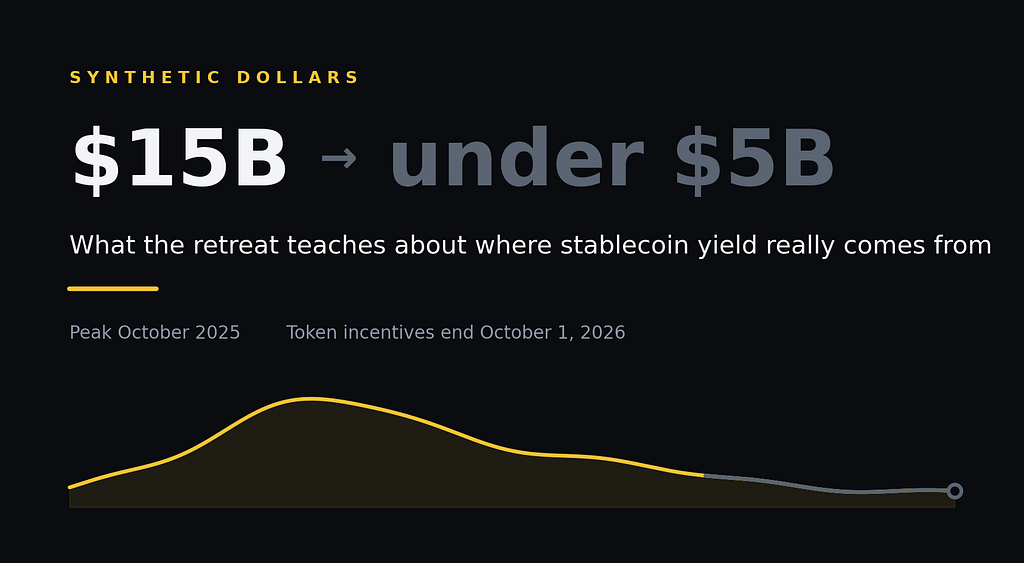
The synthetic dollar arc, from a $15 billion peak in October 2025 to under $5 billion as token incentives end.
Tonight, something quietly ends.
From October 1, 2026, Ethena stops paying ENA token rewards to anyone holding USDe or sUSDe.
The protocol announced it on September 26. Incentives tied to USDe growth had already fallen roughly 85% since the first airdrop in 2024. Now they go to zero, permanently.
Here is the price tag. More than $750 million in rewards distributed since launch.
And here is what happened to the thing those rewards were buying.
USDe peaked near $15 billion in October 2025. By late August 2026 it had dropped below $5 billion. A contraction of more than 65% in under a year.
This is not a scandal. Nobody got hurt. The peg held.
It is a receipt. And it is the clearest lesson onchain dollars have handed us in years.
For scale: in September 2025, USDe alone held roughly 4.5% of the entire stablecoin market at a $14.4 billion market cap. A year on, it is a fraction of that.
Why did the USDe supply decline happen this fast?
Three things stacked up at once.
The subsidy switched off. Token rewards were the growth engine. Capital that arrives to farm rewards leaves when the rewards shrink. Ethena said so itself.Funding rates cooled. USDe earns from a delta-neutral basis trade, long spot and short perpetual futures. That pays well when leveraged traders crowd the long side. It pays very little when they do not.October 2025 forced the unwind. The crash triggered a deleveraging event. Supply fell from above $14 billion to roughly $8.5 billion within weeks, then kept sliding.
CoinGecko put USDe at $5.9 billion at the Q1 2026 close. By September 28, 2026, readings sat near $4.9 billion.
One more detail worth holding onto. A governance proposal approved in September ties future ENA buybacks to USDe supply climbing back above $7.5 billion. From around $4.9 billion, that is roughly 53% of growth still to find.
Ethena kept every promise it made about the mechanism. The mechanism simply did what that kind of mechanism always does.
USDe circulating supply fell from roughly $15 billion to under $5 billion in under a year. The dashed line marks the $7.5 billion ENA buyback threshold.
What happens to stablecoin yield when funding rates go quiet?
It compresses. Fast.
sUSDe paid above 35% at its Q1 2024 peak. By mid-September 2026 it sat near 5%.
Now put that next to the risk-free floor. The effective federal funds rate was 3.63% on September 11, 2026.
So a strategy carrying derivatives exposure, exchange counterparty exposure and hedge execution risk was paying roughly 1.4 points over cash.
A yield that depends on other people staying leveraged is a yield you are renting, not one you own.
That is the real story inside the usde supply decline. The model did not break. It was always cyclical. The cycle finally showed up on the chart.
sUSDe yield fell from above 35% to roughly 5%, closing most of the gap to the risk-free rate.
Where does a durable yield-bearing stablecoin get its rate?
This is where the two designs part ways.
A synthetic dollar sources yield from one market condition. A capital allocation network sources it from many.
USDS is the fully backed stablecoin at the base of Sky Protocol. It is the unit of account and the credit facility for allocators. Holding it pays nothing on its own.
Supply USDS and you receive sUSDS, the yield-generating stablecoin that carries the Sky Savings Rate.
Value accrues against USDS continuously. No lockups, no cooldown, convertible back on demand.
The Sky Savings Rate is governance-set, not market-set. That single distinction is the whole argument.
Here is the actual path the money takes:
Sky Protocol makes USDS liquidity available under risk parameters set in publicIndependent allocators in the Sky Agent Network draw on that liquidityThey deploy it across credit, lending markets, treasury strategies and tokenized fundsFees flow back as Gross Protocol RevenueSky Governance sets the rate from that revenue basesUSDS holders capture it automatically
Six steps. Not one of them needs a perpetual futures funding rate to stay positive.
The Sky Savings Rate is the output of a five-step capital allocation loop, not of a single market condition.
Is diversified collateral more durable? Check the 2026 tape.
Fair challenge. So here are the numbers, published by the Sky Frontier Foundation.
Q1 2026: $123.79 million in Gross Protocol Revenue and $46.04 million in Net Protocol Surplus. Record quarter.Q2 2026: $107.35 million in Gross Protocol Revenue and $33.29 million in Net Protocol Surplus. Fifth consecutive positive quarter.Protocol Collateral: up 45.5% year over year to $12.32 billion at the Q2 close.sUSDS: up 149% year over year to $5.52 billion at the Q2 close.
Category context matters here too. Yield-bearing stablecoins peaked near $22.7 billion in March 2026 before native-yield supply contracted roughly 15% in Q2.
sUSDS came through that stretch as the largest single yield-bearing stablecoin in the market.
Now the part most brands would quietly skip.
In the August 2026 update, Gross Protocol Revenue came in 11.47% below August 2025. Protocol Collateral closed the month at $11.10 billion, stablecoin supply at $9.53 billion.
So no. Diversification is not immunity. Rates fall, revenue follows.
The difference is the shape of the fall. One model shed two thirds of its supply.
The other posted five straight positive quarters and still grew Protocol Collateral 18.2% year over year.
Protocol Collateral of $11.10 billion against stablecoin supply of $9.53 billion at the August 2026 close.
Who is allocating into USDS and sUSDS right now?
Names, not adjectives. As of September 1, 2026, Sky Agents held roughly:
$1.23 billion with Janus Henderson$618.32 million with BlackRock$304 million with Galaxy$239.60 million in PayPal USD$220 million with Anchorage$103.11 million with Securitize
Galaxy is the mover here. Exposure sat at $27 million at the Q2 close and reached about $304 million by September 1.
Then on September 23, Galaxy Digital added $100 million of sUSDS to its own corporate treasury and approved sUSDS as eligible collateral across an institutional business carrying a $1.4 billion average loan book.
Token Terminal data as of August 21 placed Sky Protocol at $4.6 billion in tokenized funds. Largest single issuer in a $34.4 billion category, ahead of Securitize, Circle, Franklin Templeton and Ondo Finance.
Across the full Sky product suite, $7.1 billion was reported on August 19, with $4.92 billion of it sitting in the Sky Savings Rate.
A synthetic dollar’s collateral is a hedge. This collateral is a list you can read.
Sky Agent allocations by counterparty as of September 1, 2026. Galaxy exposure moved from $27 million to roughly $304 million in one quarter.
Five questions to ask before you trust any stablecoin yield
Steal this checklist. Run it on every token in the category, including this one.
What pays the yield? Name the source out loud. If the honest answer is “market conditions,” you are holding a cyclical asset and should size it that way.Who sets the rate, and how? Market-set rates move with sentiment. Governance-set rates move on a vote you can read before it happens.Is the backing verifiable right now? Not quarterly. Right now. Sky’s public dashboards publish collateral, revenue and supply continuously.How fast is the exit? Lockups and cooldowns are risk. sUSDS converts back to USDS on demand, with no lock-up period and no exit fee.What does the issuer publish on a bad month? This is the real tell. Anybody can publish a record quarter.Sky Protocol held $4.6 billion of a $34.4 billion tokenized funds category in August 2026, the largest single issuer.
What the synthetic dollar contraction actually teaches
Here is the part nobody says out loud.
Ethena built something genuinely new, and it is now diversifying its reserves into institutional lending, real-world assets and tokenized equities.
That is not a retreat. That is the whole category converging on the same answer.
Diversified backing. Verifiable collateral. A rate that survives a quiet market.
The wider tape agrees. Total stablecoin supply sat near $302.8 billion in September 2026, up about 14% year over year, and it held close to record highs straight through a downturn that took 20% off total crypto market cap in Q1 alone.
Dollars onchain are not going anywhere. The only real question is which ones pay you, and out of what.
Regulators are tightening around who may pay yield, too. The GENIUS Act bars payment stablecoin issuers from paying holders directly, and in September the European System of Central Banks proposed tighter limits on stablecoin rewards. Structure is quietly becoming the differentiator, not marketing.
USDe’s chart did not prove synthetic dollars were a bad idea. It proved that where a yield comes from matters more than what the yield says today.
The subsidy era of onchain dollars ends tonight. What comes next gets funded by revenue, or it does not get funded at all.
Your turn. Would you rather hold a stablecoin paying 8% sourced from one strategy, or 4% sourced from twenty? Drop your answer below and tell me what would change your mind.
From $15 Billion to $6 Billion: What the Synthetic Dollar Retreat Teaches was originally published in Coinmonks on Medium, where people are continuing the conversation by highlighting and responding to this story.