
The rate did not break. It reported. Here is what that tells you about how stablecoin yield is actually built.
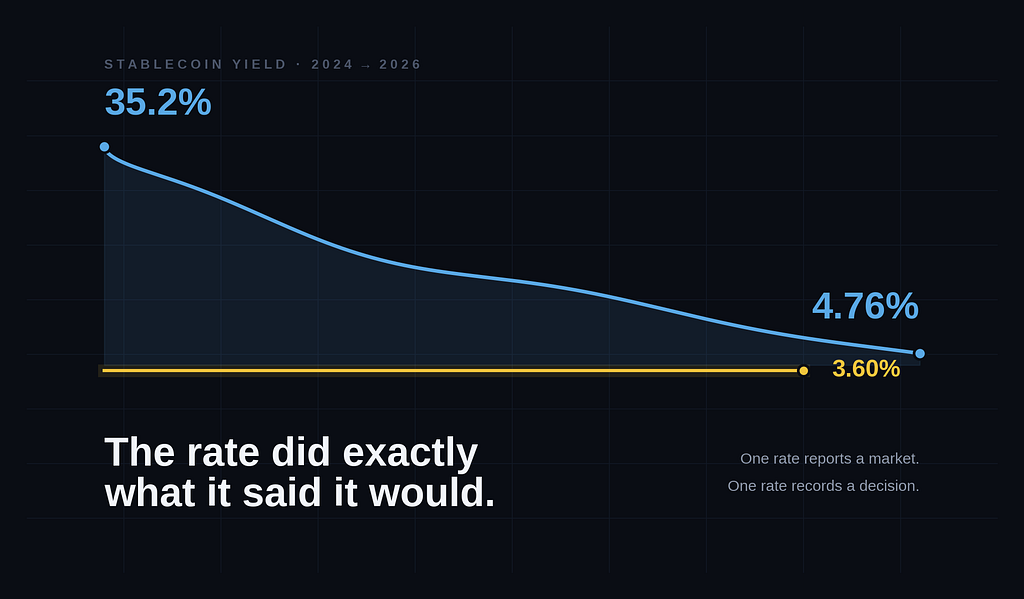
sUSDe APY fell from a 35.2% all-time high in Q1 2024 to roughly 4.76% in late September 2026. The Sky Savings Rate was moved to 3.60% over the same window.
In March 2024, sUSDe paid 35.2%. On 28 September 2026, it paid about 4.76%.
Nobody moved the goalposts. The rate did precisely what its own documentation always said it would.
That is the part most people skipped.
I have spent most of 2026 reading stablecoin yield dashboards. Two products can land on the same number and mean completely different things by it.
Quick answer, for anyone who typed “sUSDe APY 2026” into a search bar:
sUSDe paid roughly 4.76% on 28 September 2026, with a 30-day average near 4.79%, per DefiLlama. Its all-time high was 35.2% in Q1 2024. Its all-time low was 4.1% in August 2024.
The rate is not administered. It is whatever perpetual futures funding happened to pay.
What is the sUSDe APY in 2026, and how far has it actually fallen?
Here is the honest picture.
Late September 2026: roughly 4.76% APY, 30-day average 4.79%All-time high: 35.2%, during the Q1 2024 bull runAll-time low: 4.1%, during the August 2024 funding inversion2024 average: around 19% across the yearUSDe supply: near $4.95B, down from a $14.8B peak
One more number worth sitting with. In August 2024, the rate went from 19% to 4% in eleven days.
Eleven days.
Nothing was hacked. No collateral failed. Funding simply flipped.
Two rate-setting mechanisms, plotted side by side. One is discovered by perpetual funding markets. One is voted on by Sky Governance. Approximate published rates, February 2024 to September 2026.
A yield that can fall 15 points in eleven days is not a savings rate. It is a market price wearing a savings rate costume.
Where did that 35% sUSDe yield actually come from in the first place?
sUSDe earns from a delta-neutral basis trade. Strip the jargon and it works like this:
Hold spot crypto collateralShort the matching perpetual futures to cancel price exposureCollect the funding payments longs pay shortsPass those payments to sUSDe holders
When crypto is euphoric and everybody is levered long, longs pay shorts a lot. That is your 35%.
When the market cools, longs stop paying. That is your 4%.
The engine never changed. The fuel did.
So the right way to read sUSDe APY in 2026 is not “the yield collapsed.” It is “leverage demand normalised, and the instrument reported it.” Ethena documented this from day one. Credit where it is due.
Why a falling sUSDe APY is a feature of the design, not a scandal
This is where a lot of commentary got lazy.
A funding-rate yield is a thermometer. It reads the room. When positioning is crowded, it runs hot. When positioning is flat, it runs cold. Asking it to hold 35% is asking a thermometer to hold summer.
The design risk was never that the rate might fall. It is that the rate falls exactly when you most want it to hold, because both are driven by the same sentiment.
That is correlation, and correlation is exactly what treasury teams pay to avoid.
Same label on the screen, opposite order of operations. One rate is an outcome you find out about. One is a decision with a paper trail.
How the Sky Savings Rate is built the other way round: revenue first, rate second
This is the structural contrast, and it is a difference in mechanism, not a scoreboard.
The Sky Savings Rate is not discovered by a market. It is set by Sky Governance, out of revenue that Sky Protocol has already generated.
The sequence runs in this order:
Sky Protocol makes USDS liquidity available under governance-set risk parametersIndependent allocators in the Sky Agent Network borrow that liquidity and deploy it across diversified strategiesThose allocators pay fees back to Sky Protocol for accessRevenue accumulates as Protocol SurplusSky Governance then votes, onchain and in public, on what the rate should besUSDS holders receive it automatically, compounding block by block
Notice the order. The revenue exists before the rate is announced, not after.
As I write this, the Sky Savings Rate sits at 3.60% APY on skyeco.com. Sky Governance moved it there on 3 September 2026, up from 3.52%.
It is variable. It can move. But when it moves, there is a vote, a forum thread, and a timestamp attached to it.
It went up in September, incidentally. Not down.
One rate is an outcome of a market. The other is a decision with a paper trail. Neither is free of risk. They just fail in completely different ways.
What the Sky Protocol numbers look like underneath the sUSDS rate
Rates are opinions. Balance sheets are evidence.
Total Protocol Collateral: $14.15BStablecoin supply: $11.48BQ1 2026: $123.79M Gross Protocol Revenue, $46.04M Protocol Surplus, the strongest quarter on recordQ2 2026: $107.35M Gross Protocol Revenue, $33.29M Protocol Surplus, a fifth consecutive quarter of positive surplussUSDS supply at the end of Q2 2026: $5.52B, up 149% year over yearSky Protocol generated $123.79M Gross Protocol Revenue in Q1 2026 and $107.35M in Q2 2026, with $46.04M and $33.29M in Protocol Surplus respectively. Verify at financial.skyeco.com.
One more that surprised me. In Q1 2026, yield-bearing stablecoins added roughly $4.3B in net new supply as a category.
sUSDS alone brought in more than $2.5B of that, more new capital than the next four yield-bearing tokens combined.
sUSDS supply reached $5.52B at the end of Q2 2026, up 149% year over year. In Q1 2026 it took in more new capital than the next four yield-bearing tokens combined.
And in August 2025, S&P Global became the first rating agency to rate a decentralised finance protocol. The protocol was Sky Protocol.
You can argue about what a B-/Stable means. You cannot argue about who went first.
sUSDS vs sUSDe in 2026: two honest answers to two different questions
This is not a “one is good, one is bad” story. They answer different questions.
sUSDe answers: what is leverage demand paying right now?
Upside is uncapped in bull regimesCorrelated to crypto sentimentSeven-day cooldown on unstakingRate can compress to near zero if funding inverts
sUSDS answers: what has this network actually earned, and what did governance decide to pass on?
Governance-set and published before it appliesFunded from aggregate Protocol Surplus, not any single strategyNo lockup, redeem to USDS on demandBacked by diversified institutional-grade collateral you can inspect onchain
Trading a regime? The first is your instrument. Financing a payroll eighteen months out? Different tool entirely.
Where each rate has travelled since 2024, and where it sits today. Both are variable. They vary for completely different reasons.
Why September 2026 is when institutions stopped watching and started allocating
On 23 September 2026, Galaxy Digital (Nasdaq: GLXY) added $100 million of sUSDS to its corporate treasury and approved sUSDS as eligible collateral across its institutional trading business, which carries a $1.4 billion average loan book.
The clever detail: clients who post sUSDS against a loan keep accruing the Sky Savings Rate on the full position for as long as the loan runs. The collateral does not go to sleep.
That relationship started with a $500 million warehouse lending facility from Grove, an independent allocator in the network. Galaxy has since borrowed on Spark too.
Context for the trend: Sky Protocol entered Q3 2026 with $5.41 billion supplied through independent allocators and into institutional tokenised funds, including positions in BlackRock’s BUIDL and Janus Henderson’s JTRSY.
Meanwhile, onchain real-world assets excluding stablecoins passed $33 billion in July 2026, roughly four times early-2025 levels.
A treasury committee will not sign off on a rate that swings with funding sentiment. It will look at one with a governance record and a published balance sheet.
What I would actually check before parking a dollar in any yield-bearing stablecoin
Not advice. Just the checklist I use.
Where does the rate come from? Funding payments, lending spreads, treasury bills, or protocol revenue. Say it in one sentence or walk away.Who sets it, and can you watch them set it? A public vote beats a dashboard update.What is the exit? Instant redemption and a seven-day cooldown are not the same product.What happens in the bad regime? Ask what the rate does when crypto is boring, not when it is exciting.Can you verify the backing yourself? If the answer is a quarterly PDF, that is a different trust model.
You can check every Sky Protocol figure in this piece against info.skyeco.com and financial.skyeco.com. I would rather you verified me than believed me.
The uncomfortable truth about high stablecoin yields
Here is what nobody in this industry likes saying out loud.
A high APY is not a reward for being smart. It is usually compensation for a risk you have not priced yet.
sUSDe at 35% paid you to hold the other side of a very crowded trade. At 4.76% it is paying for a much quieter one. Both are honest. Only one made headlines.
And a governance-set rate at 3.60% is not trying to win a yield beauty contest. It is trying to still be there in 2028.
The rate you can plan around is worth more than the rate you can screenshot.
Now I want to hear you disagree. Do you want a yield that tells you the truth about the market every single day, even when the truth is 4%? Or one that a group of token holders decides on in public, with a vote you can read?
Drop it in the comments. I will post the receipts for any number above.
sUSDe APY in 2026: From 35% to Roughly 4%, and Why the Model Did Exactly What It Said It Would was originally published in Coinmonks on Medium, where people are continuing the conversation by highlighting and responding to this story.