
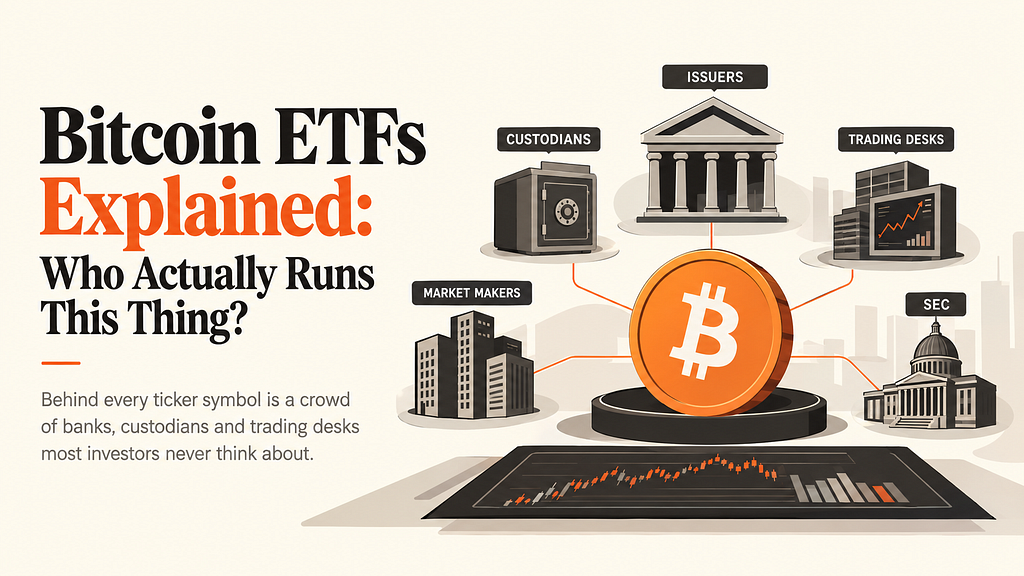
Behind every ticker symbol is a crowd of banks, custodians and trading desks most investors never think about
Remember when buying Bitcoin meant a trip down a rabbit hole? Exchange signup, ID photos, a hardware wallet that arrives in the mail, and a 24-word phrase you’re told to write on paper and hide somewhere. Mess up any step and nobody is coming to help.
Then January 10, 2024 arrived. The SEC approved the first eleven spot Bitcoin ETFs, and all that hassle became optional. You could type a ticker into the same app where you hold your index funds and be done in thirty seconds.
ChatGPT Generated Image
Simple on the surface. Underneath, it’s a surprisingly busy machine. Let’s open the hood. I’ll keep the jargon light and the opinions honest, because this topic attracts plenty of hype in both directions.
First, what is a spot Bitcoin ETF?
It’s a fund that owns real Bitcoin and sells shares against it. The share price tracks Bitcoin, minus an annual fee. That’s it.
The “spot” part matters. Back in October 2021 the first Bitcoin ETFs launched, but they held futures contracts, and futures have to be swapped out every month. That rollover quietly eats returns, so those funds lagged the actual coin. Spot funds skip the problem.
The SEC said no to spot funds for about a decade. Its main worry was manipulation on crypto exchanges. Then a federal appeals court ruled in 2023 that the agency couldn’t approve futures funds while rejecting nearly identical spot ones. Awkward for the regulator, and the dam cracked soon after.
What you get as a buyer:
Trading during normal market hoursCompatibility with IRAs and brokerage accountsNo keys or wallets to babysitRegular SEC filings, so holdings are public
The cast of characters
Nobody tells you how many companies touch a single share of IBIT. Here’s the short list.
Issuers package the fund. Eleven launched together, among them BlackRock (IBIT), Fidelity (FBTC), Bitwise, ARK 21Shares, VanEck and Grayscale.Custodians store the Bitcoin, mostly in offline vaults. Coinbase handles a huge share of it. Fidelity keeps its own.Authorized participants are the big firms allowed to create or cancel shares in bulk.Market makers quote prices nonstop so you can buy or sell at a fair number.Pricing providers publish the benchmark rates that value each fund every day.The SEC watches over all of it.
Honestly, the authorized participants and market makers are the least famous and most important group here. Without them, the ETF price would wander.
The clever bit: creating shares
Picture the ETF trading a little above its Bitcoin’s value because everyone wants in. Here’s what happens next.
An authorized participant notices the gap.They hand the issuer cash (since 2025, Bitcoin itself also works).The issuer makes new shares, and the custodian ends up with matching coins.Extra shares hit the market, and the price sinks back to fair value.
Demand falls? Same thing in reverse. Shares get cancelled and Bitcoin goes back out.
This loop is why a healthy ETF almost never strays far from its holdings. When you do spot a big premium or discount, something is stressed.
Fees, flows and one big winner
Issuers went to war over price. Most settled between 0.2% and 0.3% a year, and a few waived fees entirely for a while. BlackRock offered a temporary discount on IBIT. Fidelity waived FBTC’s fee for the early months.
Grayscale was the odd one out. Its old trust, GBTC, was converting into an ETF and charged 1.5%, which looked silly next to everyone else. Money poured out for months, since holders stuck in the old structure finally had a cheaper exit.
Meanwhile IBIT raced ahead, collecting tens of billions faster than almost any ETF in history. The lesson: when products are nearly identical, people pick the name they trust and the lower price.
Why this matters
Easier entry. Millions of people who’d never open a crypto exchange account now hold Bitcoin exposure.Respectability. Advisors and institutions finally have something their compliance teams can sign off on.Transparency. Holdings and flows get reported, so there’s real data to argue about.A ripple effect. Spot Ether ETFs, options on Bitcoin ETFs and looser listing rules for other crypto funds all followed.
Whether Bitcoin deserves a place in portfolios is a separate debate. The ETFs just made it easy to join that debate with real money.
What can go wrong
Easy doesn’t mean safe. Think about these before buying.
Wild swings. A 10% move in a week isn’t unusual, and your ETF follows.You don’t own coins. You own shares. No withdrawals, no using it for payments or apps.Concentrated custody. A handful of custodians hold most of the Bitcoin. One serious failure could ripple across funds.Fees add up. Small percentages become real money over a decade.Taxes. Rules differ by country and account type, so look yours up.Weekend gaps. Bitcoin never sleeps, but the stock market does. Big news on Saturday waits until Monday for your ETF to react.
ETF or self-custody?
Neither is “right.” It depends on what you want.
If you want simplicity, retirement-account access and a regulated structure, the ETF fits. If you want full control, the ability to move coins anywhere and round-the-clock access, hold your own. A lot of people split the difference, and honestly that seems sensible.
Where this goes next
Keep an eye on a few things:
Advisors adding Bitcoin to standard model portfoliosMore crypto ETFs beyond Bitcoin and EtherRule changes around staking and custodyFees dropping further
The takeaway
Crypto invented the asset. Wall Street built the on-ramp. The result is a market where your neighbor can own Bitcoin without knowing what a private key is, and that’s both the whole point and the whole risk.
My advice, for what it’s worth: understand what’s inside the ticker, compare expense ratios, and don’t put in more than you can stomach losing. Bitcoin has humbled plenty of confident people, and an ETF wrapper won’t change its temperament.
So which camp are you in, ETF or your own wallet? I’d like to hear why in the comments.
Bitcoin ETFs Explained: Who Actually Runs This Thing? was originally published in Coinmonks on Medium, where people are continuing the conversation by highlighting and responding to this story.