
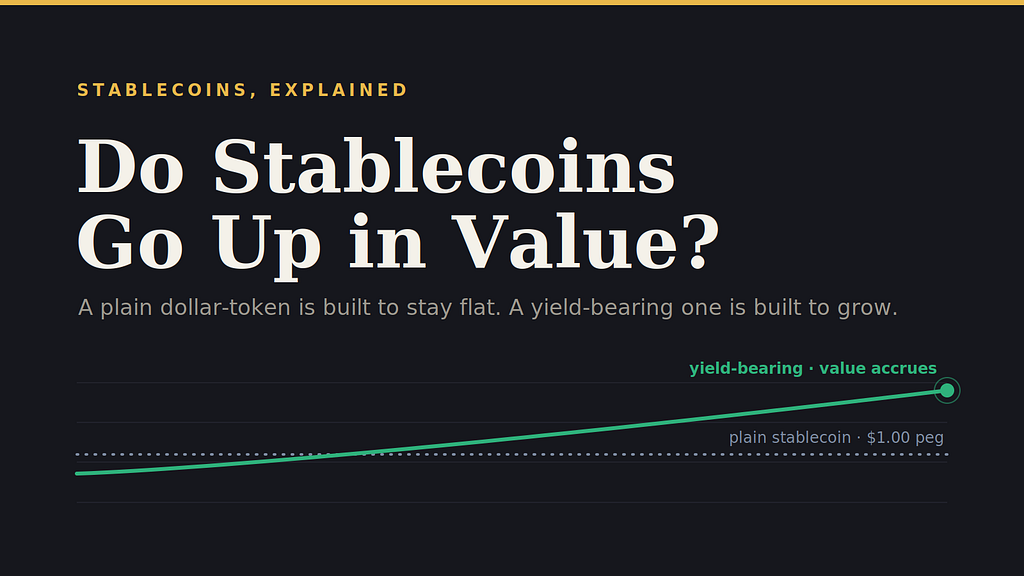
A plain stablecoin is built to sit at one dollar. A yield-bearing one is built to grow. Here is the difference, in plain English.
Let me save you the suspense. No, a stablecoin is not supposed to go up in value. That is the whole point of it.
A stablecoin is designed to track one dollar and stay there. If it swings around like Bitcoin, it has failed at its one job.
But there is a twist that trips up almost every beginner. Some stablecoins are quietly built to grow while still staying pegged to a dollar.
They are called yield-bearing stablecoins, and they behave very differently from the plain kind.
So the real question is not “do stablecoins go up in value.” It is this: which kind of stablecoin am I actually holding, and is mine working or just sitting there?
Let me walk you through it in plain English.
Do stablecoins go up in value? The short answer
No. A well-built stablecoin holds its peg near one dollar, on purpose.
Price appreciation is not the goal. Stability is.If you buy USDC or USDT at a dollar, you should still have roughly a dollar a year later.Neutral sources agree. Elliptic puts it plainly: stablecoins are designed to hold a steady value and do not appreciate.
Here is the nuance most guides skip. A stablecoin that stays flat is not the same as a stablecoin that does nothing. The dollar behind it is almost always earning yield somewhere.
The only real question is who keeps that yield. Usually it is the issuer. Sometimes, if you pick the right token, it can be you.
A stablecoin that stays flat is not the same as a stablecoin that does nothing.
Why is a stablecoin designed to stay flat?
Because its job is to be boring money. Reliable, liquid, and worth a dollar the moment you need it.
Stablecoins hold their peg through a few mechanisms:
Reserves. Each token is backed by dollars, treasuries, or other collateral held in reserve.Arbitrage. If the price drifts below a dollar, traders buy it cheap and redeem it for a dollar, which pushes it back up.Over-collateralization. Some are backed by more value than they issue, so the peg keeps a cushion.
This “boring by design” quality is exactly why the category exploded. The total stablecoin market sits above 300 billion dollars, after peaking near 322 billion in May 2026.
More than 99 percent of that supply is pegged to the US dollar. In fact, the whole category has grown nearly twelvefold since 2020. The entire appeal is that it does not move.
A healthy stablecoin peg. The goal is a flat line, not an upward one.
Think of it this way. Bitcoin is a bet. A stablecoin is a ruler. You do not want your ruler changing length while you measure with it. So a stablecoin going “up” would actually be a bug, not a feature.
If they don’t go up, how does anyone make money on stablecoins?
Good question, and this is where it gets interesting.
When you hold a plain stablecoin, your dollar does not vanish. It sits in a reserve that quietly earns yield, often from short-term US Treasury bills. For the biggest issuers, that adds up to billions in revenue every year.
Here is the catch. With a traditional stablecoin, that yield goes to the issuer, not to you. You hold the token. They keep the interest. You are basically handing someone an interest-free loan and thanking them for it.
That gap is the whole opportunity. And it is exactly why a new category showed up to close it.
What is a yield-bearing stablecoin, and does it go up in value?
This is the part beginners actually need.
A yield-bearing stablecoin still targets one dollar. But instead of the issuer keeping all the yield, it passes the yield back to holders.
There are two common designs:
Rebasing. Your balance grows. You simply wake up holding more tokens.Value-accruing. Your balance stays the same, but each token is worth a little more in dollars over time.
The value-accruing model is where it finally clicks. The token count does not change, yet its redemption value climbs day after day.
In that specific sense, yes, a yield-bearing stablecoin can go up in value while the dollar it tracks stays perfectly flat.
Same dollar peg, very different outcome. Illustrative only; the Sky Savings Rate is variable and governance-set.A value-accruing token can go up in value while the dollar it tracks stays perfectly flat.
There is a timely reason these tokens are built this way. In the US, the 2025 GENIUS Act bars stablecoin issuers from paying yield directly to holders. So the market routed around it.
A separate, value-accruing token can do what the base stablecoin legally cannot.
That single rule helped turn a workaround into the fastest growing corner of the whole sector.
And this is not a fringe experiment. Yield-bearing stablecoins grew roughly 300 percent in 2025, and drove more than half of the sector’s net supply growth in early 2026. The plumbing of digital dollars is changing under our feet.
How does sUSDS accrue value through the Sky Savings Rate?
Let me make this concrete with the leading example.
sUSDS is currently the world’s largest yield-bearing stablecoin. It is a value-accruing token.
Your balance stays fixed while each sUSDS grows in what it can be redeemed for.
That growth comes from the Sky Savings Rate, a governance-set rate you can access through Sky.money.
Here is the simple flow:
You start with USDS, a fully backed stablecoin and the entry point to Sky Protocol.You convert USDS to sUSDS through Sky.money, with instant liquidity and zero fees.Your sUSDS then accrues value automatically. No active management, and you can redeem any time.
Where does the yield come from? Not from thin air, which is the first thing a beginner should ask.
Sky Protocol makes USDS liquidity available to a network of capital allocators who deploy it across diversified strategies, such as collateralized loans, US Treasury bill exposure, and lending market liquidity.
Returns flow back into the protocol, and governance sets the rate. If you want the full mechanism, here is where sUSDS yield comes from.
The Sky Savings Rate is the output of a real, diversified system, not thin air.
The numbers here are public and verifiable onchain, which matters more than any marketing line:
USDS supply sits near 9.9 billion dollars.USDS is backed by roughly 16.8 billion dollars in collateral. That is genuine over-collateralization, not a promise.sUSDS supply is around 4.65 billion dollars.
One honest caveat. The Sky Savings Rate is variable and governance-set. Sky.money does not control, set, or guarantee it, and it can change over time.
You can always check the live rate yourself before doing anything. That is the healthy instinct here: verify, do not believe.
Are yield-bearing stablecoins safe? What beginners should check first
No yield is free, and pretending otherwise is how people get hurt. So here is the plain version.
Peg risk. Any stablecoin can lose its peg. If it does, a yield-bearing version can lose value and yield at the same time.Smart contract risk. These are onchain systems. Code can carry bugs.Variable rate. A governance-set rate is predictable in style, but it is not fixed. It moves.The part you can check yourself. Figures reflect live Sky.money data at the time of writing.
What should help you sleep at night is track record and transparency, not hype.
Sky Protocol has been building stablecoin infrastructure since 2017 with zero exploits of its core system.
The Sky Frontier Foundation’s risk frameworks are among the most systematic in the space. And every figure above can be checked onchain by anyone, including you.
Trust the ledger, not the marketing. Verify, do not believe.
If you would rather lock a rate than ride a variable one, there is a Fixed Yield option built on sUSDS.
Your rate is set when you supply, and it holds if you keep the position to its maturity date. Different tool, same underlying idea.
So what should you do with stablecoins that just sit there?
Let me bring it back to where we started.
Stablecoins are not meant to go up in value. Plain ones stay at a dollar and quietly hand the yield to someone else. Meanwhile, inflation keeps nibbling at what that idle dollar can buy.
But your dollars do not have to sit still. That is the entire idea behind putting your stablecoins to work.
A value-accruing token like sUSDS lets your position grow while staying pegged, liquid, and redeemable.
This is only going to matter more. Stablecoins are entering a more serious, institutional phase, and one respected forecast sees the market topping one trillion dollars by the end of 2026.
The question of who earns the yield on all those dollars is about to get very loud.
So here is my question for you. If you are holding idle USDC or USDT right now, who is earning the yield on your dollars? If the honest answer is “not me,” that might be worth changing.
Drop a comment and tell me what confused you most about stablecoins when you started. I read them, and the good questions usually become the next post.
Do Stablecoins Go Up in Value? The Honest Answer Every Beginner Needs was originally published in Coinmonks on Medium, where people are continuing the conversation by highlighting and responding to this story.