
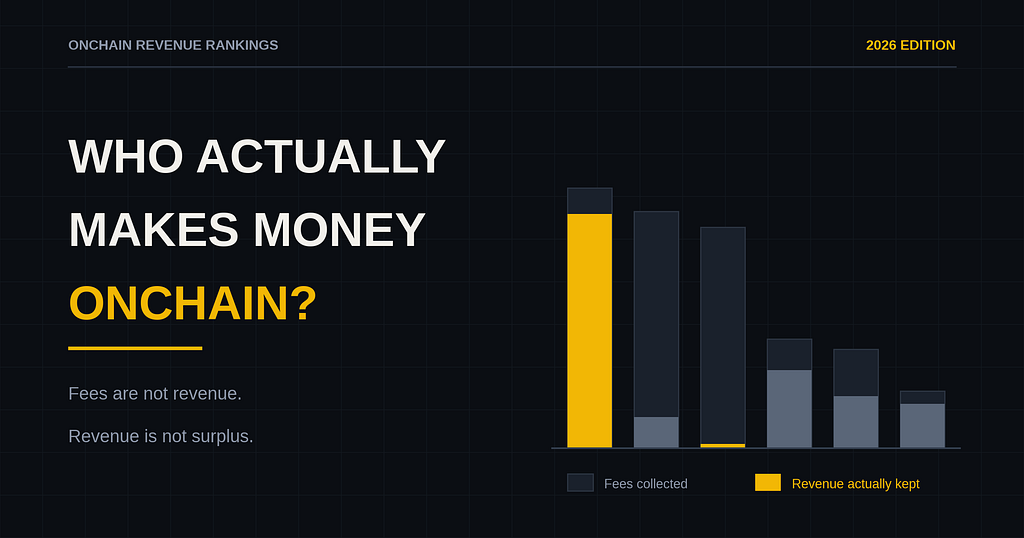
Fees are not revenue. Revenue is not surplus. The onchain revenue rankings look very different once you check the second number.
Fees measure how much money moves. Revenue measures how much a protocol keeps. Those are two different leaderboards.
Over a trailing year, Uniswap collected roughly $892 million in fees. It kept about $12 million.
Hyperliquid collected $1.05 billion. It kept $943 million.
Same industry. Same twelve months. Two completely different businesses.
That gap is the whole story of onchain revenue in 2026. It is also the reason most “highest revenue DeFi protocols” lists fall apart the moment you look past the headline number.
So let’s rank them properly. Then let’s look at the one protocol that publishes a quarterly income statement like a real company, and argue about whether it is paying out too little.
Which Are the Highest Revenue DeFi Protocols Right Now?
Short answer first, because you came here for a ranking.
By protocol revenue actually retained over a trailing year, per DefiLlama:
Hyperliquid — around $943MSky Protocol — around $209MJupiter — around $134MAave — around $127MUniswap — around $12M
Two caveats before anyone starts typing in the comments.
Third-party methodology is not the same as a protocol’s own accounting. Sky Protocol’s own monthly settlement cycles put its annualised gross run rate at $429.4M entering the second half of 2026.Several very large protocols read as near-zero revenue because their fees flow to suppliers rather than the treasury. Morpho and EigenCloud both look like that. Huge, but structurally different animals.
For scale, DefiLlama tracked $93.9 billion locked across all of DeFi on 21 September 2026.
The entire industry’s retained revenue still fits inside what a single mid-sized bank books in a quarter. Worth remembering before anyone declares victory.
Gross fees vs. retained protocol revenue, trailing-year annualised run rate. Source: DefiLlama, 2026.
Fees or Protocol Revenue: Which Number Actually Tells You Who Makes Money?
Three words get used interchangeably and they mean three different things.
Fees are what users pay. That is throughput, not income.Protocol revenue is what is left after liquidity providers, validators and incentives are paid.Surplus is what survives after the protocol covers its own operating costs.
Most rankings stop at the first one. That is how a protocol gets called a cash machine while it hands 98% of its take straight back out the door.
The number worth tracking is the revenue capture ratio: revenue divided by fees.
Hyperliquid: around 90%Aerodrome: around 77%Sky Protocol: around 53%Jupiter: around 30%Aave: around 13%Uniswap: around 1.4%Revenue capture ratio across major protocols. A low ratio is not automatically bad, but it tells you where the money stops. Source: DefiLlama, 2026.
A low capture ratio can be a deliberate growth choice. It can also be a business that never learned how to keep anything.
Where Does Sky Protocol’s Revenue Actually Come From?
This is where the model gets genuinely unusual, because it does not look like a trading venue at all.
Sky Protocol issues USDS and makes it available as wholesale liquidity. Independent capital allocators, together called the Sky Agent Network, borrow that liquidity at a governance-set Base Rate and put it to work.
Spark runs lending markets and is the largest by activityGrove handles institutional tokenized creditOsero operates a neobankObex incubates new allocators
Each agent keeps the spread it earns above the Base Rate. That spread is their business.
Their Base Rate payments then settle back to the protocol every month, alongside vault stability fees, real-world asset yield and Peg Stability Module fees.
So the revenue line is not one product with one demand curve. It is a portfolio of independent allocators competing for the same liquidity.
For scale: Total Protocol Collateral stood at $14.15B, against $11.48B in stablecoin supply, when I checked the dashboard on skyeco.com this week.
How Much Has Sky Protocol Made in 2026 So Far?
Published quarter by quarter by Sky Frontier Foundation, which is unusual in itself.
Q1 2026 — $123.79M Gross Protocol Revenue and $46.04M Net Protocol Surplus. The strongest quarter on record. DL News covered it here.Q2 2026 — $107.35M Gross Protocol Revenue, up 10.5% year on year. Net Protocol Revenue of $40.09M, up 25.1%. Net revenue margin widened from 33.0% to 37.3%.Five consecutive quarters in Net Protocol Surplus.Full-year 2025 landed at $338M. The published 2026 outlook is $611.5M.Sky Protocol quarterly revenue and surplus. The Q2 2025 figure is the negative surplus remitted to Sky Reserves. Q2 2026 was the fifth straight surplus quarter. Source: Sky Frontier Foundation.
One line deserves a pause. Operating expenses in June 2026 came in at $161K, against $9.89M in June 2025. That is not a rounding difference.
It is an organisational consolidation that turned a modest revenue increase into a much larger surplus increase.
Revenue growth gets the headline. Cost discipline did the heavy lifting.
Who Actually Gets Paid When a DeFi Protocol Makes Money?
Revenue is a vanity metric if you cannot trace where it lands. Here you can.
The Sky Savings Rate gets funded first. sUSDS holders are paid before anyone else in the stack.
What remains runs through the Stage 2 framework:
50% to the Surplus Buffer22.5% to SKY buybacks22.5% to USDS staking rewards5% to SKY buy and burnWhere surplus goes once the Sky Savings Rate is funded, and how far Sky Reserves have climbed toward the $150M floor. Source: Sky Frontier Foundation, Q2 2026.
Sky Reserves closed Q2 at $82.4M against a $150M Solvency Reserve target. Roughly 55% of the way there. Until that floor is met, reserve building outranks distributions.
Sky Governance made that call in March 2026, after S&P Global assigned Sky Protocol a B- issuer credit rating in August 2025, the first credit rating a major agency has given a DeFi protocol.
Why Is the Sky Savings Rate Only 3.6% When Revenue Is at a Record?
This is the question I see most often, and it is a fair one.
The Sky Savings Rate is a dial, not an output. Sky Governance sets it by onchain vote. It moved to 3.6% on 3 September 2026.
Turn the dial up and current sUSDS holders get paid more todayTurn it down and more surplus is retained, reserves fill faster, the protocol gets harder to break
Right now the dial is pointed at resilience rather than payout. You can argue that is too conservative, and plenty of people do.
What you cannot argue is that the tradeoff is hidden. Every change is proposed and voted onchain before it takes effect.
There is one wrinkle most coverage skipped. In July 2026, Sky Governance cut the Sky Spread from 0.1% to zero through the weekly Atlas Edit cycle, ratified onchain on 23 July.
Tiny number, real signal. More of the Base Rate now reaches savers instead of being retained as protocol margin.
Demand has not exactly collapsed in response. sUSDS supply reached $5.52B at the end of Q2 2026, up 149% year on year.
A published, governance-set rate is quietly one of the most useful things in onchain finance. It gives a treasury an actual discount rate for operating cash.
What Does Galaxy’s $100M sUSDS Position Tell Us About Onchain Revenue?
On 23 September 2026, Galaxy Digital (Nasdaq: GLXY) added $100 million of sUSDS to its corporate treasury and approved sUSDS as eligible collateral across its institutional trading business. Full announcement here.
The detail underneath the headline is the interesting part:
Galaxy’s institutional loan book averages $1.4 billionIt serves more than 1,600 trading counterpartiesClients who post sUSDS against a loan keep accruing the Sky Savings Rate on the full position for as long as the loan runsGrove already provides Galaxy a $500 million warehouse lending facilityThe demand side. sUSDS supply nearly tripled year on year while institutional collateral use expanded. Source: Sky Frontier Foundation Q2 2026 and skyeco.com.
That is collateral doing two jobs at once, which is the thing traditional cash management cannot do.
Zoom out and the trend line is the same everywhere. Onchain real-world assets, excluding stablecoins, passed $33 billion in July 2026, roughly four times their level in early 2025, per rwa.xyz. Revenue rankings follow that kind of capital flow, with a lag.
How Do You Verify Any of These Revenue Numbers Yourself?
Please do not take a ranking on trust. Mine included.
info.skyeco.com — live TVL, collateral composition, and the current state of USDS and sUSDSfinancial.skyeco.com — the balance sheet, Gross and Net Protocol Revenue, Protocol Surplus and Sky Reservesinsights.skyeco.com — the quarterly reports and monthly financial updates published by Sky Frontier FoundationDefiLlama’s Sky page — an independent cross-check with a different methodology
If two sources disagree, that is usually a methodology difference rather than a scandal. Read both.
So Who Actually Makes Money Onchain?
If “makes money” means fee throughput, Hyperliquid wins and it is not close.
If it means retained protocol revenue with a published income statement, audited security reviews and a credit rating behind it, the field narrows very fast.
And here is the thing I would actually like to argue about in the comments.
Should a protocol build reserves to a hard floor before paying holders in full? Or pay holders now and raise reserves later?
Sky Governance chose the first, and capped distributions until reserves hit $150M. Ethena, Hyperliquid and Aave have each answered it differently.
Which side are you on? And which protocol do you think will top the onchain revenue rankings twelve months from now?
Drop it below. I read every response.
Highest Revenue DeFi Protocols in 2026: Who Actually Makes Money Onchain? was originally published in Coinmonks on Medium, where people are continuing the conversation by highlighting and responding to this story.