
Three payment models that look identical on a slide deck and feel nothing alike in real life
A founder I’ll call Dev launches a small booking app for salons. In week one, a customer pays for a haircut. Dev checks his dashboard, sees the money, and assumes payments are basically solved.
Then a chargeback arrives. Then a compliance email. Then a question from his payment provider that he can’t answer: who, exactly, is responsible here?
That question is why this article exists. ISO, PayFac and acquirer get tossed around like synonyms. They aren’t. Pick the wrong one and you’ll find out at the worst possible time.
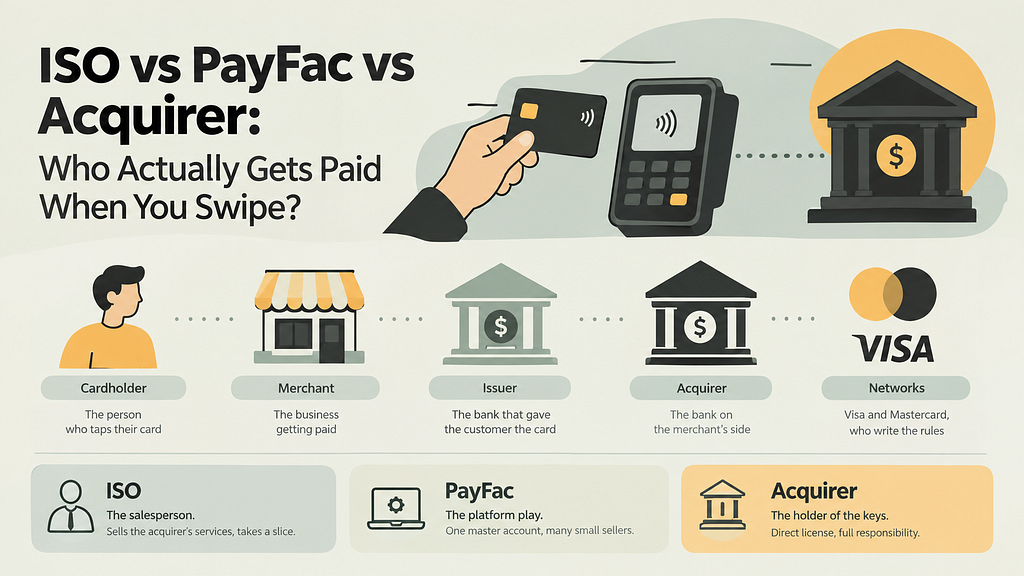
ChatGPT Generated Image
Four players and a referee
Strip away the jargon and every card payment involves the same cast:
Cardholder: the person tapping their cardMerchant: the business getting paidIssuer: the bank that gave the customer the cardAcquirer: the bank on the merchant’s sideNetworks: Visa and Mastercard, who write the rules
ISOs and PayFacs squeeze in on the merchant side. What separates them is who holds the license, who absorbs losses, and who owns the customer.
The acquirer: holder of the keys
An acquirer is a licensed bank with direct membership in the card networks. It vets merchants, settles funds, and takes the fall when things break. If a merchant disappears owing thousands in chargebacks, the acquirer gets the call.
Going direct gets you the cheapest rates, but only at serious volume. Getting there means capital requirements, PCI DSS audits, and onboarding that can take weeks. Most small businesses never talk to one. Honestly, most wouldn’t enjoy it.
The ISO: the salesperson
An Independent Sales Organization resells an acquirer’s services. It finds merchants, signs them up, and collects a slice of their processing fees for as long as they stay. It doesn’t hold funds and has no license of its own.
In practice that means:
Each merchant signs its own account with the acquirerEvery business is underwritten individuallySupport is personal, often local, and often includes terminalsYou get little say over pricing, tech, or payout speed
This suits restaurants, clinics and corner shops, where a person answering the phone beats a well-documented API. Unglamorous. Effective.
The PayFac: the platform play
A payment facilitator is a merchant of record that brings many small sellers under one master merchant account. Stripe and Square made the model famous. Instead of forms and a two-week wait, a PayFac can approve a seller in minutes using automated checks.
The price of that speed is responsibility. Fraud, chargebacks and sub-merchant compliance land on the PayFac first, and the acquirer holds it accountable. What you get back: control over checkout, pricing and payout timing, plus the customer data. For a software company, that’s the prize.
A mall, because analogies help
Think of a shopping mall. The acquirer owns the building and writes the lease rules. The ISO is the leasing agent who finds tenants and takes a commission. The PayFac is a master tenant who sublets small stalls to dozens of vendors, sets their terms, and answers to the owner when one of them causes trouble.
Side by side
Licensing: the acquirer has full membership, the ISO borrows it, the PayFac operates under sponsorshipSpeed: acquirers are slow, ISOs moderate, PayFacs nearly instantRisk: acquirers carry the final liability, PayFacs carry sub-merchant risk, ISOs carry the leastBest fit: enterprises, traditional shops, software platforms
Who makes money, and how
Every payment has layers: interchange to the issuer, network fees, then a markup on top. Who keeps that markup depends on the model.
Acquirers earn thin margins on enormous volumeISOs earn residuals, a monthly share of each merchant’s fees, plus equipment salesPayFacs keep the spread between the wholesale rate they pay and the flat rate they charge
That spread explains why so many software companies want in. Payments can turn a subscription product into a second business.
So which one do you pick?
There’s no universal answer, but there are patterns.
Choose an ISO if you run a traditional business and want a quick start, real human support, and hardware included.Become a PayFac if you run a platform or marketplace and want smooth onboarding, branded checkout, and payments revenue.Go direct to an acquirer if your volume is huge and your team can handle risk, compliance and integration alone.
Where people trip up
The same mistakes keep showing up, and most are avoidable:
Underestimating compliance. PayFacs deal with PCI DSS, KYC and constant monitoring. None of it is optional.Shrugging off chargebacks. Disputes hit the PayFac first, and a high ratio can end the acquirer relationship overnight.Skimming the contract. ISO agreements sometimes hide early termination fees and long lock-ins.Building too soon. Full PayFac status costs real money, and plenty of startups aren’t ready.
The middle path
Which brings us back to Dev. He doesn’t need to become a PayFac yet. He needs PayFac-as-a-Service: PayFac-style onboarding while a partner handles underwriting, compliance and risk.
He launches faster, keeps a good chunk of the revenue, and can graduate to full PayFac status once volume justifies the bill.
Questions to ask before you sign
Before committing to anything, sit down with these:
How many merchants will you onboard, and how fast?Do you need control over checkout and payouts?Can your team realistically handle fraud and compliance?Is payments revenue central to your plan, or a bonus?What’s your budget and launch timeline?
Where this is heading
The boundaries are blurring. Big acquirers now sell embedded payments, ISOs are bolting on software, and PayFacs are chasing direct bank relationships. Card networks keep tightening sub-merchant onboarding rules too, so strong risk controls matter more every year.
Bottom line
These three aren’t rivals so much as layers of one stack. The acquirer builds the rails, the ISO sells access, and the PayFac wraps it all into something people actually enjoy using.
Match the model to your stage. New and small? Keep it simple. Payments central to revenue? Push for control. Massive volume? Talk to an acquirer directly. Get that call right early and payments stop being a headache.
ISO vs PayFac vs Acquirer: Who Actually Gets Paid When You Swipe? was originally published in Coinmonks on Medium, where people are continuing the conversation by highlighting and responding to this story.