
The financial industry is increasingly exploring blockchain-based applications that can provide new approaches to lending, borrowing, asset management, and other financial activities. One of the important areas within decentralized finance is the development of lending and borrowing platforms.
Unlike traditional lending models that generally involve financial intermediaries, DeFi lending platforms use blockchain networks, decentralized applications, and smart contracts to automate predefined processes. This creates an environment where lenders and borrowers can interact through a decentralized application according to the rules encoded in the underlying smart contracts.
What Is DeFi Lending and Borrowing?
DeFi lending and borrowing refers to financial applications built using blockchain technology where lending and borrowing activities can be facilitated through decentralized applications and smart contracts.
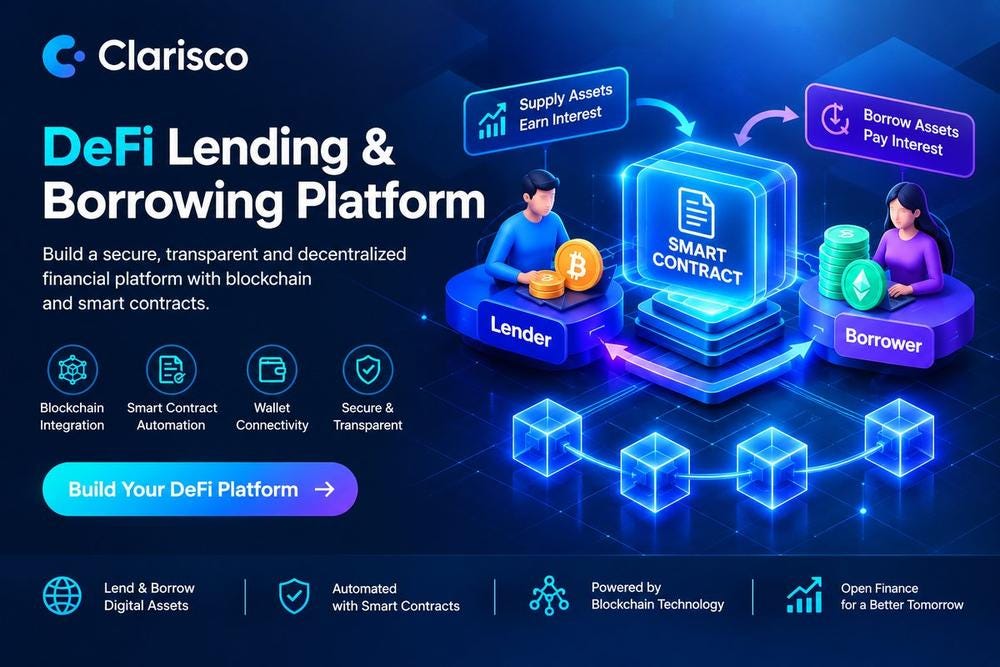
In a typical DeFi lending model, a lender can provide funds through the platform, while a borrower can access funds according to the platform’s predefined conditions. Smart contracts can automate specific processes when the required conditions are met.
This model is commonly associated with peer-to-peer lending and decentralized financial applications. Clarisco’s current platform page describes DeFi lending/borrowing as a combination of blockchain, DApps, and smart contracts.
How Does a DeFi Lending Platform Work?
A DeFi lending platform generally connects lenders and borrowers through a blockchain-based application.
The basic workflow can involve:
A user connects to the decentralized application.A lender provides supported digital assets.A borrower requests or accesses a loan according to the platform’s rules.Smart contracts execute predefined conditions.Interest and repayment terms are handled according to the protocol.Blockchain transactions provide a record of relevant activities.
The exact workflow depends on the platform’s architecture, supported assets, smart contracts, risk parameters, and business requirements.
Businesses planning this type of application can explore DeFi Lending Platform Development to understand the development approach, platform components, and possible functionality.
Role of Smart Contracts in DeFi Lending
Smart contracts are an important component of decentralized lending applications.
A smart contract is code deployed on a blockchain that can execute predefined actions when specified conditions are met. In a DeFi lending environment, smart contracts can be designed to manage parts of the lending process without requiring every transaction to be manually handled by an intermediary.
This can support automation and transparency in the platform’s operations. Clarisco’s page specifically describes smart contracts as a mechanism for executing predefined processes on DeFi lending and borrowing platforms.
What Is Open Finance?
DeFi is also commonly associated with the broader concept of open finance.
The Clarisco page describes open finance as covering activities such as trading, investment, borrowing, risk management, and lending. Blockchain-based applications and smart contracts can be used to automate parts of these processes.
For businesses, this creates opportunities to develop financial applications around specific use cases rather than relying exclusively on conventional centralized architectures.
DeFi Lending Platform Development
Developing a DeFi lending platform requires more than simply creating a user interface.
A complete development project can involve:
Blockchain integrationSmart contract developmentLending and borrowing logicWallet integrationDigital asset managementInterest and repayment mechanismsUser dashboardsTransaction trackingSecurity considerationsPlatform testingBackend and frontend development
The architecture should be designed according to the intended business model and supported financial functionality.
Businesses looking to create their own decentralized lending application can explore DeFi Lending Platform Development for additional information.
DeFi Lending and Borrowing Platform Development
DeFi Lending and Borrowing Platform Development focuses on building an application where lending and borrowing functions can operate through blockchain-based infrastructure.
A platform may be designed around different requirements, such as:
Lender Functionality
Lenders can provide supported digital assets through the platform according to the protocol’s rules.
Borrower Functionality
Borrowers can interact with the platform to access available lending mechanisms according to predefined conditions.
Smart Contract Automation
Smart contracts can automate specified actions and enforce the conditions programmed into the protocol.
Wallet Connectivity
Users can interact with blockchain applications through compatible wallets, depending on the platform architecture.
Transaction Visibility
Blockchain technology can provide transaction records that can be verified on the relevant network.
Why Businesses Are Exploring DeFi Lending
DeFi lending can provide businesses with a framework for creating blockchain-based financial applications.
Potential areas of focus include:
Automation: Smart contracts can automate predefined financial processes.
Peer-to-Peer Interaction: DeFi lending can facilitate direct interaction between lenders and borrowers through decentralized applications.
Blockchain-Based Records: Transactions can be recorded on the underlying blockchain.
User Asset Control: Blockchain wallets can provide users with control over their supported digital assets.
Programmable Financial Logic: Smart contracts allow developers to encode specific rules into the platform.
These capabilities need to be implemented carefully according to the project’s technical and regulatory requirements.
Important Considerations Before Building a DeFi Lending Platform
Before starting development, businesses should define their platform requirements.
Some important considerations include:
Which blockchain network will be used?Which digital assets will be supported?How will lending and borrowing work?How will interest rates be calculated?What smart contracts are required?How will wallets be integrated?What security measures are required?How will the platform be tested?What user roles are needed?What regulatory requirements apply to the intended jurisdiction?
The answers to these questions can influence the development architecture and overall project scope.
DeFi Lending Platform Development With Clarisco
Clarisco’s current page presents its DeFi lending and borrowing development services around blockchain, smart contracts, and decentralized applications. The company states that its team works on DeFi development, blockchain protocols, asset tokenization, and smart contract development.
For businesses planning a decentralized lending application, the development process should begin with the business model, platform requirements, supported assets, technical architecture, and security considerations.
Conclusion
DeFi lending and borrowing represents one application area where blockchain technology and smart contracts can be combined to create decentralized financial platforms.
From peer-to-peer lending to automated smart-contract-based processes, businesses can explore different approaches to developing financial applications based on their requirements.
If you are researching DeFi Lending Platform Development or DeFi Lending and Borrowing Platform Development, understanding the underlying blockchain architecture, smart contracts, user workflows, security requirements, and platform functionality is an important starting point.
DeFi Lending and Borrowing: How Blockchain Is Reshaping Digital Finance was originally published in Coinmonks on Medium, where people are continuing the conversation by highlighting and responding to this story.