
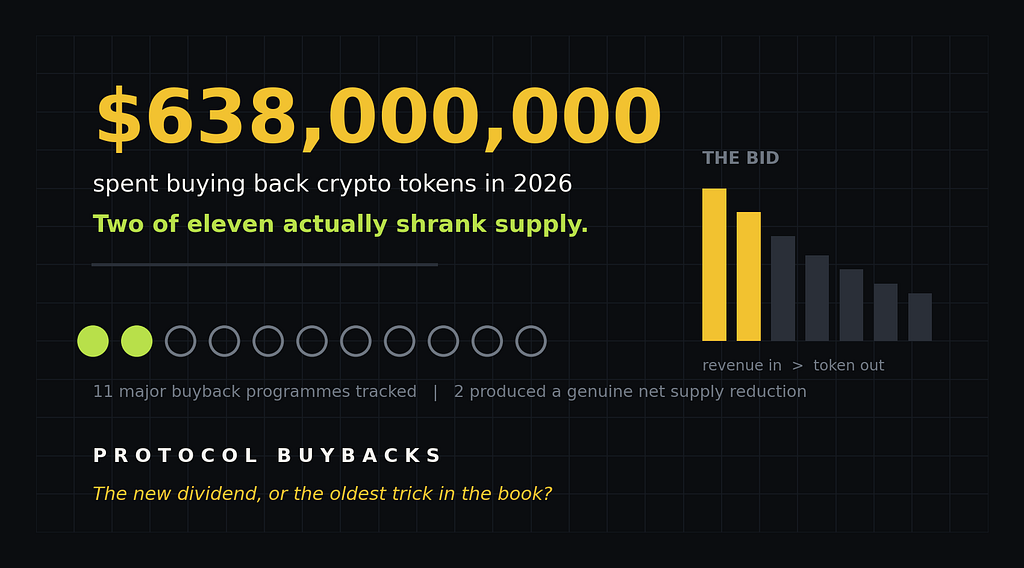
$638 million spent in 2026. Only two tokens actually shrank supply. A look at what separates a real protocol buyback from a press release.
Crypto protocols spent $638 million buying back their own tokens in 2026. Only two of eleven tracked programmes produced a genuine net supply reduction.
In 2024, crypto protocols spent a grand total of $366,000 buying back their own tokens.
Not million. Thousand.
By the end of August 2026, that number was $638 million.
Something shifted, and it happened fast enough that most people are still repeating talking points from a market that no longer exists.
Short answer before we go deeper: protocol buybacks work, but only under three conditions. The revenue has to be real. The spend has to outrun new supply. And the balance sheet has to be strong enough to afford the spend in the first place.
Most programmes fail at least one of those tests. Here are the receipts.
What is a protocol buyback in crypto, and why is every project suddenly running one?
The mechanic is simple. A protocol takes revenue it actually earned, goes to the open market, and buys its own token. Then it either burns that token or holds it in a treasury.
It is the onchain version of a share repurchase, with one real advantage. You can verify the whole thing yourself on a block explorer.
Why the sudden rush? Because tokens spent a decade with no clean answer to a very basic question. What do I actually own?
A share gives you a claim on earnings and a legal wrapper around it.A token usually gives you a vote and a vibe.A buyback is the closest thing crypto has built to a cash flow link.
That is also exactly why calling it a dividend is wrong. I will come back to that at the end.
Do crypto protocol buybacks actually work? The 2026 scoreboard is brutal
Allium Labs tracked $638 million in buybacks between 1 January and 31 August 2026, a figure the Financial Times reported. That is up 17% from $545 million over the same window in 2025.
From $366,000 in all of 2024 to $638 million in eight months of 2026. Note the log scale, because a linear one would not fit on the page. Source: Allium Labs via the Financial Times.
Sounds like a healthy, maturing trend. It is not, at least not yet.
Hyperliquid alone accounted for roughly $370 million, routing 99% of eligible trading fees into automated HYPE purchases.Pump.fun added around $200 million, committing 50% of designated revenue to buy and burn.Together those two are close to 90% of the entire year.Chainlink sits near $30 million. Sky Protocol near $26 million.The headline number hides the concentration. Two protocols account for almost all of it. Source: Allium Labs.
Now the part that should make you uncomfortable. Of eleven major buyback tokens tracked this year, only two, BNB and RAY, achieved a genuine net reduction in circulating supply. Everything else was cancelled out by unlocks and ongoing emissions.
Uniswap is the cautionary tale. UNI is down roughly 50% since its buyback and burn programme began.
Aave is the reality check. In March 2026 its DAO cut the annual buyback budget from $50 million to $30 million, a 40% reduction, after borrow fee revenue fell 25%.
A buyback is not a price floor. It is a bid. Bids get overwhelmed.
The buyback coverage ratio: the one number nobody puts in the press release
If you remember one thing from this post, make it this.
Coverage ratio equals buyback spend divided by the market value of new supply issued over the same period.
Below 1, the float is still growing. The buyback is a partial offset, not a reduction.Above 1, supply genuinely tightens.The single test that separates a supply reduction from a partial offset. Most programmes score below 1.
Run that maths on most programmes and the result is embarrassing. A protocol can commit a quarter of its revenue to buybacks, execute honestly, publish every transaction, and still watch its float grow by 2% because the vesting cliff sitting next to it was eight times larger.
Nothing went wrong in that scenario. The announcement was simply smaller than the unlock schedule.
Thirty seconds of arithmetic saves you from most buyback marketing.
Why Sky Protocol cut its own buyback by 87%, and why that was the bullish signal
Here is the case that breaks the pattern.
In Q1 2026, Sky Protocol was running one of the most aggressive programmes in DeFi.
It repurchased 319 million SKY, deployed $41.29 million, and executed 3 to 5 million SKY a day, funded by 75% of Net Protocol Surplus.
Then on 14 March 2026, Sky Governance voted to cut that allocation from 75% to 7.5%.
An 87% reduction. Voluntarily. During a quarter that produced a record $123.79 million in Gross Protocol Revenue.
The money went into reserves instead, with a $150 million Solvency Reserve target attached to the vote.
That is the opposite of what a protocol optimising for a price chart does. And it worked.
Q2 2026 delivered $107.35 million in Gross Protocol Revenue, a second consecutive quarter above $100 million and a fifth consecutive surplus quarter.$29.87 million was remitted to Sky Reserves, against an $8.15 million deficit in the same quarter a year earlier.Sky Reserves reached $82.40 million against the $150 million target.Protocol Collateral hit $12.32 billion, up 45.5% year over year.Sky Reserves climbed from $50.90 million to $82.40 million in a single quarter while buybacks were throttled to 7.5% of Net Protocol Surplus. Target is $150 million.
In August 2026 the buyback scaled back up under Stage 2 of the staking rewards framework.
Each month’s Protocol Surplus now splits four ways. 22.5% to SKY buybacks funding SKY Staking Rewards.
22.5% to USDS Staking Rewards. 5% to SKY buy and burn. Up to 50% continuing into the Surplus Buffer.
Stage 2, live since August 2026. Half of every month’s Protocol Surplus still goes to the Surplus Buffer before a single token is repurchased.
Reserves first. Buybacks second. That sequencing is the entire argument.
The market has partially caught on. Research by analyst Bill Hsu found that of ten major tokens with active buyback programmes, only three outperformed Bitcoin during their buyback windows. AAVE, HYPE and SKY.
Where the Sky Savings Rate, sUSDS and USDS fit into all of this
This is the part most buyback coverage skips, and it is the part that decides whether a programme survives a downturn.
A buyback is only as durable as the engine behind it.
Sky’s engine is not perp fees. It looks like this.
USDS is the foundational stablecoin. Stablecoin supply currently sits near $11.48 billion against roughly $14.15 billion in Total Protocol Collateral.The Sky Agent Network, made up of independent allocators including Spark, Grove, Keel, Obex and Osero, borrows USDS at a governance-set Base Rate and deploys it across diversified strategies.Those payments pool into Protocol Revenue.Governance then sets the Sky Savings Rate from that revenue. It currently sits at 4.00% APY.sUSDS is how anyone accesses it. Supply reached $5.52 billion at the end of Q2, up 149% year over year.Whatever remains funds reserves, staking rewards, and the buyback. Every line of it is published quarterly.
So the buyback sits downstream of a savings product, not a trading desk. That is a structurally different cash flow to fee revenue that evaporates the moment volumes cool.
External validation arrived on 23 September 2026. Galaxy Digital added $100 million of sUSDS to its corporate treasury and approved sUSDS as eligible collateral across an institutional trading business carrying a $1.4 billion average loan book.
Clients who post sUSDS against a loan keep accruing the Sky Savings Rate on the full position for as long as the loan runs.
Capital that earns while it works as collateral. That is what a real revenue engine buys you.
How to judge any crypto protocol buyback in 60 seconds
Five questions. Use them on anything, including Sky.
Where does the money come from? Actual revenue, or treasury tokens being recycled into the market?What is the coverage ratio? Spend versus new supply in the same window. Nothing else matters as much.Burned or held? Held tokens can come back. Burned tokens cannot.Rule-based or discretionary? Discretionary programmes have a habit of buying high and going quiet at the bottom.Is the balance sheet solvent first? A buyback funded ahead of reserves is a dividend paid out of the fire extinguisher.
So, is a protocol buyback actually a dividend?
No. And anyone telling you otherwise is selling you something.
A dividend is a legal entitlement. A buyback is a market mechanism. Tokenholders generally have no enforceable claim on protocol cash flows, and that distinction gets quietly dropped from most tokenomics threads.
What a well-designed buyback does deliver is signal. It says this protocol earns money, is willing to prove it onchain, and chose to return capital rather than spend it elsewhere.
That is not nothing. Across the last year, 197 protocols returned $2.11 billion to holders and most of their tokens still fell. Verifiable beats promised.
So the better question is not whether a protocol runs a buyback.
It is this. Could it stop, and would anything break?
For Sky, that was tested in March. It stopped. Reserves grew. Revenue kept compounding. The programme came back larger and better structured than before.
Most protocols have never had to answer that question. Which is exactly why you should ask it.
Your turn. Which buyback do you think is actually working, and which one is pure theatre? Drop the ticker in the comments and I will run the coverage ratio on the three most mentioned.
Crypto Protocol Buybacks Are the New Dividend. Do They Actually Work? was originally published in Coinmonks on Medium, where people are continuing the conversation by highlighting and responding to this story.