
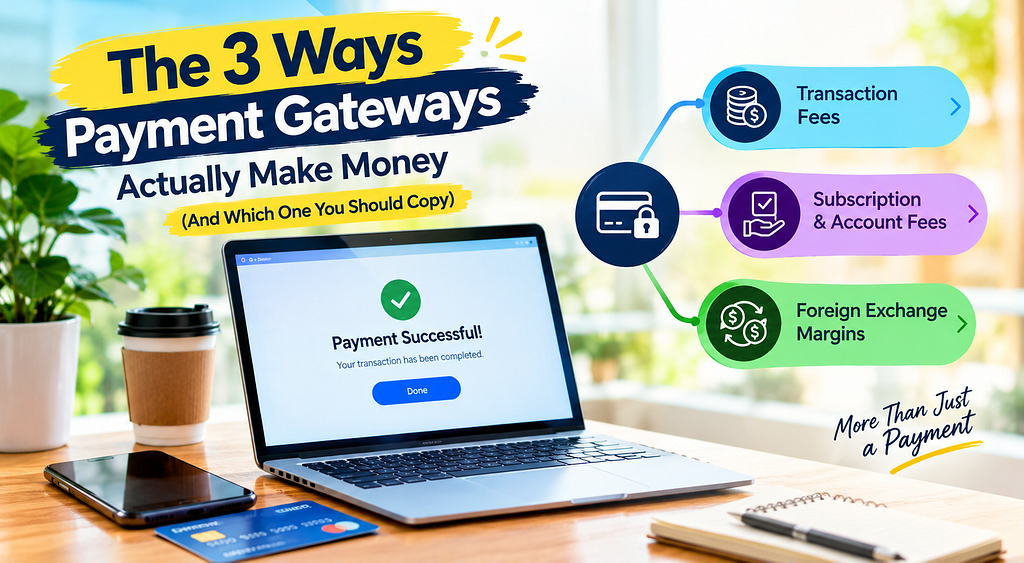
The global payment processing market is on track to hit $71.8 billion in 2026. Here’s exactly how that money gets made and why picking the wrong pricing model can quietly bleed your margins before you even notice.
AI Generated Image
Every payment gateway founder eventually asks the same question a merchant does when comparing processors:
how do you actually price this thing so it makes money without scaring off the businesses you’re trying to sign up?
Here’s the part that doesn’t get said enough, there isn’t one right answer. There are three dominant revenue models running the industry right now, and each one wins with a completely different type of customer.
Picking based on what sounds simplest, rather than who you’re actually serving, is one of the more common ways new gateway businesses quietly cap their own growth.
Model 1: Flat-rate pricing (simple, but built for volume, not margin)
This is the model most people already know without realizing it.
Stripe charges 2.9% plus 30 cents on standard online transactions. Square runs 2.6% plus 10 cents for card-present sales.
One blended percentage, applied to every transaction, regardless of which specific card a customer swipes.
The appeal is obvious: total predictability. A merchant doing $10,000 in monthly card sales can estimate their fees to the dollar without understanding a single thing about interchange categories. For a gateway business, that simplicity is the entire product, instant approval, same-day onboarding, and a pricing sheet that fits in one sentence.
The catch, and it’s a real one, sits underneath that simplicity. Flat-rate pricing has to be set high enough to cover the most expensive card types a customer might swipe, premium rewards cards, corporate cards, cards with steep interchange costs baked in.
That means the gateway is effectively overcharging on cheap debit transactions to subsidize the pricier ones. It works beautifully for low-volume, low-complexity merchants who value simplicity over savings.
It becomes a genuinely bad deal fast for anyone processing serious volume, which is exactly why merchants doing more than roughly $30,000 to $50,000 a month tend to migrate away from it.
Model 2: Interchange-plus (the transparent, scale-friendly option)
This is the model that wins once a merchant’s volume gets large enough that a percentage point actually means real money. Instead of bundling everything into one number, interchange-plus separates the fee out into two visible pieces:
the actual wholesale interchange rate set by the card networks, plus a clear, disclosed markup from the processor, typically somewhere between 0.10% and 0.40%, plus a small per-transaction fee.
For a gateway business, this model is less about flashy simplicity and more about earning trust through transparency, then monetizing at scale. The markup itself is thin on any single transaction, but it compounds meaningfully across high volume.
It’s also the model regulators and savvier merchants increasingly prefer, because it removes the guesswork, nobody’s quietly getting overcharged to subsidize someone else’s rewards card.
The tradeoff for a gateway offering this model is complexity. Interchange-plus statements require merchants to actually understand what they’re reading, and gateways have to build out the reporting and support infrastructure to make that transparency genuinely useful rather than just confusing.
Done well, though, it becomes a real competitive advantage, the pitch practically writes itself:
“see exactly what you’re paying, and exactly what we’re keeping.”
Model 3: Subscription plus value-added services (where the real margin lives)
Here’s the model that’s quietly reshaping the industry in 2026, and it’s the one newer gateway businesses should be paying closest attention to.
Some processors, Payment Depot and Stax among them, have shifted toward a flat monthly membership fee (often around $99 a month) combined with interchange-plus pricing that drops the percentage-based markup entirely, replacing it with a small flat fee per transaction instead.
That structure changes the entire revenue logic. Instead of earning a sliver of every dollar processed, the gateway earns predictable recurring revenue from the subscription itself, then layers additional monetization on top, fraud prevention tools, PCI compliance management, surcharge engines that pass card costs back to the end customer, foreign exchange handling, and increasingly, lending or cash-advance products built directly into the payment flow.
Industry data shows the shift is real and fast: in January 2026 alone, 74% of new retail merchant accounts opted into some form of dual or bundled pricing model rather than a single traditional fee structure.
This is genuinely the model with the best long-term unit economics for a gateway business, because it turns a thin-margin transaction business into something closer to a SaaS company with payment volume attached.
The recurring subscription smooths out revenue predictability, and the value-added services, the tools merchants actually rely on daily, build real switching costs that a pure percentage-based competitor can’t easily replicate.
So which one should you actually build around?
If your target customer is small, low-volume, and values dead-simple pricing above all else, flat-rate remains a legitimate entry point, it’s just worth knowing you’re optimizing for ease of adoption over long-term margin. If you’re chasing merchants doing real volume who care about transparency and fair pricing, interchange-plus builds the kind of trust that keeps accounts from churning to a cheaper competitor.
And if you’re building for the long game, the subscription-plus-services model is where the industry’s smartest operators are already migrating, because it’s the only one of the three that doesn’t leave your entire revenue line hostage to transaction volume alone.
The businesses winning in payments right now aren’t necessarily the ones with the lowest rate.
They’re the ones that figured out pricing isn’t really about the percentage sign at all, it’s about which problem you’re actually solving for the merchant standing on the other side of the transaction.
The 3 Ways Payment Gateways Actually Make Money (And Which One You Should Copy) was originally published in Coinmonks on Medium, where people are continuing the conversation by highlighting and responding to this story.