
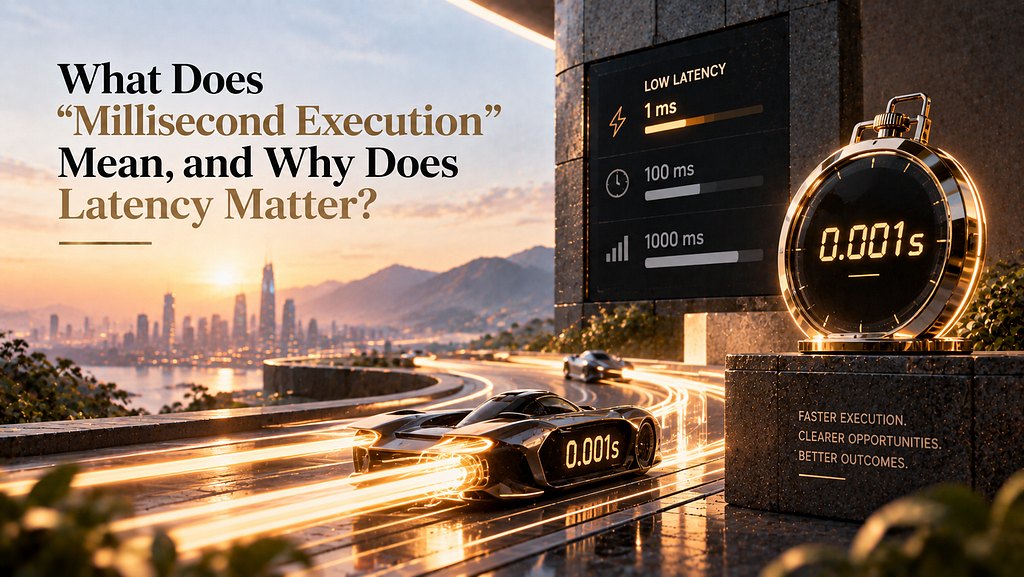
Learn what millisecond execution means, why latency matters in crypto trading, and how real-time market intelligence can improve trading decisions.
In crypto trading, a few seconds can change the market.
Prices can move, liquidity can disappear, trading volume can suddenly increase, and new information can reach the market almost instantly. This is why latency has become an important part of modern crypto trading infrastructure.
You may have heard platforms talk about millisecond execution, but what does it actually mean, and why does speed matter?
What Is Latency in Crypto Trading?
Latency is the amount of time it takes for information or an action to travel from one point to another.
In trading, this could mean the time between:
A market event occurring and the data reaching a platformA trader submitting an order and the exchange receiving itAn order being received and executedNew market information being processed and presented to the trader
The lower the latency, the faster these processes can happen.
When a platform describes its infrastructure as operating at millisecond speeds, it generally means certain parts of its data processing or execution process can happen within milliseconds rather than seconds.
Why Do Milliseconds Matter?
Crypto markets operate continuously and can change rapidly.
Imagine Bitcoin suddenly moves because of a major market development. Within a very short period, trading volume may increase, liquidity can shift, and traders across different markets may react.
A delay of several seconds can mean that the information a trader is looking at no longer represents the exact market conditions that existed when the event first occurred.
This is where real-time market intelligence becomes important.
The objective is not simply to receive information quickly. It is to receive, process, and understand relevant information quickly enough for it to remain useful.
Speed Is More Than Order Execution
When people hear “millisecond execution,” they often think only about how quickly an order is placed.
Execution speed is certainly important, but latency can affect several other parts of the trading process.
A modern trading system may need to process price movements, liquidity changes, on-chain activity, derivatives data, market sentiment, and breaking news.
If that information arrives late, the trader may be working with an outdated picture of the market.
This is why crypto market intelligence increasingly depends on both speed and context.
Fast data without meaningful interpretation can still leave traders trying to figure out what actually matters.
Latency vs. Market Intelligence
Speed and intelligence solve different problems.
Latency answers:
“How quickly did the information arrive?”
Market intelligence asks:
“What does this information mean in the context of everything else happening?”
For example, a platform may detect a sudden increase in trading volume within milliseconds.
That is useful, but the next question is whether the increase is connected to a major announcement, a liquidity change, derivatives activity, or unusual on-chain movement.
Combining fast data processing with contextual analysis can provide a more complete view of market activity.
This is one reason AI-powered crypto trading platforms are increasingly focused on processing information in real time.
Where AI Can Help
AI can process large amounts of market information much faster than a person manually checking multiple sources.
It can help identify changes across different datasets and bring potentially relevant information together.
For example, an AI trading intelligence system could detect:
A sudden price movementUnusual trading volumeChanges in liquidityLarge on-chain transactionsShifts in derivatives activityRelevant breaking news
The value comes from connecting these developments rather than treating each one as an isolated alert.
For traders, this can reduce the time spent searching through fragmented information and make real-time crypto market intelligence more accessible.
Does Faster Always Mean Better?
Not necessarily.
A platform can process information extremely quickly, but speed alone does not guarantee better trading decisions.
If a system delivers hundreds of alerts without explaining their relevance, the trader can still be overwhelmed.
The real advantage comes from combining low latency, reliable data, and useful context.
In other words, the goal is not simply to know something milliseconds earlier.
It is to understand what changed while that information is still relevant.
Why Latency Is Becoming More Important
As crypto markets become more automated and interconnected, the time between an event and a market reaction can continue to shrink.
Traders are therefore looking beyond traditional charts and isolated indicators. They increasingly need access to information that is timely, comprehensive, and connected to the wider market.
This is where platforms focused on AI trading intelligence and crypto market intelligence can play a role.
i5, for example, focuses on real-time market intelligence designed to help traders understand market activity as it develops, rather than relying only on delayed or fragmented information.
Final Thoughts
Millisecond execution is ultimately about reducing the time between an event, information processing, and action.
In fast-moving crypto markets, that time can matter.
But speed is only one part of the equation. The bigger challenge is turning fast-moving data into useful market context.
The future of crypto trading may therefore depend not only on how fast information arrives, but also on how quickly traders can understand what that information means.
What Does “Millisecond Execution” Mean, and Why Does Latency Matter? was originally published in Coinmonks on Medium, where people are continuing the conversation by highlighting and responding to this story.