
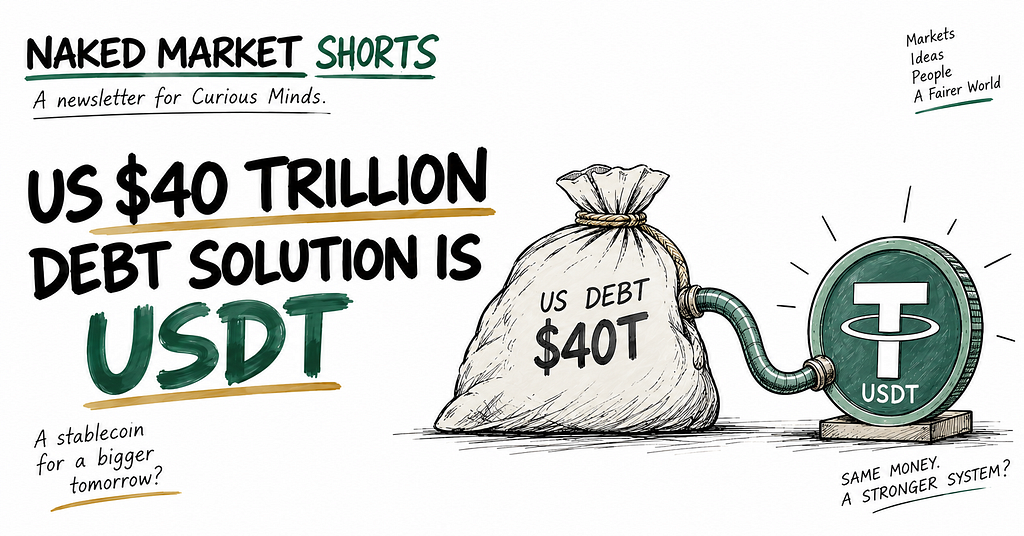
Behind the $1 promise is a much bigger story.
I want to show you a trick.
Its almost a hundred years old. Its completely legal. Nobody goes to jail for it. And a new version of it is running, right now, inside an app that sits on half the planet’s phones. Maybe on yours.
Let me show you what it looks like from the ground.
Somewhere in Buenos Aires, a woman who runs a small shop is moving her savings out of pesos and into a token on her phone. Shes not a “crypto person.” Shes never read a whitepaper and never wants to. And honestly? Shes doing the smartest thing she can.
Because if she had kept ten thousand dollars in pesos for ten years, shed be left with about a hundred and fourteen. Read that again. Ten thousand, down to a hundred and fourteen. So she does what millions of people in Lagos, Istanbul, Cairo and Manila are doing. She buys a digital dollar. USDT. One token, one dollar. Nothing feels safer than that.
And that safe feeling is exactly where the trick lives.
That little equation she trusts, the one that lets her sleep at night, 1 USDT = 1 dollar, is not as solid as it looks. The same equation fooled a whole country back in 1934. They also thought a dollar was a dollar. They were right, on paper. It still cleaned them out.
Quick thing before we open this up. If youre new here, welcome. Naked Market has one job, and its right there in our pinned welcome post: we take the market’s clothes off and stare at the machine underneath. And nothing here is me telling you to buy or sell anything. Im not selling tips. Im showing you how the machine works. What you do next is your call.
So. Let me tell you about the biggest debt-wipe in modern history, and how the people who pulled it off never broke a single rule.
The trick that broke no laws
Picture America in early 1933. The banks are falling over. And theres one promise, written into almost every serious contract in the country, that everybody trusts. Its called the gold clause. It says: if you owe me money, you can be made to pay me in gold, or in paper worth that much gold. Lenders loved it. It was their seatbelt.
Back then a dollar was legally worth a fixed slice of gold. 20 dollars and 67 cents bought a full ounce. That was the law since 1900. A dollar wasnt a vague feeling. It was a receipt for real metal, and you could walk into a bank and pick it up.
Then, in three moves across ten months, Roosevelt quietly changed what a dollar even was.
Move one, April 1933. Every American had to hand in their gold, coins and bars and certificates, to the government by the first of May. The price they were paid? The old one. 20.67 an ounce. Say no and you were looking at up to ten years in prison. Most people just handed it over.
Move two, June 1933. Congress killed the gold clause. All of them, in every contract, old and new. The seatbelt was cut out of the car. And it happened fast, before anyone could argue. If youd lent money expecting gold back, too bad. Youd get paper now.
Move three, January 1934. Roosevelt announced a new price for gold. 35 dollars an ounce. Overnight, gold jumped 69 percent. Which is another way of saying the dollar lost about 41 percent of its value against gold. Same word, “dollar.” Suddenly worth a lot less.
Now look at what those three moves did together. The government was the biggest borrower in the country. It owed mountains of dollars. By killing the gold clause and then cutting the dollar’s value, every one of those debts got paid back in cheaper money. By one estimate, around 40 percent of all debt in America, public and private, just melted away between 1933 and 1935.
And heres the part almost nobody teaches. No contract was torn up. Not one. Every debt was paid in full, to the letter. A dollar was still, legally, a dollar. They didnt touch the number. They changed what the number was worth. The receipt stayed the same. What it could buy got quietly gutted.
Keep that shape in your head, because youre about to watch it run again. Only this time its not gold. Its a token in half a billion pockets. And the people left holding the short end arent American lenders. Its the woman in Buenos Aires.
What she actually owns
Lets be clear about what shes holding. A USDT is a receipt. Tether, the company that prints it, promises that behind every token sits one real dollar. And most of that dollar is short-term US government debt. T-bills. IOUs from the American Treasury.
(If youve never really pinned down what a stablecoin is under the hood, I walked through the whole thing in Stablecoins: How a Casino Chip Became the Most Important Money in Crypto.)
So read this slowly. When she buys a “digital dollar” to escape her own broken money, what shes really doing is lending to the United States government. Through her phone. Without a vote, without a seat, without anyone asking her. She thinks shes holding cash. Shes holding America’s debt.
And shes far from alone. Tether says more than 570 million people now touch its products. There are around 185 billion dollars of USDT floating out there, the biggest stablecoin on the planet. And by the research, roughly two-thirds of all stablecoins on Earth are held not by Wall Street traders but by regular people in poorer countries, using them as a savings account.
Which makes Tether a very strange animal. Going by its own 2026 numbers, it holds about 141 billion dollars of US government debt. That makes a private crypto company the 17th biggest holder of US Treasuries in the world. Bigger than Germany. Bigger than South Korea. A firm with about a hundred staff now lends Washington more than most countries do.
So we have half a billion people, most of them not rich, most of them running from their own governments, who have quietly become one of the biggest lenders to the richest government alive. And almost none of them know it. They think theyve stepped out of the money games. They just walked into the main one.
Why this is happening right now
Heres the bit the headlines skip. America has a buyer problem. Its debt just crossed 40 trillion dollars. Its now paying close to a trillion a year just in interest. And the people who used to reliably buy that debt are backing away from the table.
(If you want the deeper wiring of who props up a government’s money, I laid it out in How Central Banks Actually Control the Economy.)
The Fed has been shrinking what it holds, not adding. Foreign governments, nervous about the size of the debt and about what happens to countries that upset Washington, have been trimming too. And US banks are boxed in by their own rules. One by one, the old reliable buyers are stepping back.
So in July 2025, America passed a law called the GENIUS Act. On the surface its a safety bill for stablecoins. Underneath, its something much cleverer. It says any US dollar stablecoin has to be backed by cash or short-term Treasuries. Which means every new digital dollar that gets made is, by law, forced to go buy American government debt.
Think about how neat that is. A normal buyer picks up T-bills when the return looks good and dumps them when it doesnt. A stablecoin issuer gets no such choice. The law ties them to Treasuries. Theyre a buyer that cant walk away. America didnt find a new lender. It built one, and glued its hands to the wheel.
And nobody in charge is really hiding it. The Treasury Secretary has said, more or less out loud, that stablecoins could bring a wave of demand for US debt, push down borrowing costs, and help “rein in the national debt.” He called it a win-win-win. The senator who wrote the law said stablecoin issuers would become the biggest holders of Treasuries in the world. They said the quiet part into a microphone.
Theres one more tell, and its my favourite. USDT, the coin the whole world uses, doesnt actually pass the new American rules. So Tether built a separate, clean coin, USAT, just for Americans. Sit with that for a second.
The tidy, regulated, checked-every-month version is for US citizens. The other one, the one 570 million foreigners hold as their life savings, runs by looser rules. Two coins. One for the people who write the rules. One for everybody who has to live under them.
Now, the honest part: three ways to read this
I promised you the machine, not a conspiracy. So lets weigh this properly, because there are three real camps and they cant all be right.
Camp one, the official story. Stablecoins are a gift. They hand the dollar to billions who want it, they make fresh buyers for US debt, they lower America’s borrowing costs, everyone wins. And on the facts, this camp is strong. The law is real. The buying is real. The Treasury is already changing how it borrows to feed this new hunger. This isnt a guess. Its happening.Camp two, the doubters. Relax, they say. The whole stablecoin market is only about 300 billion dollars against a 40-trillion-dollar debt. Its a rounding error. It even shrank lately.
And Tether itself is the real risk, not some master plan. For years it was checked by a small firm, not a big-name one. Regulators once fined it for telling half-truths about its reserves. It can freeze your tokens, and this year it froze over half a billion dollars in one go. The doubters are right that its small today and that Tether is genuinely shady.
Camp three, which is where I land after chewing on all of it. Both other camps are fighting over the wrong number. Theyre arguing about whether stablecoins will shrink the 40-trillion debt. They wont. But shrinking the debt was never the trick in 1934 either.
In 1934 the debt number didnt drop. What the dollar could buy dropped, and the number got paid in full the whole way down. Thats the move. You dont cut what you owe. You keep a buyer who cant leave so you can keep borrowing cheap, you leave the door open to let inflation slowly eat the real value, and, this is the new part, you spread the loss across the whole planet instead of just your own people.
Because inflation is just the 1934 trick in slow motion. Gold going from 20 to 35 overnight was loud, one big shock. Inflation is the same money-shuffle spread thin across years so nobody riots. (I broke it down small in What Inflation Really Is, and who it quietly pays in Who Really Benefits When Prices Rise.)
And the peg is what hides it. 1 USDT stays exactly 1 dollar. The number never flinches. So the woman never notices her “dollar” buys a little less rice each year. The peg isnt her seatbelt. Its her blindfold.
That is the honest read. Not a secret meeting of men in a room. Its worse, in a way. Its a setup so clean it doesnt need a plot. Everyone just follows their own interest, and the machine still ends up pushing the slow bleed of American debt onto a farmer in Nigeria and a nurse in Manila, one quiet percent at a time.
Where I could be wrong
Let me argue against myself, because you should trust the person who does. Maybe this really is mostly about convenience, not taking. Maybe stablecoins never hit the trillions the officials dream about, and the whole thing stays a footnote. Thats a real chance, and the recent dip in the market backs it up.
Theres also a sharper risk pointing the other way. The thing most likely to hurt that woman in the next year isnt a slow inflation drip. Its Tether itself. A run, a freeze, a hole in the reserves.
To be fair, in 2026 Tether finally hired a big-name firm for a proper audit. But a coin held by 570 million people has never been tested by a real panic. If it breaks the loud way, it wont feel like 1934. It will feel like 2008.
Oh, and one detail that keeps me up. The same company selling the world digital dollars is quietly buying gold, about two tons a week, and sitting on roughly 20 billion of it plus billions in Bitcoin. The people printing the paper are stacking the metal. When the house starts hedging against its own chips, its worth a long look.
The one thing to keep: the Anchor Test
Heres the tool I want you to walk away with, good for life, not just for USDT. Any time someone hands you something “stable,” “pegged,” or “safe,” run it through four questions. Call it the Anchor Test.
One. What is it pegged to? Every stable thing is tied to something else. A stablecoin to the dollar. Your bank balance to your government. Find the thing its tied to.Two. Who controls that thing? This is the whole game. If the thing that holds your value can be moved by someone whose interests arent yours, your “safety” is really just trust on loan. The dollar is run by a government that owes 40 trillion and would love it to shrink.Three. Do you have a vote, a claim, or a way out? Can you change the thing its tied to? Can you cash out fully, any time you want? Can they freeze you? If the answers are no, no, and yes, you dont own an asset. You hold a promise you cant enforce.Four. If it sinks, who eats the loss? Follow the pain. In 1934 it was American lenders. Today, when the dollar drifts down, its 570 million savers who ran out of their own money and into someone else’s. If the loss doesnt land on you while things are calm, ask why. Then ask what happens when theyre not.
Run anything through those four, your savings, your country’s money, the next “safe” thing a bank sells you, and the fog usually clears in about thirty seconds.
So where does this leave us
Step back and something almost hopeful shows up. 570 million people, spread across dozens of countries, with nobody coordinating them, all reached for the same money. They voted, with their feet and their phones, for one shared currency over 180 shaky ones. The hunger for a single global money isnt a theory anymore. Its already here.
(I counted the cost of the old, broken, 180-currency way in What 180 Currencies Actually Cost You.)
But look at what they actually reached for. The woman ran from money she couldnt trust, straight into money that belongs to someone else, someone who can quietly shrink it whenever the debt gets heavy. She didnt escape the trap. She swapped one owner for another.
(Crypto was supposed to be the way out of exactly this. Whether it delivered is a fight I picked in Crypto Was Supposed to Escape the System.)
And that, if you let it sit, is the real question under all of this. Not “which country’s money should I trust.” Money tied to any single country can always be turned against everyone else who holds it, because that country will always want its own debt to get lighter.
The only clean answer is money that answers to no single government. One neutral money, for one earth, that nobody can quietly water down against the rest of us.
I didnt come to that idea to sell you a coin. I backed into it, the same way you just did, by following the machine to the end and not liking where it points. Its the thing this whole newsletter keeps circling, and its why it exists.
The woman in Buenos Aires got the instinct dead right. Run from money you cant trust. She just hit the oldest catch there is: the exit everybody rushes toward can belong to the same people you were running from. In 1934 they changed what a dollar was and kept the receipts looking normal. The receipts are digital now, there are billions of them, and most of the world reads “1 = 1” and feels safe.
You know better now. Watch the anchor, not the number.
Thats the whole job here, issue after issue. Take the story off whatever the market is selling you, a coin, a currency, a “safe” account you never think to question, and look hard at who holds the power underneath. Do that, and most of finance, honestly most of the world, gets a lot clearer.
The market is always wearing clothes. Our job is to see it without them.
If you want to understand where money is really heading before it becomes obvious, this is the newsletter for it.Subscribe to Naked Market
Keep going
Start here (pinned): One Planet, 180 Currencies. Somethings Off. — why the world is drifting toward one money.Who Really Benefits When Prices Rise — inflation as a quiet handoff of wealth, the exact engine under this piece.Stablecoins: How a Casino Chip Became the Most Important Money in Crypto — what a “digital dollar” really is, under the hood.How Central Banks Actually Control the Economy — who really holds the levers, and how.
-More soon
US $40 Trillion Debt Solution Is USDT was originally published in Coinmonks on Medium, where people are continuing the conversation by highlighting and responding to this story.