
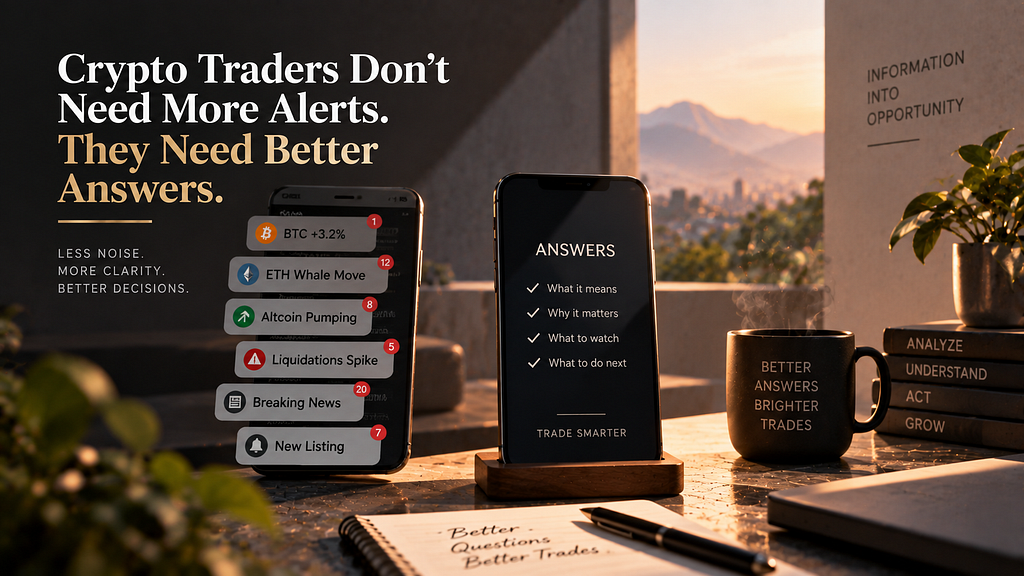
Crypto traders have plenty of alerts. Explore why better context, connected market data, and clearer answers may matter more than receiving more notifications.
A trader’s phone can easily become a constant stream of crypto updates. Bitcoin volume is rising, a large wallet has moved funds, open interest is increasing, sentiment has shifted, and breaking news has just appeared. Every notification may be useful on its own, but after receiving ten different updates, the trader can still be left asking the same question: What actually matters?
That is the problem with today’s crypto information environment. Traders don’t necessarily lack information; they lack the context needed to turn separate pieces of information into a clear picture of what is happening in the market.
An Alert Is an Event. An Answer Is an Explanation.
Consider a simple notification saying that Bitcoin trading volume has increased by 42%. That is an interesting development, but the number alone doesn’t explain why the increase happened or whether it actually matters. Was there a major price movement at the same time? Did liquidity change? Did derivatives activity accelerate? Was there breaking news, or did traders simply become more active for a short period?
The alert identifies an event, but the trader still has to investigate the story behind it. This distinction is becoming increasingly important as crypto market data becomes faster, larger, and more fragmented across different platforms.
The Alert Economy Has Created a New Problem
Crypto platforms have become extremely good at detecting market events. Traders can receive notifications when prices cross certain levels, trading volume changes, whale wallets move funds, funding rates shift, liquidations occur, or a new piece of market news emerges. The problem isn’t that these alerts are useless; the problem is that receiving more of them doesn’t necessarily make the market easier to understand.
When every unusual movement generates another notification, traders eventually have to become their own information filter. They move between charts, news feeds, derivatives dashboards, on-chain platforms, and social channels just to determine whether several alerts are connected. The market continues moving while the trader is still trying to assemble the story.
The Question Behind the Alert Matters More
The real value of market information often appears in the question that follows an alert. If trading volume suddenly increases, the important question may not be whether volume increased, but why participation increased and what changed around it.
The same applies to other market events. A large wallet transaction raises questions about where the funds moved and whether other activity supports its significance. A rise in open interest raises questions about positioning, while a sudden price movement raises questions about liquidity, news, and broader market participation.
An alert gives traders something to investigate. A useful market intelligence system should help make that investigation easier.
More Notifications Don’t Mean More Understanding
There is a natural assumption that more information leads to better decisions. In practice, traders have limited time and attention, and a constant stream of notifications can make it harder to distinguish meaningful developments from routine market activity.
Imagine receiving separate alerts for rising volume, increasing open interest, declining liquidity, unusual wallet activity, and a new market headline. Looking at each notification independently creates five different events. Understanding that they happened within the same period and may be connected creates a much more useful market picture.
That is where crypto trading intelligence becomes different from simply collecting more data.
Context Connects the Pieces
Markets rarely move because of one isolated data point. Price, volume, liquidity, derivatives positioning, on-chain activity, sentiment, and news can influence one another, sometimes within minutes.
For example, a sharp price movement accompanied by rising volume and strong liquidity tells a different story from the same price movement occurring while liquidity is falling and derivatives positioning is becoming increasingly concentrated. The price chart may look similar in both cases, but the surrounding conditions are completely different.
The value of crypto market analysis therefore isn’t always in finding another indicator. It can come from understanding how existing information fits together.
The Problem With Looking at Data Separately
Fragmented data forces traders to build the connections themselves. A price chart might show the movement, an on-chain platform might show wallet activity, a derivatives dashboard might show positioning, and a news platform might explain what triggered the change.
Each source provides something useful, but the trader becomes responsible for combining everything. This can create delays and make it harder to understand the sequence of events, particularly when markets are moving quickly.
The challenge isn’t necessarily finding the right data source. It is reducing the distance between the data and the understanding that comes from it.
AI Can Help Move From Alerts to Answers
This is where AI can have a more practical role in crypto trading. Instead of simply generating another notification, AI can help process different information sources and organize related developments around the same market event.
For example, if an asset suddenly moves, an AI-powered system could help bring together changes in volume, liquidity, derivatives, on-chain activity, sentiment, and relevant news. The goal isn’t to automatically predict what happens next; it is to reduce the manual work involved in understanding what has already changed.
That makes AI-powered crypto market analysis particularly relevant as the amount of available market information continues to grow.
What Traders Actually Want to Know
Most traders aren’t looking for an endless list of events. They want answers to practical questions: What changed? Why did it change? Is the move supported by actual participation? Is this happening across the market or only in one asset? Did something happen before the price reacted?
Those questions require more than an alert.
They require context.
And context doesn’t necessarily mean giving traders more information. Sometimes it means taking the information already available and showing how the important pieces relate to one another.
Where i5 Fits
This is where i5.xyz approach to crypto market intelligence becomes relevant. Instead of treating market activity, liquidity, derivatives, on-chain developments, sentiment, and news as completely separate streams, i5 brings these different forms of information into a broader market context.
If an asset suddenly moves, the useful question isn’t simply whether the price changed. Traders can also look at what happened around that movement: whether liquidity shifted, whether trading activity increased, whether derivatives positioning changed, whether on-chain activity was unusual, or whether relevant news appeared.
The goal is not to replace the trader’s judgment. It is to make the information surrounding a market event easier to understand.
The Future May Be Fewer, Better Alerts
The next generation of crypto trading tools may not be defined by how many notifications they can produce. It may be defined by how effectively they can filter events, connect related information, and help traders understand why something deserves attention.
That could mean fewer interruptions but more useful information. Instead of constantly telling traders that something happened, intelligent market tools can help explain what changed, what it may be connected to, and which parts of the market are worth investigating further.
The real upgrade isn’t another notification.
It is a better answer.
Conclusion
Crypto traders don’t have an information shortage. They have an interpretation challenge created by the sheer amount of data being generated across markets, blockchains, derivatives platforms, news sources, and social channels.
Alerts are useful because they tell traders that something happened. But the real value comes when those events can be connected to the wider market context.
As crypto markets become more data-rich, the advantage may not come from receiving the most notifications. It may come from understanding the important ones without having to spend hours connecting the dots yourself.
Crypto traders don’t need more alerts. They need better answers.
Crypto Traders Don’t Need More Alerts. They Need Better Answers. was originally published in Coinmonks on Medium, where people are continuing the conversation by highlighting and responding to this story.