
So my cousin won’t shut up about Bitcoin. Every family dinner, same thing. And for years I just nodded and changed the subject because honestly, I thought it was for people who watch too many YouTube videos with thumbnails of rockets and green candles.
Then this spring I got bored on a Sunday and actually tried to fact-check him. Not to agree with him to prove him wrong, if I’m being honest. That backfired a little.
Here’s what I found, minus the cult stuff.
It started as a “we’re mad at the banks” project
October 2008. Lehman Brothers just imploded, the government’s bailing out the same banks that caused the mess, and regular people are watching their retirement accounts get gutted while nobody responsible loses their job. That’s literally the month Bitcoin’s whitepaper dropped.
The guy (or group, nobody actually knows — the name “Satoshi Nakamoto” is almost certainly fake) wasn’t trying to build a get-rich scheme. He was trying to build money that didn’t need a bank’s permission to move, and that no single entity could just… make more of whenever they felt like it.
There’s a hard cap. 21 million coins. Forever. My cousin brought this up probably four times before I actually understood why it mattered — it’s not a marketing number, it’s baked into the code, and changing it would require basically the entire global network of Bitcoin users agreeing to rewrite the rules. Which isn’t happening.
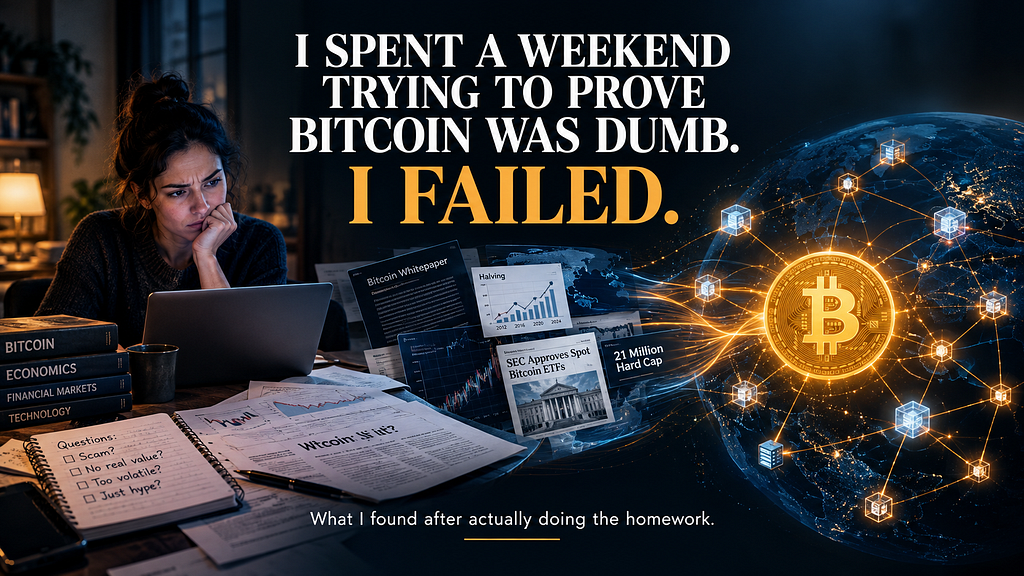
Image Generated by Chatgpt
The “halving” thing that I genuinely didn’t get for months
Okay, this part actually took me a while.
Every four years-ish, the reward for mining a Bitcoin block gets cut in half. Automatically. Nobody votes on it, no CEO signs off; it’s just scheduled into the software from the very first line of code back in 2009. The last one happened in April 2024.
Look at price charts after previous halvings (2012, 2016, 2020), and there’s a pattern: prices tend to climb in the following year or two. Is that guaranteed to happen again? No. Absolutely not. But it’s not some conspiracy theory either; it’s just supply shrinking against demand that hasn’t shrunk, which is like, econ 101.
The part that actually got my attention
January 2024. The SEC approves spot Bitcoin ETFs.
I had to look up what that even meant. Basically — you can now buy Bitcoin through a normal brokerage account, the same app you’d use to buy Apple stock. No crypto wallet, no “write down these 12 random words or lose everything forever” nonsense.
BlackRock runs one of these funds now. BlackRock. The company that manages money for pension funds, insurance companies, literal governments. Billions of dollars went into these funds within months of launch.
That’s the moment I stopped being able to write it off as internet monopoly money for people with too much free time.
Why some governments straight up hate it
Nobody really says this part out loud but I’ll say it: Bitcoin isn’t just annoying to banks, it’s annoying to anyone who wants control over money.
Governments decide who can move money, how much exists, who gets frozen out of the system. Bitcoin doesn’t ask. You’ve got internet access, you can send it anywhere, to anyone, and no one can stop the transaction from happening.
That’s why some countries have banned mining outright. It’s also why central banks everywhere are scrambling to build their own government-controlled “digital currencies” — which, ironically, is them trying to build a version of digital money they CAN control, because Bitcoin was specifically designed so they can’t.
Make of that what you will.
Should you actually buy some
I’m not your financial advisor and honestly I’d be suspicious of anyone online who confidently tells you yes or no on this. Too many people selling courses, too many people selling coins, too many people with an agenda dressed up as advice.
What’s true: Bitcoin has crashed more than 50% several separate times in its history. People have lost real, painful amounts of money panic-selling during those crashes. Other people held through the chaos and made genuinely life-changing money.
If you’re curious, the only rule I’d actually stand behind: don’t put in money you can’t afford to lose. That’s not me being cautious for legal reasons, that’s just… common sense with anything this volatile.
Where I ended up
I still think a chunk of crypto Twitter is insufferable. That hasn’t changed. But I stopped thinking Bitcoin itself is dumb, because the “why” behind it actually makes sense once you dig past the memes — it’s a real attempt at rebuilding who controls money, and it’s still an open question whether it works long-term.
My cousin’s insufferable about being right, by the way. I’m not telling him that part.
Not financial advice, just a guy who got bored on a Sunday. Do your own homework before putting real money into anything.
I Spent a Weekend Trying to Prove Bitcoin Was Dumb. I failed. was originally published in Coinmonks on Medium, where people are continuing the conversation by highlighting and responding to this story.