
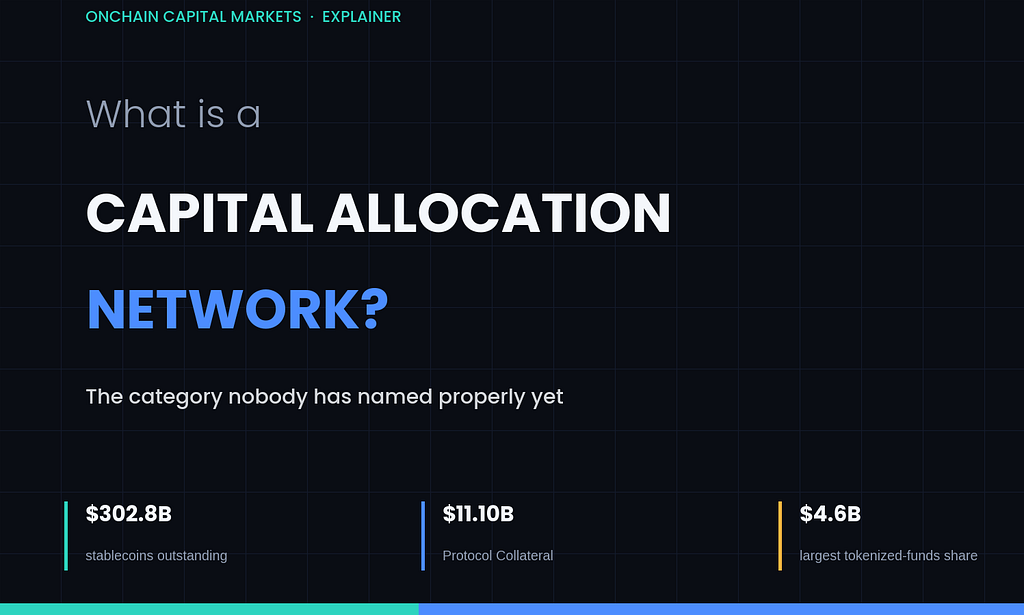
Around $300 billion in stablecoins exists right now. Most of it earns its holder nothing. The architecture that changes that already exists. The vocabulary does not.
The category is already running at billions in scale. The vocabulary is lagging the architecture.
There is a number in onchain finance nobody enjoys saying out loud.
As of 10 September 2026, the total stablecoin market stood at roughly $302.8 billion. Almost all of it dollar-denominated.
Now the awkward question. How much of that money is actually working?
For most holders, none of it. You hold the token. Someone else holds the Treasury bills. Someone else keeps the yield.
That is not a product gap. It is a category gap. We named the token. We never named the system that puts the token to work.
So let me name it.
What is a capital allocation network?
A capital allocation network pools stablecoin liquidity, lends it to independent allocators who deploy it into real yield strategies, enforces risk limits set in public and executed by code, and routes the resulting revenue back to the holders who supplied the capital.
Four conditions have to hold at once:
Pooled liquidity any approved allocator can draw on, with no fundraising cycleIndependent allocators competing on performance rather than relationshipsPublic risk parameters enforced automatically, visible before anything movesA return path back to token holders, not only to the issuer
Remove one and you get something familiar. Drop the return path and you have a conventional stablecoin issuer.
Drop independence and you have a single manager with a blockchain. Drop public parameters and you have a black box with better design.
Sky Ecosystem is the clearest live example of all four running at once.
A capital allocation network is not a place to park money. It is the plumbing that decides where money goes next.
Why does most stablecoin capital still sit idle?
Because the original stablecoin bargain was never built to share.
You hand an issuer dollars. They hand you a token. They buy short-dated government debt. They keep the return.
Fine when stablecoins were a trading tool. Very different now that roughly 269 million onchain addresses hold a stablecoin balance.
The market has noticed. Tokenized US Treasuries grew from about $750 million at the start of 2024 to nearly $11 billion by early 2026.
But that solves half of it. A yield-bearing wrapper is not the same thing as a competitive network of allocators improving what sits inside it.
How does a capital allocation network actually move money?
Through allocators, not through a desk.
In Sky Ecosystem the allocators are Sky Agents. Each is an independent business, not a subsidiary. The loop is short:
Sky Protocol makes USDS liquidity available under governance-set limitsSky Agents borrow it and deploy into onchain lending markets, tokenized Treasuries, institutional credit and real-world lendingAgents pay a Base Rate on everything deployed, settled onchain each monthThat revenue accrues to Sky ProtocolSky Governance sets the Sky Savings Rate against itFive steps from idle stablecoin to a published rate. The loop repeats every settlement cycle.
Raising capital is the hardest part of building any credit business. Sky Protocol supplies the credit facility. The allocator supplies the expertise. Governance supplies the guardrails.
Competition is the design, not a side effect. How much USDS an Agent can deploy is capped by a governance-set debt ceiling, and raising one takes an Executive Vote with a mandatory delay.
Each Agent posts risk capital proportional to its exposure, calibrated by asset class on a Basel III style methodology. Underperform and you hold more capital before deploying another dollar.
Where does the Sky Savings Rate on sUSDS actually come from?
From protocol revenue. Not a marketing budget, and not a promise.
The Sky Savings Rate is a variable rate set by Sky Governance and paid from revenue Sky Protocol earns.
The largest single source is lending USDS to the Sky Agent Network. The protocol also earns from Stability Fees, the Peg Stability Module and other fee flows.
Accessing it takes one step. Convert USDS into sUSDS, the world’s largest yield-generating stablecoin, and the rate accrues programmatically with no lockups.
Two things people get backwards:
sUSDS holders access the rate. They are not exposed to any single Agent’s performance. Holding sUSDS is not a claim on one borrower, pool or strategy.The rate is variable and governance-set. It moves with protocol revenue and market conditions, and it is published live rather than quoted from a deck.
USDS is the unit underneath: fully backed, convertible 1:1 through the Peg Stability Module, and the borrowing unit every Agent draws on.
What happens if a Sky Agent loses money?
This is the second question every serious allocator asks. The answer has to be structural, not reassuring.
Losses are absorbed in a fixed, predetermined order:
The Agent’s own risk capital, held proportional to deployed exposure, absorbs the shortfall firstThe Surplus Buffer, where protocol revenue accumulates before distributionRecapitalization through SKY issuance, requiring an Executive Vote with a mandatory time delayEmergency Shutdown, a last resort that lets every USDS holder redeem directly against remaining collateralLoss absorption is sequenced in advance, not negotiated after the fact.
Around that waterfall sit controls that are easy to miss and hard to fake. Price data waits one hour in the Oracle Security Module before taking effect, so a manipulation attack has to hold a false reading for over an hour in public view.
Undercollateralized positions clear through descending-price Dutch auctions.
The record is checkable. The core protocol ran through Black Thursday in 2020, carried zero exposure to the UST collapse and the FTX bankruptcy, and held through the USDC depeg pressure of March 2023. Seven years, zero exploits.
In 2024, S&P Global assigned it a B- rating, the first structured finance credit rating given to an onchain protocol.
How big is this capital allocation network right now?
Big enough that the numbers get reported quarterly instead of tweeted. From Sky Frontier Foundation:
Q1 2026: $123.79M in Gross Protocol Revenue and $46.04M in Net Protocol Surplus, the strongest quarter on recordQ2 2026: $107.35M in Gross Protocol Revenue and $33.29M in Net Protocol Surplus, the fifth consecutive positive quarterAugust 2026 close: Protocol Collateral of $11.10B, up 18.2% year over year, with Sky Agent vaults growing from $5.63B to $6.06B in one monthFive consecutive positive quarters, reported by Sky Frontier Foundation rather than estimated.
Where that capital sits is the more interesting part. As of 1 September 2026, Sky Agents held roughly $1.23B with Janus Henderson, $618.32M with BlackRock, $304M with Galaxy, $239.60M in PayPal USD, $220M with Anchorage and $103.11M in Securitize.
Sky Agent allocations by counterparty. Every position is published at token level and updates continuously.
Galaxy is the number that tells the story. Exposure was $27M at the Q2 close.
Ten weeks later it sat around $304M, driven by a warehouse lending facility announced by Sky Agent Grove.
Three more data points worth sitting with:
Token Terminal data as of 21 August 2026 placed Sky Protocol at $4.6B, the largest single share of a $34.4B category, ahead of Securitize, Circle, Franklin Templeton and Ondo Finance.In April 2026, Coinbase completed the migration of DAI to USDS, the largest stablecoin migration to dateBetter (NASDAQ: BETR), the digital mortgage lender, runs a $500M mortgage credit facility as a Sky Agent, and is the first publicly listed US company to allocate capital inside the networkOnchain lending, a tokenized Treasury book and a mortgage facility, funded from one liquidity pool and reported on one balance sheet.
How is this different from a stablecoin issuer keeping the yield?
The difference is who the revenue belongs to.
A conventional issuer earns on reserves and keeps the earnings. A capital allocation network earns on deployed capital and routes a published share back to holders.
The collateral position is public too. Protocol Collateral sits across Sky Agent vaults at roughly 40%, the Peg Stability Module at roughly 38% and overcollateralized crypto vaults at roughly 22%, with Sky Reserves as an additional buffer.
What backs every USDS in circulation, and where the surplus goes each settlement cycle.
The surplus has rules as well. Since August 2026, each settlement cycle allocates 22.5% to SKY buybacks for staking rewards, 22.5% to USDS staking rewards, 5% to a permanent buy and burn, and up to 50% to the Surplus Buffer.
Protocol revenue is now actively reducing SKY supply for the first time in years.
How can you verify any of this yourself?
You do not have to take anyone’s word for a single figure in this post.
financial.skyeco.com publishes the balance sheet, Gross and Net Protocol Revenue, Protocol Surplus, Sky Reserves and collateral composition in real timeSky Frontier Foundation quarterly reports cover closed periods with time-stamped figuresAgent allocations are published at token level and update continuously
That is the real argument for this category. Not the rate. The auditability.
The naming problem is a real problem
Call it DeFi and institutions hear risk. Call it a stablecoin and people hear parking. Call it asset management and you have described something it legally is not.
Capital allocation network is the phrase that fits. Pooled liquidity. Independent allocators. Public risk parameters. Revenue that flows back.
The category already runs at billions in scale, with quarterly reporting and a credit rating attached. The vocabulary is lagging the architecture.
So here is my question.
If your stablecoins are sitting idle right now, is that a deliberate decision about risk? Or is it just that nobody gave the alternative a name you recognised?
Tell me in the comments. I will happily argue about the terminology.
What Is a Capital Allocation Network? The Category Nobody Has Named Properly Yet was originally published in Coinmonks on Medium, where people are continuing the conversation by highlighting and responding to this story.