
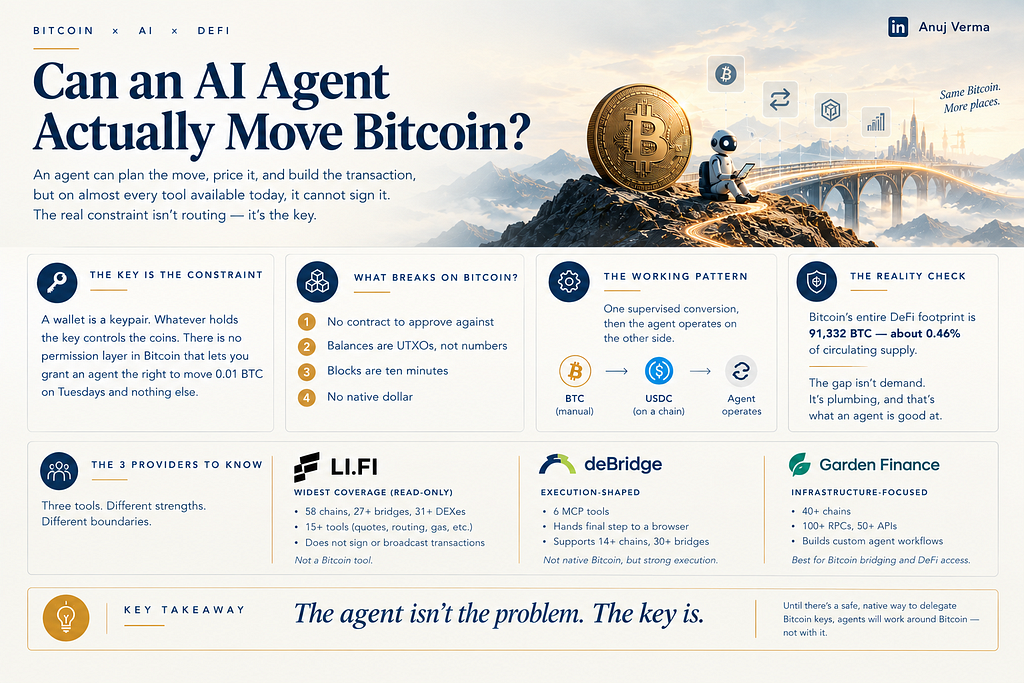
An agent can plan the move, price it, and build the transaction, but on almost every tool available today, it cannot sign it, and the two largest agent-facing bridge servers do not carry Bitcoin at all. The limit is not routing. Routing is solved. The limit is that moving Bitcoin requires a key, and handing a key to an autonomous process is a decision nobody has found a safe default for.
This piece covers why the key is the constraint, what breaks on Bitcoin specifically, the working pattern people actually use, and the three providers whose tools an agent can call today.
Why can’t an AI agent just hold Bitcoin?
An agent has no way to hold Bitcoin that is meaningfully different from a script holding a private key, and that is the whole problem. A wallet is a keypair. Whatever holds the key controls the coins. There is no permission layer inside Bitcoin that lets you grant an agent the right to move 0.01 BTC on Tuesdays and nothing else.
Compare that with what an agent gets on an EVM chain. There, a token approval is a bounded grant — a spending cap on one contract for one token, revocable. Account abstraction goes further: session keys, spending limits, allowlisted destinations, a co-signer. None of that exists on Bitcoin. The key signs everything or it signs nothing.
So “agent holds Bitcoin” collapses into “some process on a machine has the seed.” That is a custody decision dressed up as an architecture decision, and it is why the serious tools decline to make it for you.
What breaks when an agent tries to move Bitcoin specifically?
Four things break, and they are all properties of Bitcoin rather than shortcomings of the agent.
There is no contract to approve against. Bitcoin Script can check a signature, enforce a timelock, and verify a hash preimage. It cannot hold the persistent state an allowance needs. The entire approve-then-spend pattern that agent tooling is built around has no Bitcoin equivalent.
Balances are UTXOs, not numbers. Spending requires selecting inputs, calculating change, and building a transaction. Send 0.05 BTC from a 0.4 BTC input, and the remainder comes back as change to an address you must control. Get that wrong, and the difference goes to miners.
Blocks are ten minutes. An agent loop expects a result in seconds. A Bitcoin confirmation is minutes, and most destinations want several. Anything holding a quote across that window is exposed to the price moving.
There is no native dollar. The reason to move Bitcoin at all is usually to reach something priced in dollars — a lending market, a perp venue, a payment. Bitcoin has no stablecoin, so the move and the conversion are the same action.
So what does the working pattern actually look like?
One supervised conversion, then the agent operates on the other side. Rather than giving an agent Bitcoin, you move the Bitcoin once — with a human signing — into an asset on a chain where bounded permissions exist. USDC on Base, USDC on Arbitrum, a wrapped BTC token if you want to keep the price exposure. From that point, the agent works inside an approval you set and can revoke.
This is a narrower claim than “agentic Bitcoin,” and it is the one that survives contact with the tooling. The agent’s job is research, routing, quoting, monitoring and execution on the destination side. The Bitcoin leg stays manual, once, at the start.
It is also where the demand is. Spark’s BTCFi research, published 29 May 2026, put Bitcoin’s entire DeFi footprint at 91,332 BTC — about 0.46% of circulating supply. The gap is a plumbing problem, and the plumbing is exactly what an agent is good at, right up to the signature.
Which providers let an AI agent move Bitcoin?
Three are worth knowing. Two of them are bigger than the third and neither touches native Bitcoin.
LI.FI – the widest coverage, explicitly read-only
LI.FI’s MCP server is the broadest route surface an agent can query, and it is deliberately incapable of moving anything. It exposes around fifteen tools across token and chain metadata, quotes, routing, gas, allowances, and transaction status, covering 58 chains, 27-plus bridges and 31-plus DEXes, and works with Claude, Cursor, Windsurf and VS Code Copilot.
The docs are blunt about the boundary: the server “provides read-only tools” and “does not sign or broadcast transactions.” A quote comes back with an unsigned transactionRequest that you sign and submit with your own wallet. Rate limits are 200 requests per two hours without an API key, 200 per minute with one.
The honest part: Bitcoin is not in the chain list. LI.FI is an EVM-and-Solana aggregator, and for an agent that already holds tokens on those chains it is the best research tool of the three. It is not a Bitcoin tool.
deBridge – execution-shaped, with the signature handed back to you
deBridge shipped its MCP server in February 2026 and designed it around handing the final step to a browser. The Block covered the launch on 16 February 2026. The server exposes six tools — get_instructions, search_tokens, get_supported_chains, create_tx, estimate_same_chain_swap and get_trade_dapp_url — across 24 to 28 networks and more than 40,000 tokens, with a hosted endpoint at agents.debridge.com so an agent can connect without installing anything.
The last tool is the interesting one. The agent produces a shareable deBridge App link, and the documentation describes the boundary plainly: the server “never touches private keys or signs transactions. The user always completes the swap themselves: open the generated link, connect their wallet, review, and sign.”
The honest part: same gap. Bitcoin is not a supported native chain — the coverage is EVM plus Solana. deBridge is the better of the two if you want an agent that gets you to a one-click confirmation, and it still starts from tokens you already hold off Bitcoin.
Garden – the one with the Bitcoin chain in it
Garden Finance is a Bitcoin-first cross-chain protocol, which makes it the only one of the three whose route set starts where Bitcoin actually is. Its catalogue on 8 September 2026 listed 26 assets across 15 chains, including Lightning, Solana, Starknet and Hyperliquid, 13 of those entries a form of Bitcoin across seven tickers. Settlement is by atomic swap: the swap completes on both sides or refunds on both, so there is no pooled balance for an agent to be wrong about.
It reaches agents through two formats, and the difference decides where the tool is reachable rather than what it can do. MCP is portable. The protocol is spoken by Claude Code, Cursor, Codex, Windsurf and VS Code alike, so one server covers every environment an agent might run in. A skill file is not. A .md skill is native to Claude and does nothing in Cursor or Copilot. Garden ships both: an MCP server for swaps, a Claude skill that drives the same flow conversationally, and a second Claude skill for developers embedding Garden into their own application.
Underneath either one the API is the same, and it is already agent-shaped: quote, create order, execute HTLC action, instant refund hash, available liquidity. A refund that is a script condition rather than a support ticket matters more when a machine is driving, and quotes are whole — Garden states it charges no fee of its own and that the quoted figure includes network costs, so an agent does not have to model fee layers separately to know what it will receive. In a nine-swap cost snapshot on 20 August 2026, Garden quoted lowest on all nine against Chainflip and Relay, the gap widest on $100 swaps.
How do the three compare?
Who actually signs, and why does every tool stop there?
All three stop at the signature, and they stop at the same place for the same reason: an agent that can sign is an agent that can lose everything on a bad inference. A hallucinated address, a decimal misread, a prompt-injected instruction inside a token name or a web page the agent read on the way — each of those is survivable when a human confirms and unrecoverable when nothing does.
This is not a Bitcoin-specific caution. Base shipped its MCP in May 2026 behind OAuth with user approval on every transaction. Bybit and BitGo both shipped agent servers in 2026 with the same shape. The pattern across the whole category is identical: agents propose, humans dispose.
On Bitcoin, the stakes of crossing that line are higher, because there is no revoke. An EVM approval can be pulled after the fact. A Bitcoin transaction cannot.
What should you check before letting an agent near your Bitcoin?
Keep the key out of the agent’s context. A key pasted into a chat is in the transcript, the logs and possibly a provider’s retention window. Anything holding a key should read it from an OS keystore at the moment of use.
Confirm the destination address out of band. The single highest-value target for prompt injection against a swap agent is the destination field.
Have gas on the destination chain. Arriving with a Bitcoin-denominated token and no ETH, SOL or STRK is the most common way a first attempt stalls, agent or not.
Size to the route, not to your balance. Caps exist on every route, and inside them the far side’s depth sets your slippage.
Assume the conversion is taxable. In most jurisdictions giving up BTC for a token is a disposal, and coming back is a second one. An agent running conversions on a schedule generates a lot of those.
FAQ
Can AI agents hold crypto?
They can hold a key, which is not the same as being trusted with one. On EVM chains bounded permissions exist — token approvals, session keys, spending caps — so an agent can be given limited authority. Bitcoin has no equivalent, so authority there is all or nothing.
Can Claude execute a crypto swap?
Claude can call an MCP server to search tokens, price a route and build an unsigned transaction. On LI.FI and deBridge the signature is handed back to a wallet you control. That handoff is deliberate, not a missing feature.
Does deBridge support Bitcoin?
Not as a native chain. Its MCP covers EVM networks and Solana. You can move a wrapped Bitcoin token across those chains; you cannot start from BTC on the Bitcoin chain.
Does LI.FI support Bitcoin?
Bitcoin is not in its 58-chain list either. LI.FI aggregates across EVM chains and Solana.
What is the safest way to give an agent access to funds?
Move a fixed amount to a dedicated wallet, on a chain where approvals are bounded and revocable, and grant nothing from your main holdings. Treat it as a float rather than an account.
Can an agent move Bitcoin without any human step at all?
Only if something in the loop holds the key and signs unattended, which every provider named here declines to do. If a tool offers it, that is the question to ask about it first.
Is a bridge cheaper than an exchange for this?
Often not, for common pairs. An exchange usually wins on BTC to USDC. Bridges win when the destination is a rollup that exchanges do not support as a withdrawal network, which is most of them.
Can an AI Agent Actually Move Bitcoin? was originally published in Coinmonks on Medium, where people are continuing the conversation by highlighting and responding to this story.