
Circle earns interest on dollars that belong to you. It is legal, it is disclosed, and it is 95% of the business. Here is where that money goes, and what the other design looks like.
Circle earned $667.7M in reserve income in Q2 2026. USDC holders received none of it.
Last quarter, Circle earned $667.7 million.
Not from fees. Not from software. From interest on dollars that USDC holders handed over and were never paid a cent on.
That is not an accusation. It is line one of a public filing.
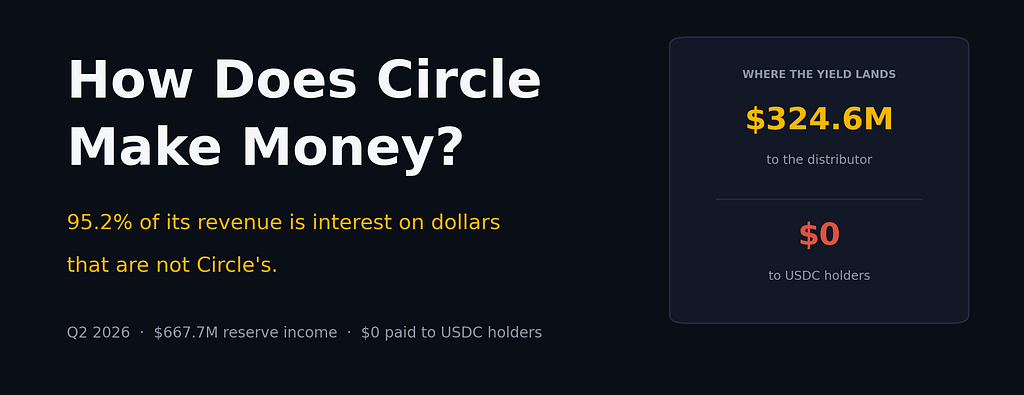
95.2% of Circle’s Q2 2026 revenue came from interest on money that was not Circle’s.
“How does Circle make money” has a boring answer and an interesting one. The boring answer fits in a sentence.
The interesting one is about who the float belongs to, and whether it has to work this way.
So, How Does Circle Make Money? It Earns Interest on Your Idle Dollars
Answer first, then the receipts.
You send $1 to Circle. Circle mints 1 USDC.Circle parks your dollar in short-term US Treasuries and bank deposits.Those instruments pay interest. Circle collects it.You hold a token worth exactly $1. Indefinitely.
The Q2 2026 numbers, from Circle’s own results:
Total revenue and reserve income: $701.3 millionReserve income alone: $667.7 million, or 95.2% of the totalTransaction revenue: $5.3 millionUSDC in circulation at quarter end: $73.3 billionReserve income is 95.2% of Circle’s Q2 2026 revenue. Everything else is a rounding error.
Circle has never hidden this. Reserve income accounted for 95% to 99% of total revenue in 2022, 2023 and 2024. The model is not a secret. The model is the product.
One statistic reframes the whole thing. USDC settled roughly $14.8 trillion in onchain volume in Q2, up 151% year over year. Circle booked $5.3 million in transaction revenue from all of that movement.
The float is the business. The movement is the marketing.
Where Does USDC Reserve Income Actually Go?
Here is the part most explainers skip.
Circle does not keep most of it. In Q2 2026 the company recorded $410.4 million in distribution and transaction costs. Of that, $324.6 million went to Coinbase.
The structure, in plain terms:
Coinbase collects 100% of reserve income on USDC held on Coinbase.Coinbase collects 50% of residual reserve income on USDC held everywhere else.The agreement, signed August 2023, was confirmed renewed on the same terms through 2029 on the August 5, 2026 earnings call.The yield moves. It just moves sideways, to the distributor rather than the holder.
In 2025, Coinbase-linked distribution costs hit $1.4 billion, roughly 51% of Circle’s total revenue and reserve income for the year.
So the money does move. It just moves sideways.
Your dollars generate the yield. The distributor collects it. You keep a token worth a dollar.
Why Doesn’t USDC Pay You Yield? The GENIUS Act Answer
This is where people direct their annoyance at the wrong party.
Section 4(a)(11) of the GENIUS Act bars permitted payment stablecoin issuers from paying holders any form of interest or yield for simply holding the coin. Cash, tokens, other consideration, all of it.
The OCC’s February 2026 proposed rule goes further, presuming that yield routed through affiliates and third parties is also prohibited unless the arrangement can be justified.
Circle is not choosing to withhold anything. US law forbids a payment stablecoin issuer from passing reserve income to holders.
That line is now the loudest fight in US financial policy. Banks want it enforced strictly, arguing that pass-through rewards drain insured deposits and shrink credit.
The digital asset industry argues Congress deliberately left third parties out of scope.
Every major GENIUS implementing rule across the OCC, FDIC, Treasury and FinCEN was still pending finalisation as of mid-2026, while the OCC noted private forecasts of payment stablecoin issuance reaching $500 billion this year.
Half a trillion dollars of float, and the entire policy argument is about who is allowed to earn on it.
Which surfaces the real question, and it is an engineering question rather than a moral one:
If a dollar instrument cannot legally pay its holder, what would one look like that can?
What Happens When Protocol Revenue Goes Back to the Holder Instead?
Sky Protocol was built around the opposite answer.
USDS is not a payment stablecoin issued by a company sitting on your cash. It is an overcollateralized stablecoin generated onchain against governance-approved collateral.
Users retain non-custodial control of their holdings throughout. There is no issuer holding your float.
Supply USDS to the savings module and you receive sUSDS, which programmatically accrues the Sky Savings Rate. No lockups, no exit fees, no application form.
Same dollar, two destinations. The design decides who earns on the float.
The receipts, from the Q2 2026 quarterly report published by Sky Frontier Foundation:
Cumulative Sky Savings Rate distributions to holders crossed $250 million on June 29, 2026$17.49 million accrued through sUSDS in the month of June alonesUSDS closed Q2 at $5.52 billion, up 149% year over year, the largest rate-bearing stablecoin by supplySky Protocol generated $107.35 million in Gross Protocol Revenue in Q2, a second consecutive quarter above $100 millionOne design routes reserve income to distribution partners. The other routes protocol revenue to the people holding the instrument.
Who Sets the Sky Savings Rate, and Where Does the Money Come From?
Not from token emissions. Not from a marketing budget.
The Sky Agent Network is a group of independent capital allocators, including Spark, Grove, Keel, Obex and Osero, that borrow USDS from Sky Protocol at a governance-set Base Rate and deploy it into their own strategies across credit, lending and tokenized real-world assets. They keep their spread. They pay the Base Rate back.
Those payments, plus vault stability fees, real-world asset yield and Peg Stability Module fees, pool in the protocol’s surplus layer.
Sky Governance then sets the Sky Savings Rate as a separate parameter, calibrated against revenue capacity and reserve targets.
Two consequences worth sitting with:
The rate is variable and governance-set, not market-set. Mid-Q2 2026, governance moved it from 3.75% to 3.60% on purpose, to sustain the pace of reserve accumulation. No algorithm did that. People voted.Governance can move the spread toward the holder. On July 23, 2026, the Sky Spread was cut from 0.1% to zero, ratified onchain.
Set that next to a distribution agreement that renews on identical terms for another three years.
sUSDS grew 149% year over year while paying out more than $250M to holders.
The network around it kept compounding through the quarter. Binance completed its upgrade from DAI to USDS with automatic one-to-one conversion of user balances.
Pendle Finance introduced fixed-rate access to sUSDS, which reached $55.94 million in TVL by late July at a 5.37% fixed rate.
Spark seeded $150 million into a shared stablecoin liquidity layer on Uniswap v4 and cleared $70 million in volume in its first three days.
Across the USDS and DAI complex, unique holders held broadly steady at 673,811.
Three Questions to Ask About Any Stablecoin You Hold
Steal these. They work on every issuer, including this one.
Who earns the interest on my balance? If the answer is “the issuer and its distribution partners,” you are the funding, not the customer.Where is the revenue published, and how often? A quarterly attestation is not the same as a live balance sheet you can refresh.Who can change the terms, and can I watch them do it? A private renegotiation and an onchain governance vote are very different accountability structures.
Most people have never asked question one. It is the one that decides where a few billion dollars a year ends up.
Can You Actually Verify Any of This? Yes, and That Is the Point
Stablecoin trust usually means trusting a quarterly attestation and a PDF.
Sky Protocol publishes two live surfaces instead:
financial.skyeco.com is the financial record: balance sheet, Gross and Net Protocol Revenue, Protocol Surplus, Sky Reserves, and the collateral backing USDS.insights.skyeco.com carries the quarterly reports and monthly operational updates behind every figure above.Four numbers, all refreshable in public, none of them requiring an attestation PDF.
Protocol Collateral reached $12.32 billion at Q2 close, up 45.5% year over year.
Sky Reserves sat at roughly 55% of the $150 million Solvency Reserve target that governance approved in March 2026, deliberately prioritising the buffer over near-term distributions.
You do not have to take any of those numbers on faith. You can open the dashboard and check them mid-sentence.
Two Designs, One Question: Who Is the Float For?
Circle’s model is legal, disclosed and, for a payment instrument, defensible. Payment rails are not savings products, and the GENIUS Act drew that line deliberately.
Still, $667.7 million a quarter is a lot of float to route past the people who supplied it.
The alternative is not “a higher number.” It is a different answer to the ownership question.
Sky Protocol is a capital allocation network where revenue lands with the protocol, and governance decides in public how much of it flows back to holders through the Sky Savings Rate. Every parameter is a vote, and every vote is onchain.
Idle dollars are never actually idle. Somebody is always earning on them.
The only question that matters is whether that somebody is you.
Your turn. If your stablecoin issuer earns roughly 3.5% on your balance and pays you nothing, is that a fee you agreed to or a fee you were never shown? Drop your answer below. I read every response.
How Does Circle Make Money? The $668 Million Answer Hiding in Plain Sight was originally published in Coinmonks on Medium, where people are continuing the conversation by highlighting and responding to this story.