
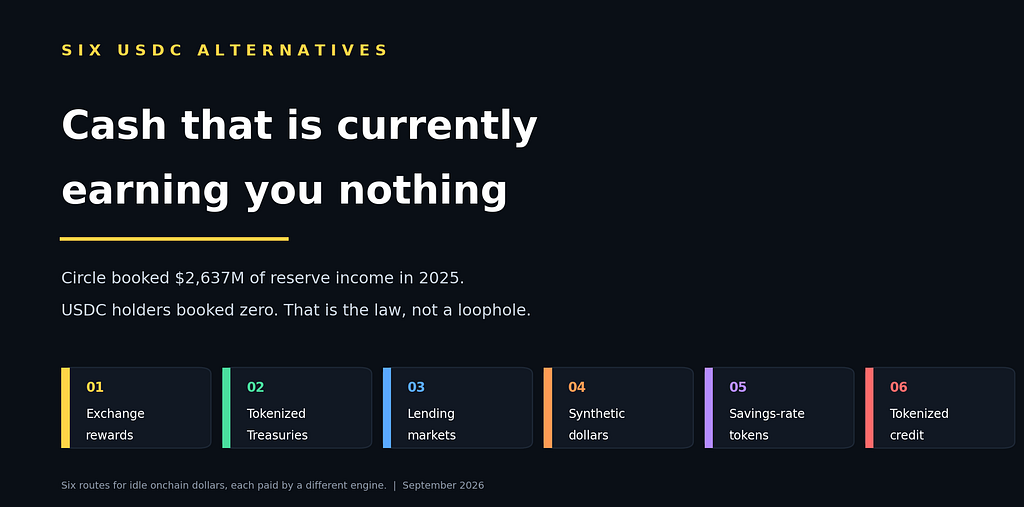
Circle booked $2.6 billion on reserves in 2025. Holders booked zero. Here is where that yield actually lives in 2026.
The six routes for idle onchain dollars. Each pays from a different engine, and each breaks in a different way.
In 2025, Circle earned roughly $2,637 million in reserve income on the dollars backing USDC. Holders of USDC earned nothing on those same dollars.
That is not a loophole. It is the law.
Short answer for anyone scanning. The six realistic USDC alternatives in 2026 are exchange rewards programmes, tokenized Treasury funds, onchain lending markets, synthetic dollars, yield-generating stablecoins, and tokenized credit. Each pays from a different engine. Each breaks in a different way.
Here is what each one actually is, and what it costs you.
Why does USDC pay you nothing?
Because a United States payment stablecoin issuer is legally barred from paying you.
Section 4(a)(11) of the GENIUS Act prohibits a permitted issuer from paying holders any form of interest or yield, whether in cash, tokens, or other consideration. The Perkins Coie analysis of the OCC rulemakingThe OCC has proposed extending that ban to affiliates and distributors, using a rebuttable presumption of violation. The comment window closed on 1 May 2026.MiCA Article 50, the FCA’s PS26/10 and Singapore’s September 2026 draft amendments all land in the same place.
So the reserve income does not disappear. It stops at the issuer. Circle paid out $1,662 million of that 2025 reserve income in distribution costs and still closed the year with a $70 million net loss from continuing operations.
The money is real. The only question is who ends up holding it.
How big is the idle-dollar problem in 2026?
Yield-bearing wrappers are excluded from the headline stablecoin market cap. All 103 of them together come to $16.2B.
The total stablecoin market sat at $302.8 billion on 10 September 2026. USDT held $183.4 billion. USDC held $74.2 billion, roughly 24% of the market. Live tracker here.
Yield-bearing wrappers are not counted in that figure. All 103 of them together come to $16.2 billion.
Do the arithmetic and the picture is stark. Around 5% of onchain dollars sit in a position that pays the holder anything.
By most estimates roughly 80% of stablecoin supply is deployed into no yield source at all.
What are the six best USDC alternatives right now?
1. Exchange rewards: the easiest USDC alternative, and the most exposed
You keep holding USDC. The exchange pays you out of its own share of the reserve economics.
Programmes have run in the 3.5% to 4.35% range through 2026 depending on membership tier and region.
Best for: small balances, US residents, people who do not want a walletThe catch: this is the exact arrangement the OCC’s proposed rule is aimed atThe risk you are accepting: custodial credit risk, plus regulatory risk
2. Tokenized Treasury funds: the regulated wrapper route
BlackRock’s BUIDL, Ondo’s OUSG and USDY, Franklin Templeton’s BENJI. You hold a claim on short-dated US Treasuries inside a fund structure.
Net yields have clustered in the 4.0% to 5.0% band, anchored to the front end of the curveBUIDL was around $3.0B in mid-2026, USDY around $2.1BThe catch: eligibility gates, minimums, and a fund administrator between you and the assetThe risk you are accepting: duration, counterparty, and access restrictions
3. Onchain lending markets: a rate set by borrowers, not by policy
Aave, Morpho, Spark, Compound, Fluid. You supply USDC and overcollateralised borrowers pay to take it.
Rates float with utilisation, typically 3% to 8%Morpho’s USDC vault on Base averaged 6.2% across one 90-day window in early 2026The catch: the rate collapses when borrowing demand does, and it doesThe risk you are accepting: smart contract risk and oracle risk
4. Synthetic dollars: the widest range of outcomes on this list
Ethena’s USDe and its staked version are the scale example. The yield comes from perpetual futures funding, captured through a delta-neutral position.
The trailing range across 2024 to 2026 has run from roughly negative 6% to positive 75%It printed 11.8% on a 90-day trailing basis in April 2026, then compressed to around 4.4% as funding cooledThe catch: the engine is a market structure, and market structures reverseThe risk you are accepting: funding-rate risk and exchange riskSix engines, six very different ranges. The width of the bar is the risk, not the yield.
5. Yield-generating stablecoins: a savings rate set in public
Here the rate is not a market price. It is a parameter.
sUSDS is the scale example. It is the access token for the Sky Savings Rate, a rate that Sky Governance sets against revenue Sky Protocol has actually earned.
Where that revenue comes from
The Sky Agent Network pays a Base Rate on all USDS it deploys, settled onchain monthlySpark has allocated roughly $500M to BUIDL and more than $1B across tokenized TreasuriesGrove runs around $2.7B through Basin, including a $50M anchor position in a Galaxy tokenized CLOBetter (NASDAQ: BETR) runs a $500M mortgage credit facility, the first publicly listed US company to deploy capital as a Sky Agent
Per Sky Frontier Foundation’s Q2 2026 report, Sky Protocol generated $107.35M in Gross Protocol Revenue and a $33.29M Net Protocol Surplus, a fifth straight quarter in surplus.
Cumulative Sky Savings Rate distributions to holders crossed $250M on 29 June 2026.
A governance-set rate is only as good as the revenue underneath it. Sky Protocol quarterly results, published by Sky Frontier Foundation.The catch: a governance-set rate can be voted down as easily as upThe risk you are accepting: governance concentration and protocol risk. S&P assigned Sky Protocol a B- with a stable outlook, the first credit rating on an onchain protocol, and named holder concentration and governance centralisation as constraints. Read that as a data point, not a trophy. S&P separately scores USDS peg stability at 4, constrained, against USDC at 2, strong (full assessment table).Never take the rate from an article, including this one. It is published live at financial.skyeco.com and it moves by vote.
6. Tokenized credit: the highest headline, the thinnest exit
Maple, Centrifuge, Goldfinch. Loans to off-chain borrowers, packaged onchain.
Maple’s syrupUSDC is now the largest single USDC yield venue by TVL at around $2.6BMaple’s high-yield strategy reported 11.4% in Q4 2025, against two historical defaults totalling $36MThe catch: you are a credit investor now, whether the interface says so or notThe risk you are accepting: borrower default, and liquidity that vanishes exactly when you want it
How should you actually compare USDC alternatives?
Ignore the APY first. Two rates that both read 4% can be produced by completely different machines.
Four questions that sort every option on this list. Ask them before you look at a single APY.What is the engine? Reserve interest, T-bill coupon, borrower demand, funding rate, protocol revenue, or credit spread.Who sets the number? A company, an open market, or a public vote. Each has a different incentive to change it.What breaks it? Every engine has one specific failure mode. Name it out loud before you allocate.Can you leave on a bad day? Instant redemption, a fund settlement window and a credit lock-up are three very different promises.
Congress is still arguing about the first two questions. The Congressional Research Service summary of the stablecoin yield debate is a short read and worth it.
What does switching out of USDC actually cost?
Less than most people assume, and this is the part that surprises readers.
You do not have to leave the dollar to leave the yield gap. Sky Protocol’s Peg Stability Module converts USDC to USDS at a strict 1:1 with no fees and no slippage, because the conversion happens against the protocol rather than against another trader.
That module is worth knowing about for a second reason. During the SVB bank run in March 2023, brief USDC depeg pressure hit it directly. The peg was restored without an emergency measure.
Exit works the same way. Convert back whenever you want, no lock-up.
So which USDC alternative should you pick?
There is no single answer, and anybody selling you one is selling you something.
Small, US-based, passive: an exchange rewards programme, with the regulatory caveat attachedTreasury-mandate money: a tokenized Treasury fundNon-custodial and active: a lending marketComfortable with variance: a synthetic dollarWant the rate set in public and paid from reported revenue: a governance-set savings rateWant credit exposure and know it: tokenized credit
Most serious onchain treasuries do not pick one. They run a base layer and a smaller risk sleeve, and they rebalance quarterly.
The only genuinely bad answer is the default one. Holding $74 billion of dollars that pay their holders nothing while somebody else books the coupon.
Verify everything before you move. Live protocol figures are published at financial.skyeco.com, and if you want the full architecture rather than the summary, this explainer walks through it.
Which of the six are you actually using, and which one did you try and quietly abandon? The abandoned ones are more interesting. Leave it in the comments.
Nothing here is financial advice. Rates are variable and every figure should be checked at source before you act on it.
Six USDC Alternatives for Cash That Is Currently Earning You Nothing was originally published in Coinmonks on Medium, where people are continuing the conversation by highlighting and responding to this story.