
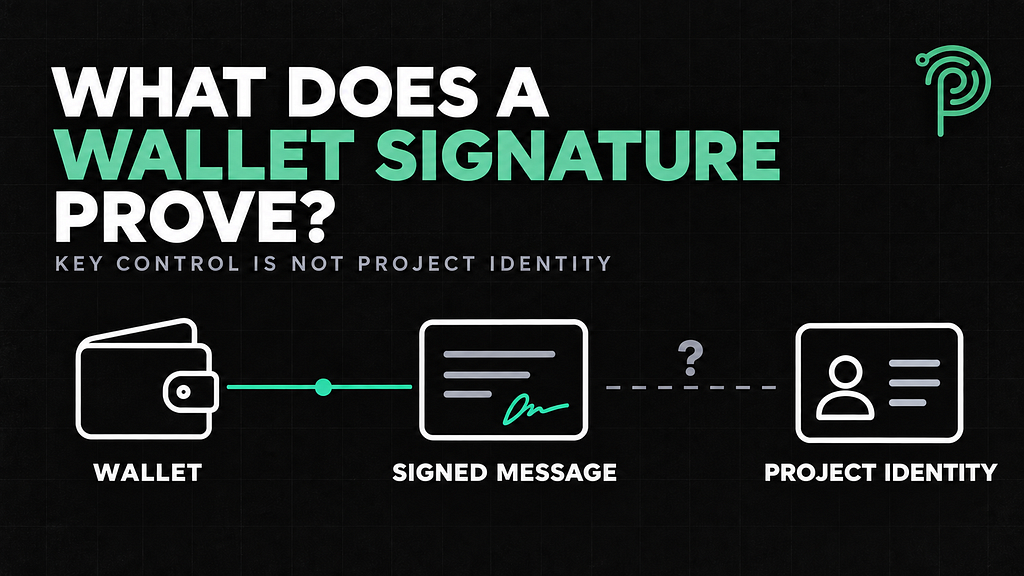
A valid signature confirms that a wallet approved a message. Proving that the wallet belongs to a project requires more evidence.
A valid wallet signature proves a narrow fact: a specific wallet approved a specific message. It does not, by itself, prove that the wallet belongs to a crypto project, that the signer is authorized to represent the team, or that the statement is true. Verifying an official project wallet requires both cryptographic proof and a reliable link between the wallet and the project.
Editorial note: This article was developed with AI assistance and reviewed against primary technical standards.
Imagine that a new crypto project publishes a wallet address on its website. Next to the address, you see a signed message saying, “This is our official wallet.”
The signature verifies correctly. It feels like strong evidence, and it is. But it answers only one part of the question.
It shows that the wallet approved the message. It does not establish who operates the website, whether the signer represents the project, or whether the wallet still has the same role today.
What does a valid wallet signature tell you?
A wallet signature connects three elements:
a wallet address;an exact message;a cryptographic signature.
When the signature is verified, it shows that the signing authority associated with the wallet approved that message.
For a standard wallet controlled by a private key, this usually means that someone with access to the key signed it. Multisignature accounts and smart-contract wallets may use different verification methods, so the network and account type still matter.
A valid signature also protects the integrity of the message. If someone changes a word, address, or date after it was signed, the original signature should no longer verify against the modified message.
The NIST Digital Signature Standard makes an important distinction here. Verifying a signature and confirming the identity associated with a public key are separate tasks. The cryptography can validate the signature, but it cannot create the real-world identity link on its own.
What does a wallet signature not prove?
A valid signature does not automatically prove that:
the wallet belongs to the project named in the message;the signer is a founder, employee, or authorized representative;only one person can use the wallet;the wallet still has the same role today;the signed statement is accurate;the project or its token is safe.
This last point is easy to overlook. A wallet can sign a false or exaggerated statement. The signature proves that the wallet approved the words. It does not prove that the words are true.
Think of a signature as an answer to one precise question:
Did this wallet approve this exact message?
If the real question is “Does this wallet officially represent the project?”, another layer of evidence is needed.
Why the exact message matters
A signature has meaning only when you can read what was signed.
A request that simply says “Sign this message” provides very little context. It does not explain which project is involved, what the signature authorizes, or how long the claim should remain valid.
A useful signed message should identify the wallet, the requesting domain, the network, and the purpose of the signature. When appropriate, it should also include a unique nonce, an issue time, and an expiration time. These details make the claim clearer and reduce the risk of an old signature being reused in a different context.
The Sign In With Solana specification provides a structured format for wallet authentication. A Sign In With Solana message can include the domain, wallet address, statement, network, nonce, issue time, expiration time, request identifier, and related resources. The verifier receives the account, the signed message, and the signature.
Sign-In with Ethereum, ERC-4361, follows a similar approach for Ethereum accounts. Its message format includes the domain, address, URI, chain ID, nonce, and issue time. The verifier is expected to check those fields as well as the signature.
These standards focus on authentication, but they illustrate a broader rule: the wording of the message defines the limits of the proof.
A signature authorizing a login does not prove that the wallet controls a project treasury. A message confirming one website does not automatically verify every social account using the same project name. A signature created several months ago may no longer describe the wallet’s current role.
The problem with circular proof
Suppose you discover an unfamiliar website claiming to represent a crypto project.
The website lists a wallet as official. That wallet then signs a message saying the website is official.
The signature may be completely valid, but the evidence is circular. The website identifies the wallet, and the wallet validates the website. If the same unknown person controls both, nothing outside that circle confirms the project’s identity.
A stronger verification starts from a source whose relationship to the project is already established. This might be a previously known domain, maintained documentation, or an official channel with a verifiable history.
That source identifies the wallet and explains its role. The wallet can then sign a fresh message that refers to the same project, domain, and purpose.
The two pieces of evidence support different parts of the claim:
the project source connects the wallet to the project;the signature shows that the wallet approved the message.
Neither should be expected to do both jobs alone.
How to verify an official project wallet
You can review an official wallet claim without connecting your own wallet or sending a transaction.
1. Clarify the wallet’s role
Start by asking what the wallet is supposed to represent.
Is it a treasury wallet, a contract deployer, a token authority, a profile administrator, or simply a public contact address?
The label “official wallet” is too broad if no role is given. A wallet may be official for one purpose without being authorized for every project activity.
2. Find the wallet address in an established project source
Look for the complete wallet address on a project website, in maintained documentation, or through another channel whose history you can verify.
Do not rely only on a search result, private message, screenshot, or token name displayed inside a wallet. Those sources may help you discover the address, but they do not establish its identity.
Compare the complete address. Shortened forms are useful for display, but not for final verification.
3. Read the complete signed message
Check exactly what the wallet approved.
The message should make the project, domain, network, wallet address, and purpose clear. If the signature is intended to confirm a current relationship, look for an issue time and a reasonable expiration time.
Do not verify a wallet signature from a screenshot alone. The original message and signature data are necessary because a screenshot can hide missing fields or remove important context.
4. Verify the signature using the correct method
Use a verifier that supports the relevant blockchain and account type.
Confirm that it checks the exact message you read and the exact wallet address being claimed. If a structured standard such as Sign In With Solana or Sign-In with Ethereum is being used, the expected fields should also be checked.
A “valid” label is only meaningful if you understand what the verifier actually tested.
5. Check the claimed role on-chain
If the project describes the wallet as a deployer, treasury, token authority, or another on-chain role, inspect the relevant blockchain records separately.
The signed message shows what the wallet claims. The blockchain can show what the wallet or related account has done.
For example, signing a message that says “We deployed this contract” does not replace checking the deployment transaction. Claiming to manage a token authority does not replace inspecting the authority recorded on-chain.
6. Record when the claim was verified
Wallet roles can change.
A project may rotate its treasury wallet, revoke an authority, replace a team member, or move to a multisignature setup. A signature that was accurate when created may become outdated later.
Save the full address, signed message, signature, source, stated role, and verification date. This turns an isolated badge into evidence that can be reviewed again.
Can a valid signature still be misleading?
Yes. A signature can be cryptographically valid while the conclusion drawn from it is wrong.
This may happen when the message is vague, the wrong domain or network is named, an old signature is presented as current, or the website and wallet only validate each other.
It can also happen when the signature is interpreted too broadly. A wallet may confirm control of one profile without controlling the project treasury. A founder may sign a message personally without proving that the wider team authorized the statement.
The signature remains valid. The interpretation is the part that fails.
Does an official wallet prove that a project is safe?
No. Identity and safety are separate questions.
Even a well-documented project wallet can interact with risky contracts, retain powerful token permissions, manage concentrated funds, or become compromised later.
A wallet signature does not audit a smart contract. It does not explain token liquidity, holder concentration, mint permissions, or future behavior.
It should be treated as one useful piece of evidence, not as a final verdict about the project.
A practical checklist
Before accepting an official project wallet claim, ask:
What exact wallet address signed?What exact message was signed?What role is being claimed?Which project source connects the wallet to that role?Does the message identify the correct domain and network?Is the signature recent enough for the claim being made?Has the signature been verified using the correct method?Does the relevant on-chain activity support the claimed role?Has the project replaced or withdrawn the wallet since then?
If one answer is missing, leave it marked as unknown. Do not let a verification badge answer a question the available evidence does not cover.
The bottom line
A valid wallet signature proves that a wallet approved a specific message. It does not independently prove that the wallet officially represents a crypto project.
To verify the broader claim, connect the wallet to an established project source, read the complete message, check its purpose and date, verify the signature correctly, and inspect any claimed on-chain role separately.
Wallet signatures are valuable because they provide precise evidence. The mistake is asking them to prove more than they can.
Save the address, message, signature, source, role, and verification date before relying on an official wallet claim.
Primary sources
NIST FIPS 186–5: Digital Signature StandardSign In With Solana specificationERC-4361: Sign-In with Ethereum
Does a Wallet Signature Prove a Crypto Project Is Official? was originally published in Coinmonks on Medium, where people are continuing the conversation by highlighting and responding to this story.