
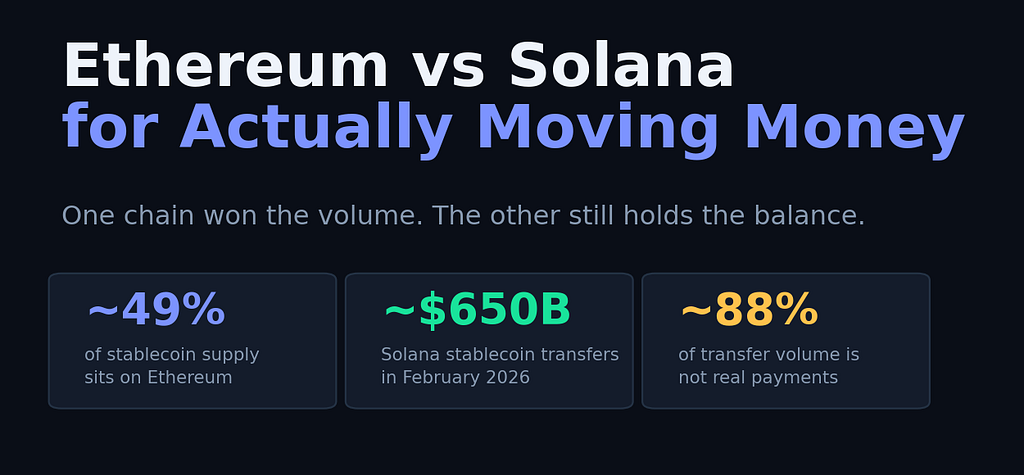
One chain won the volume. The other still holds the balance. The dollar you move and the dollar you park may not belong on the same chain.
Two chains, two jobs. The stablecoin market split into a movement layer and a settlement layer, and most comparisons still treat it as one race.
In January 2026, Solana passed both Ethereum and Tron in adjusted monthly stablecoin transaction volume.
By June 2026, Ethereum still held roughly $154 billion in stablecoin supply. About 49% of everything issued. Solana held around $15 billion. About 5%.
Both facts are true. Same year. Same asset class.
That gap is the entire Ethereum vs Solana argument, and most versions of it online miss the point.
Money does two jobs. It moves, and it sits. Solana got very good at the first one. Ethereum still holds the second.
Picking a winner only makes sense once you say which job you mean.
Stablecoin supply by chain, June 2026. Ethereum holds roughly 49 percent of everything issued. Solana holds roughly 5 percent.
Ethereum vs Solana Speed: Three Numbers, Not One
Payment speed is not a single metric. It is three, and people mix them up constantly.
Block time. How often the chain produces a block. Solana runs 400 millisecond blocks. Ethereum runs 12 seconds.Confirmation. When your wallet turns green. Fast on both chains. Probabilistic on both chains.Finality. When the transfer cannot be reversed. This is the only one a treasury desk cares about.
Finality is where the two chains genuinely diverge.
Settlement finality on a log scale. Confirmation is not finality, and finality is the number a treasury desk prices.Ethereum finalizes after two consecutive epochs. Roughly 12.8 minutes.Solana finalizes in roughly 12.8 seconds today.Alpenglow, Solana’s consensus overhaul, targets 100 to 150 milliseconds, with mainnet activation guided toward late 2026.
Same digits, different units. It is a useful way to remember the scale.
Fees split along the same line. Solana transfers sit well under a tenth of a cent. Ethereum mainnet is priced like a settlement venue, because that is what it has become.
Ethereum has not stood still either. The Fusaka upgrade shipped in December 2025 and raised blob capacity for rollups across two follow-on increases.
Glamsterdam, the next fork, has been in testnet hardening through 2026. Fidelity Digital Assets read Fusaka as a shift toward economic sustainability rather than raw throughput.
Single-slot finality, which would collapse that 12.8 minute window toward 12 seconds, remains research rather than a shipping date.
Why Solana Won the Stablecoin Payment Volume War
Solana processed roughly $650 billion in stablecoin transactions in February 2026, close to triple its January figure.
The reasons are unglamorous and real:
400 millisecond blocks make retry logic cheapSub-cent fees make sub-dollar payments viableFiredancer, the Jump Crypto validator client, lifted the throughput ceilingPayment apps and neobanks route high-frequency, low-value flows there by default
Now the part most comparison posts leave out.
Roughly 88% of stablecoin transfer volume is exchange activity, bots and arbitrage routing. Not real-economy payments.
Teams that filter the noise land on a few hundred billion dollars a year in genuine payment flow, not the trillions in the headlines.
So Solana did win something real. It is just not “most of the world’s money now moves on Solana.”
There is also a third chain nobody puts in the headline. Tron still carries the majority of real remittance flow, with roughly $90 billion in stablecoin supply and median transfer fees near nine cents.
If your framing is strictly “best blockchain for payments,” Tron has an uncomfortable claim that the Ethereum vs Solana framing keeps out of frame.
Why Institutional Capital Still Settles on Ethereum
Volume leadership and where value actually sits are two different races.
Ethereum hosts about 61.4% of tokenized assets, roughly $206.2 billion in onchain valueBlackRock, Franklin Templeton and WisdomTree all selected Ethereum for tokenization productsReversing a finalized Ethereum block would require an attacker to control and forfeit roughly 11 million staked ETHVolume leadership and value custody are separate races. Solana leads one. Ethereum leads the other.
That last line is the one large allocators price. Ethereum finality is slow measured in seconds and expensive measured in dollars. On a $50 million transfer, 12.8 minutes is not a delay. It is the product.
Sky Protocol made the same call. Its core smart contracts are deployed on Ethereum, chosen for the security and transparency that back billions in Total Protocol Collateral.
As of this writing that figure sits at roughly $14.15 billion, against a stablecoin supply near $11.48 billion.
What Does Your Dollar Do Between Transfers?
Here is the question the chain debate never touches.
A payment takes one second, or twelve minutes. A dollar sits still for weeks.
Neither Solana’s 400 millisecond blocks nor Ethereum’s economic finality does anything about the idle balance in between.
Chain choice is a transport decision. Yield is a separate decision, and it is usually the larger one.
That is where USDS and sUSDS sit.
[USDS](https://www.skyeco.com/products#usds) is the fully backed unit of account of Sky Ecosystem. The transport-layer dollar.[sUSDS](https://www.skyeco.com/products#susds) is the yield-generating version. Supply USDS, receive sUSDS, and the position accrues the Sky Savings Rate programmatically.The Sky Savings Rate is variable and set by SKY-token-holder governance. The live figure is published on the financial dashboard.No lockups. Convert back to USDS at any time, with no fees and no slippage.
The funding source matters more than any headline rate. The Sky Savings Rate is sourced from revenue accrued by Sky Protocol through institutional-grade collateral and deployment strategies, not from token emissions.
Independent allocators including Spark, Grove and Osero draw USDS liquidity under governance-set risk parameters and pay for that access.
Sky Frontier Foundation’s Q2 2026 report, for the quarter ended June 30:
Gross Protocol Revenue of $107.35M, up 10.5% year over yearNet Protocol Revenue of $40.09M, a 37.3% net marginNet Protocol Surplus of $33.29M, a fifth consecutive positive quartersUSDS supply of $5.52B, up 149% year over yearUSDS supply of $10.04B, up 41% year over yearSky Protocol, Q2 2026, as published by Sky Frontier Foundation. The Sky Savings Rate is funded from revenue accrued by the protocol, not from token emissions.
SkyLink: How One Dollar Lives Natively on Both Chains
You do not actually have to choose. USDS already lives on Ethereum and Solana, plus Base, Arbitrum and Avalanche.
The mechanism matters here, because most multichain stablecoins are wrapped IOUs with a bridge operator hiding inside them.
SkyLink is Sky Protocol’s cross-chain infrastructure, built on LayerZero’s omnichain token standardEthereum to Solana: USDS locks on Ethereum, the Solana program mints native USDSSolana to Ethereum: the Solana side burns, the Ethereum adapter unlocksNo third-party bridge liquidity pool. No wrapped representation. USDS on Solana stays backed 1:1 by USDS on EthereumDaily transfer limits are set by Sky Governance, not by a bridge operatorIn November 2025 the Ethereum to Solana route migrated from Wormhole to LayerZero through two governance spells, each carrying a 24-hour security delay. The USDS token address on Solana did not change.How SkyLink moves USDS between Ethereum and Solana. Lock and mint outbound, burn and unlock on the return. No wrapped representation and no bridge liquidity pool.
There is also an incentive layer. The Pioneer Prime program rewards independent agents for growing USDS on a specific chain. Keel holds the Solana designation.
Grove pioneered the Avalanche route in April 2026, starting under a $5 million daily cap that governance raised over the following weeks.
One detail from that November migration says more about the operating culture than any tagline.
Sky Governance published the full timeline in advance: a 31-hour expected downtime window, the exact contract addresses before and after, what happened to pending transfers, and three separate scenarios for how long the checks might run.
>> PULL QUOTE >> Bridge operators do not usually pre-announce their worst case. It is a small thing that tells you which risk model you are buying into.
A Four-Question Test for Picking a Chain
Skip the tribalism. Answer these instead.
A chain-selection test that survives the next upgrade cycle. Ticket size, counterparty, holding period, token provenance.What is the ticket size? Sub-dollar and high frequency favors Solana. Eight figures favors Ethereum finality.Who is on the other side? If the counterparty settles through a regulated intermediary, ask which chain they support before optimizing for fees.How long will the balance sit? Longer than a week and the yield question outweighs the fee question, by a lot.Is the token native or wrapped? A wrapped representation adds a bridge operator to your risk stack. Native issuance does not.
The Answer Is a Division of Labor, Not a Chain
Solana is winning the movement layer. Ethereum is holding the settlement layer. That is not a contradiction.
It is specialization, and it rhymes with how clearing and depository functions split roles in the system stablecoins are quietly rebuilding.
Sky Protocol was designed for that world on purpose. Collateral and settlement logic on Ethereum.
Native distribution to Solana and other chains through SkyLink. One dollar in USDS, with a yield-generating version in sUSDS for the balance that is not moving today.
Check the numbers yourself rather than taking them from a post. Protocol financials are public, and so is the onchain state.
Now the argument I want to have in the comments.
If Alpenglow ships at 150 millisecond finality, does Ethereum’s economic finality still justify a twelve-minute wait on institutional-size transfers? Or does the settlement layer start losing ground too?
Pick a side and tell me why.
Disclaimer to append at the end of the post
This content is published for information purposes only. It does not constitute financial, legal or tax guidance.
Ethereum vs Solana for Actually Moving Money was originally published in Coinmonks on Medium, where people are continuing the conversation by highlighting and responding to this story.