
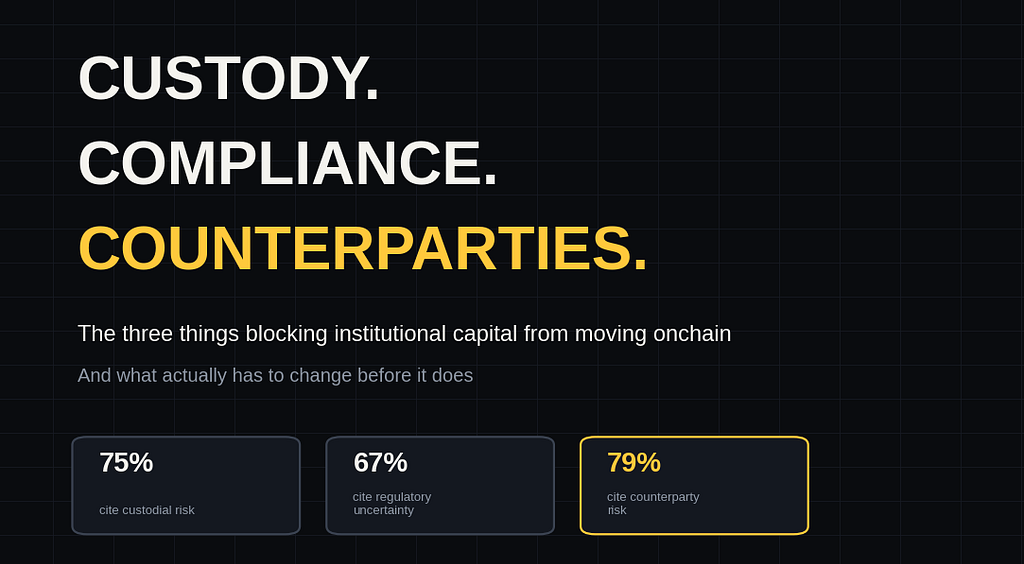
Institutions say they want onchain exposure. Three words in every risk memo say otherwise. Here is what each one really means, and what it would take to clear it.
Three words decide most institutional allocation conversations. None of them is price.
Ask a treasury team why they have not allocated onchain yet, and you will rarely hear “we think it goes down.”
You will hear three words. Custody. Compliance. Counterparties.
The same three, in roughly that order, across almost every risk memo and almost every jurisdiction. They are not price objections. They are plumbing objections.
That difference matters. Price objections resolve themselves when the market moves. Plumbing objections only resolve when somebody rebuilds the plumbing.
And the appetite is already there. In EY’s 2026 institutional digital asset survey, 73% of institutions said they plan to increase allocations this year. Stablecoin market capitalisation crossed $322 billion in June 2026.
Tokenized Treasuries climbed from roughly $8.9 billion at the start of the year to somewhere between $12 billion and $15 billion by mid-year.
The money is not undecided. It is blocked.
Here is what makes that expensive. By most estimates, around 80% of stablecoin supply sits in no yield-generating position at all. That is not caution. That is capital paying a tax to wait.
The blockers institutions name themselves, ranked. Counterparty risk edges out custody, and regulatory uncertainty sits behind both.
Barrier One: Institutional Crypto Custody Has No Clean Answer
Custody is the first gate because it is the easiest one to lose your job on.
Around 75% of institutional investors flag custodial risk as a top-tier concern. The response has been revealing. 61% now run a multi-custodian model. Only 36% use a single custodian.
Read that again. Institutions are not solving custody risk. They are diversifying their exposure to it.
Splitting balances across three providers shrinks the size of any single failure. It does not remove the failure mode. The dependency does not disappear. It just gets divided by three.
Institutions are not solving custody risk. They are diversifying their exposure to it.
EY framed the shift well. The question has moved from who can custody to who can custody under scrutiny, meaning scrutiny from regulators, auditors, clients and internal risk committees at the same time.
The scar tissue is earned. FTX wiped out roughly $8 billion in customer funds in 2022 and caught Tiger Global, Sequoia and the Ontario Teachers’ Pension Plan off guard simultaneously.
Credit agencies still do not rate digital asset counterparties the way they rate a clearing house, so risk committees end up working from reputation and regulatory status.
There is a third option that most institutional crypto conversations skip past. Architecture where no third party can reach the collateral at all.
Sky Protocol is non-custodial by construction. No third party can move balances, override liquidation logic, or reach collateral directly.
Sky Governance sets parameters through onchain Executive Votes, and every sensitive change carries a mandatory time delay before it takes effect.
That is not a service commitment. It is a property of the contracts.
Barrier Two: Compliance Clarity Is the Gate, Not the Gas Pedal
Regulatory uncertainty is the most-cited blocker in the market. 66% of institutions name it as their primary concern. 67% call it the single biggest barrier to allocating into tokenized products.
2026 moved the line. GENIUS Act implementing rules landed on the one-year mark. MiCA’s transition window for legacy issuers closed on 1 July. Hong Kong granted its first stablecoin issuer licences in April.
But clarity in the statute is not the same as clarity in the diligence file.
What a compliance team actually needs is evidence, produced on a schedule they control. That is where most of the market still fails them.
Traditional financial reporting runs on quarterly cycles, so by the time a report is published, the position it describes is months old.
Sky Protocol inverts that. The balance sheet, Gross Protocol Revenue, Net Protocol Revenue, Protocol Surplus and Sky Reserves are published live.
Closed-period detail sits in the quarterly reports published by the Sky Frontier Foundation.
Two more signals worth putting in a diligence file:
S&P Global assigned the protocol a B- rating in 2024, the first structured finance credit rating given to an onchain protocol.Critical contracts sit under continuous review by Certora, ChainSecurity and Cantina, with the full audit history public.
Operational entry matters too. The Peg Stability Module converts major stablecoins into USDS at a strict 1:1 ratio with no fees and no slippage, so a large allocation does not pay a spread simply to arrive.
Verifiable beats permitted.
A diligence analyst can check every claim in this section in about four minutes, without an NDA and without a sales call.
A quarterly report answers a diligence question on the publisher’s schedule. A live dashboard answers it on the reader’s.
Barrier Three: Counterparty Risk Is the One Nobody Wants to Name
This is the quiet one, and the largest.
79% of institutional traders name counterparty risk as their single greatest concern in OTC markets.
48% reported settlement delays in 2025 caused by counterparty creditworthiness. 42% have capped exposure to smaller venues outright.
In most yield-bearing dollar products, counterparty risk is concentrated and invisible at the same time.
One issuer. One balance sheet. One attestation cycle. If it breaks, you are a creditor in a queue.
Sky Ecosystem is built the other way around. The Sky Agent Network is a set of independent capital allocators that access USDS liquidity under governance-set risk parameters and deploy it across diversified strategies.
Spark runs lending markets. Grove handles institutional tokenized credit. Obex incubates new allocators. They are separate businesses, not subsidiaries.
Better, the NASDAQ-listed mortgage lender, runs a $500M mortgage credit facility and is the first publicly listed US company deploying capital as a Sky Agent.
In April 2026, Coinbase completed the migration of DAI to USDS, the largest stablecoin migration recorded to date.
Here is the part most people get backwards.
An sUSDS holder accesses the Sky Savings Rate. They are not a claimant on any specific collateral pool, borrower, Agent or strategy. If an Agent’s book takes losses, those losses hit a fixed, pre-published order.
The Agent’s own risk capital first, sized against deployed exposure using a Basel III CRR methodology.The Surplus Buffer second, where protocol revenue accumulates before distribution. Sky Governance raised the target to $150M USDS in May 2026.Recapitalization through SKY issuance third, which requires an Executive Vote and a mandatory delay.Emergency Shutdown last, which halts minting and lets every USDS holder redeem directly against the remaining collateral pool.The loss waterfall, published in advance. sUSDS holders access the Sky Savings Rate; they are not a claimant on any single Sky Agent.
That waterfall is not a marketing diagram. It has been tested. The protocol carried zero exposure to the UST collapse and zero to the FTX bankruptcy, because governance had never approved either as eligible collateral.
It held through Black Thursday in March 2020, and through the March 2023 depeg pressure that reached the Peg Stability Module. Across seven years of operations, the core protocol has recorded zero exploits.
The Numbers an Allocator Can Check Without Calling Anyone
Sky Protocol Q2 2026: second consecutive quarter above $100M in Gross Protocol Revenue, with sUSDS supply up 149% year over year.
This is where the argument either holds up or falls over.
Protocol Collateral stands at $14.15B against $11.48B in circulating stablecoin supply. The system runs overcollateralized by design, not by policy.Sky Protocol generated Gross Protocol Revenue of $107.35M in Q2 2026, up 10.5% year over year and the second consecutive quarter above $100M.Net Protocol Revenue reached $40.09M, up 25.1%, with the net margin widening to 37.3% from 33.0%.The annualized gross run rate hit a record $419.08M.sUSDS supply closed Q2 at $5.52B, up 149% from $2.22B a year earlier, making it the largest yield-generating stablecoin by outstanding supply.Cumulative Sky Savings Rate distributions passed $250M.Prime Agent Vaults held $6.84B, including roughly $2.58B allocated across Janus Henderson, BlackRock’s BUIDL fund, Anchorage, PayPal, Securitize and Galaxy.
That last line is the interesting one. Institutions are not all waiting outside the door. Some are already inside, deploying through the network.
Overcollateralized by construction. Every USDS in circulation is backed by Protocol Collateral, and the position is auditable in real time.
What This Does Not Solve
Any honest piece on institutional crypto barriers needs this section.
Smart contract risk is real. Audits reduce it. They do not remove it.The Sky Savings Rate is variable and governance-set. It is a parameter, not a promise, and it moves with rate conditions and protocol revenue.Governance is still a human process. Time delays and dual-reviewer checks slow bad decisions down. They do not prevent them.Onchain settlement does not answer every jurisdictional question a regulated allocator has to answer.
Anyone selling certainty on those four points is selling something.
So What Actually Unblocks Institutional Capital?
Custody stops being the question when there is no third party to trust with it.
Compliance stops being the question when the balance sheet is public and continuous instead of quarterly and curated.
Counterparty risk stops being the question when exposure sits across independent allocators with a published loss waterfall behind them.
That is the thesis, and none of it requires taking anyone’s word for it. Every figure above is on a public dashboard right now at skyeco.com.
Custody stops being the question when there is no third party to trust with it.
Now the part I actually want to hear about.
Which of the three is the real blocker inside your organisation? Custody, compliance, or counterparties? And if your risk committee approved an onchain allocation tomorrow, which one would have been the last to sign off?
Tell me in the comments. I read all of them.
Custody, Compliance, Counterparties: The Three Things Blocking Institutional Capital was originally published in Coinmonks on Medium, where people are continuing the conversation by highlighting and responding to this story.