
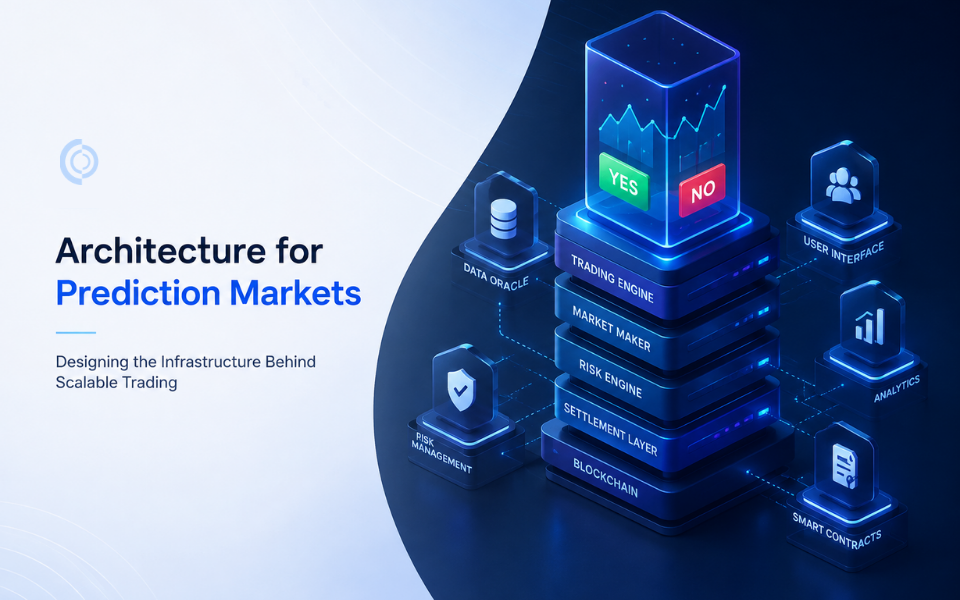
Prediction Markets Architecture
A prediction market is easy to explain:
Users trade on an outcome. An oracle determines what happened. The winners receive the payout.
Building the infrastructure that makes those three steps fast, reliable, transparent, and scalable is considerably harder. A production prediction market combines a trading engine, liquidity system, smart contracts, oracle infrastructure, settlement logic, indexing, APIs, and security controls.
For B2B crypto founders and developers, the critical architectural question is:
What should happen on-chain, what should happen off-chain, and where should trust be enforced? That decision affects performance, cost, scalability, and ultimately the viability of the product.
The Architecture at a Glance
A practical prediction-market stack looks like this:
Prediction Market Architecture
Each layer solves a different problem.
Application layer handles users and business logic.Trading layer handles price discovery and execution.Liquidity layer makes trading possible at reasonable prices.Oracle layer determines the real-world outcome.The settlement layer converts that outcome into financial payouts.Blockchain provides the verifiable state and execution environment.
The architecture becomes powerful when these responsibilities are clearly separated.
The First Decision: Centralized, Decentralized, or Hybrid?
There is no architectural prize for putting everything on-chain. The right design depends on what your product needs.
Centralized
The backend controls trading, balances, and settlement.
– Strength: maximum performance and operational control.
– Weakness: users must trust the operator.
Decentralized
Smart contracts handle core trading and settlement logic.
– Strength: transparent, verifiable execution.
– Weakness: blockchain latency, gas costs, and smart-contract complexity.
Hybrid
High-speed operations run off-chain while trust-critical settlement happens on-chain.
This is not merely a theoretical model. Polymarket’s current trading infrastructure, for example, uses off-chain CLOB matching with on-chain settlement, combining order-book performance with blockchain-enforced settlement.
The B2B Takeaway
For many commercial platforms, the strongest design principle is: Keep performance-sensitive operations off-chain. Keep trust-sensitive financial operations on-chain.
Market Definition Is a Technical Problem
Before users trade, the platform needs to define exactly what they are trading. A market should have structured parameters such as:
Market IDQuestionOutcomesOpening TimeClosing TimeResolution RulesOracle SourceSettlement AssetFee ModelMarket Status
Consider:
Will BTC exceed $150,000 by December 31?
That question is not technically complete. You still need to define:
Which BTC price?Which data source?What timestamp?Does a temporary price spike count?What happens if the data source is unavailable?
Why this matters
Ambiguous market definitions create downstream problems in oracle resolution, disputes, and settlement. A prediction market should therefore convert natural-language questions into deterministic resolution conditions. This is one of the most important pieces of infrastructure and one of the easiest to underestimate.
Trading Architecture: Order Book vs. AMM
Once a market exists, users need a mechanism to trade its outcomes.
Order Book
A Central Limit Order Book (CLOB) maintains buy and sell orders at different prices.
BUY SIDE SELL SIDE
$0.60 × 500 – $0.65 × 300
$0.59 × 700 – $0.66 × 500
$0.58 × 900 – $0.68 × 400
The matching engine pairs compatible orders.
Best suited for
Professional tradersMarket makersAdvanced order typesHigh-volume marketsPrecise price discovery
The major engineering requirement is low-latency order matching. A real implementation can keep matching off-chain while submitting matched trades for blockchain settlement. Polymarket documents this exact hybrid model for its CLOB.
Automated Market Maker
An AMM allows users to trade against protocol-controlled liquidity.
Instead of waiting for a matching seller, the pricing mechanism determines the trade price based on pool liquidity.
Best suited for
Permissionless marketsSimpler trading UXMarkets that need continuous liquidity
But AMMs introduce a major challenge:
Price impact: If liquidity is shallow, a large trade can move the price significantly.
Architectural decision: Don’t ask — “Which model is better?”
Ask: “What trading behavior does the product need to support?” That decision should drive the architecture.
Liquidity Is Infrastructure, Not Marketing
A market with no meaningful liquidity isn’t a useful market. Poor liquidity creates:
Wide spreads → higher slippage → worse execution → lower participation
For a B2B platform, liquidity architecture may involve:
Professional market makersLiquidity incentivesProtocol-owned liquidityAMM poolsMarket-specific liquidity parameters
The engineering system should continuously expose metrics such as:
Bid/ask spreadOrder-book depthTrading volumeSlippageLiquidity utilization
This gives the platform an objective way to identify markets that are technically live but economically unhealthy.
Smart Contracts: What Actually Belongs On-Chain?
Smart contracts should enforce the rules users need to trust. Typical responsibilities include:
Collateral
Lock or manage assets backing positions.
Position ownership
Represent who owns which outcome positions.
Settlement
Determine whether positions can be redeemed.
Fees
Apply protocol-defined fee logic.
Market state
Record critical state transitions.
The important architectural principle is minimalism. You don’t need to put search, analytics, notifications, or every business operation on-chain. Every on-chain operation introduces additional considerations around:
Gas → latency → throughput → upgradeability → security
Put the financial invariants on-chain. Keep everything else where it can be processed more efficiently.
The Oracle Is the Bridge to Reality
The blockchain cannot independently determine whether an external event happened. That’s why prediction markets need an oracle:
For a financial market, the oracle may provide a price. For a sports market, it may provide a final score. For a governance market, it may provide a proposal result.
But the real problem is not data delivery.
It is resolution integrity. The system must answer: “Why should this particular piece of data be accepted as the final truth?” A serious oracle design therefore considers:
Source reliabilityData freshnessTimestamp rulesMultiple sourcesFallback mechanismsDispute handlingFinality conditions
This is why oracle design should be treated as risk architecture, not simply an API integration.
Resolution and Settlement Are Different
These two concepts are often incorrectly treated as one operation.
Resolution
Determines the winning outcome.
Settlement
Uses that outcome to distribute financial value. The flow is:
Market Closes
↓
Oracle Reports Outcome
↓
Validation / Dispute Period
↓
Outcome Finalized
↓
Settlement Contract
↓
Winner Redeems
Keeping resolution and settlement logically separate makes the system easier to audit and reason about. It also gives you room to introduce different resolution mechanisms without rewriting the entire settlement system.
Data Architecture: Blockchain Is Not Your Query Engine
A common mistake is expecting the blockchain to serve every application query. Imagine an enterprise client asks: “Return every market this wallet traded during the last 12 months, including entry price, exit price, realized P&L, and market outcome.”
Scanning the chain for every request would be inefficient. A better architecture is:
Blockchain
↓
Event Logs
↓
Indexer
↓
Operational Database
↓
API
↓
Enterprise Application
The blockchain remains the source of verifiable state. The database becomes the application-optimized query layer.
Why B2B customers benefit
This architecture enables:
Fast dashboardsHistorical analyticsPortfolio reportingSearchMarket intelligenceEnterprise APIsWebhooks
This is where prediction-market infrastructure can become valuable beyond its own frontend.
API Architecture Turns a Product Into Infrastructure
A B2B prediction-market platform should think beyond its user interface. Expose capabilities through APIs:
Market APIOrder APIPosition APIPrice APIResolution APIHistorical Data APIAnalytics APIWebhooks
A third-party application could then consume:
Market prices → implied probabilities → historical outcomes → trading activity
without rebuilding the underlying infrastructure. This creates a second product surface: Prediction markets as infrastructure.
For founders, that means the business can potentially serve not only traders but also financial platforms, analytics products, research companies, and other applications.
Security Must Follow the Data Flow
Prediction markets have a wider attack surface than a normal DeFi application because they combine financial assets with external information. Think about security by layer:
Layer & its Associated Risks
The key insight: A secure smart contract does not automatically make a secure prediction market. The entire transaction path must be secured.
Scalability: Don’t Let One Workload Break Another
Trading, analytics, indexing, and user-facing APIs have different performance requirements. A scalable architecture separates them:
API GATEWAY
↓
┌────────────┴────────────┐
↓ ↓
TRADING SERVICES READ SERVICES
↓ ↓
MATCHING ENGINE CACHE
↓ ↓
SETTLEMENT DATABASE
↓
BLOCKCHAIN
Trading needs low latency. Analytics needs high query throughput. Indexing needs reliable event processing. Separating these workloads prevents a heavy reporting query from competing directly with the trading engine.
For B2B platforms, this is critical. Enterprise customers expect predictable performance — not a system that slows down whenever usage spikes.
Observability: Monitor the Financial System, Not Just the Server
Traditional application monitoring isn’t enough. You need both technical and market-level observability.
Infrastructure
CPU/GPU utilizationMemoryAPI latencyError ratesQueue depth
Trading
Order volumeFill rateSpreadSlippageMatching latency
Blockchain
Failed transactionsConfirmation timeGas consumptionContract events
Oracle
Data freshnessUpdate failuresResolution latencySource discrepancies
This gives engineering teams visibility into whether the platform is merely online or actually operating correctly.
The Architecture B2B Builders Should Aim For
For a commercially scalable prediction-market platform, a hybrid architecture is a strong starting point:
Hybrid Architecture
The architecture follows one simple rule:
Off-chain
Handle:
High-frequency matchingSearchAnalyticsUser interfacesAPI processingIndexing
On-chain
Enforce:
Asset custodyPosition ownershipSettlementCritical financial rules
Oracle
Determine:
External event outcomesResolution dataFinal market state
This separation gives each layer a job it is actually good at.
The Real Architecture Checklist
Before development starts, a B2B builder should be able to answer these questions,
Trading: Will the product use a CLOB, AMM, or both?
Liquidity: Who provides liquidity, and how is market depth maintained?
Blockchain: Which financial operations actually need on-chain enforcement?
Oracle: Where does the outcome come from?
Resolution: What happens when the oracle is wrong or the outcome is disputed?
Data: How will historical market and trading data be indexed?
API: What capabilities should external businesses be able to consume?
Scalability: Can trading remain responsive while analytics and indexing workloads increase?
Security: What happens if any individual layer fails?
If these questions aren’t answered before implementation, architectural debt is almost guaranteed.
Conclusion: The Competitive Advantage Is in the Architecture
A prediction market isn’t simply: Frontend + Smart Contract + Oracle. It is a distributed financial system where several components must agree on one thing: What happened, who owns the resulting position, and how much should be paid?
The strongest architecture separates those responsibilities.
Trading infrastructure provides performance.Liquidity infrastructure provides usable markets.Smart contracts provide verifiable financial rules.Oracles connect blockchain state to external reality.Resolution systems establish the outcome.Indexers and APIs turn blockchain state into usable business data.Observability and security keep the entire system reliable.
For B2B crypto builders, the goal isn’t maximum decentralization. It is purposeful decentralization: Put trust-critical logic where it can be verified.
Put performance-critical workloads where they can scale. That architectural boundary is what turns a prediction-market concept into production-grade financial infrastructure.
Architecture for Prediction Markets: Designing the Infrastructure Behind Scalable Trading was originally published in Coinmonks on Medium, where people are continuing the conversation by highlighting and responding to this story.