
Zcash just crossed $1,000. Monero is the one still worth watching. Here’s what the charts, and the money, are actually telling us.
By altFINS · September 7, 2026
If you filed privacy coins under “2021 relic,” the last quarter was expensive.
Zcash is up more than 235% over 90 days. It broke $1,000 for the first time since early 2018 on September 4, and as of this writing it’s trading north of $1,190. It now has its own spot ETF on the New York Stock Exchange. The narrative most of the market wrote off two years ago just became the cleanest trend on the board.
But the headline number isn’t the trade. The trade is buried one layer down, in the coin that hasn’t gone parabolic yet. More on that below.
First, the setup.
Where the market is
The backdrop was risk-on before privacy ever caught a bid. Bitcoin is up roughly 25% over the last 30 days, with short- and medium-term trend both reading Strong Up and RSI around 68-firm, but not yet stretched. When Bitcoin sets that kind of tone, capital doesn’t sit still. It picks a lane.
This quarter, the lane was privacy. And unlike the meme-driven rotations that burn out in a week, this one has a spine of real catalysts underneath it.
Why this is a narrative, not noise
Three things happened in the same window, and together they changed the structural story for the entire category:
1. Zcash got a Wall Street wrapper. On August 25, Grayscale converted its nine-year-old Zcash Trust into a spot ETF — ticker ZCSH — live on NYSE Arca. It’s the first US-listed spot ETF for any privacy coin. It launched with roughly $304 million in assets and, in under ten days, inflows pushed that past $414 million. A privacy asset now sits inside ordinary brokerage accounts, which is a sentence that would have sounded absurd in 2023.
2. THORChain opened the plumbing. The same day, THORChain’s 3.20 upgrade went live with native Monero and Zcash swaps — no wrapped tokens, no custodial intermediary, no KYC gate. For coins that have spent two years getting quietly delisted from centralized exchanges, a self-custodial cross-chain route isn’t a feature. It’s a lifeline, and a fresh source of organic demand.
3. The delistings backfired. Exchange restrictions were supposed to starve Monero. Instead they concentrated demand into the venues that still list it and, now, into the decentralized rails that don’t need permission. Scarcity of access, it turns out, is not the same as scarcity of interest.
That’s the difference between a story and a squeeze. A squeeze needs liquidations. A story needs a reason the flow keeps coming after the squeeze is over. Privacy has both right now.
The whole basket is trending, and still broadening
This isn’t a one-coin move. Run the privacy category through a screener and the trend is visible across the board, not just at the top. The rotation is also still widening: fresh resistance-breakout signals have been firing on names further down the market-cap list, which is exactly what you want to see if you think a narrative has legs rather than a single blow-off top.
Breadth is the tell. A rally carried by one name is a headline. A rally where the second and third tier are independently breaking resistance is a rotation.
The one that isn’t overbought yet
Here’s where discipline separates the entry from the chase.
Zcash, Dash, and Firo are all sitting at RSI 85-plus. ZEC’s 14-day RSI is above 86; Dash is above 87. Those are not entry signals. Those are “you’re late, and you’re paying for it” signals. Buying a vertical move at RSI 86 is a bet that greater fools arrive faster than gravity does. Sometimes they do. It is not a plan.
Monero is the laggard-leader. It’s up about 46% on the month, a real move, but its RSI is only around 72. Short- and medium-term trend both read Strong Up. It has participated in the narrative without going vertical, which is the rarest and most useful thing a chart can offer in a hot sector: exposure to the theme without the overbought tax.
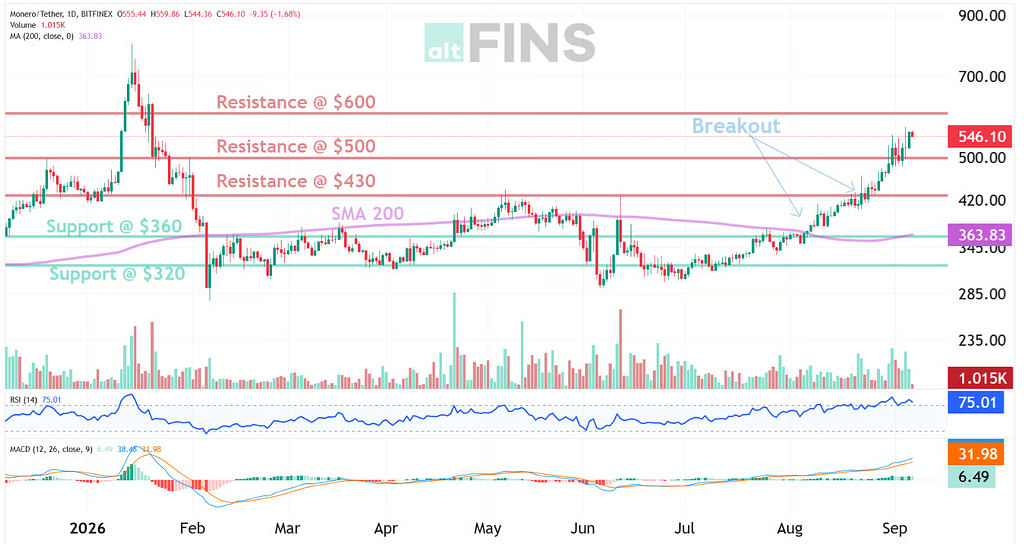
XMR is trading near $537, stalled just under the $550–$600 resistance shelf, the last real overhead supply before the February spike high up near $800.
The altFINS curated setup on XMR
Source: altFINS Technical AnalysisAggressive entry: price has already broken above $500.Lower-risk entry: a pullback toward the $430 key level.Invalidation: a daily close back below $430.Hard stop: $395.Nearest target: ~$600.Extended objective: ~$800.
Read that as a framework, not a fortune. The point of writing entries, invalidation, and targets down is that it forces the trade to have a shape before emotion gets a vote. The $430 level is doing the real work here: above it, the thesis is alive; on a daily close below it, the thesis is wrong and you’re out. That’s the whole discipline in one line.
XMR / USD, daily
Monero broke through $500 resistance and is now testing the underside of the $550–$600 zone. Clear it, and $600 is the near-term magnet, with the $800 February high as the extended objective. Fail here, and $430 is where the setup either reloads or invalidates. Everything else is commentary.
The takeaway
The privacy trade already happened for Zcash — 235% in 90 days and a four-figure price prove it. Chasing ZEC at RSI 86 isn’t participating in the narrative; it’s underwriting everyone who got in earlier. The more interesting question is where the unspent fuel is, and right now the charts point at the laggard-leader that hasn’t gone vertical.
Narratives are found on the screener before they’re found in the headlines. By the time a move is a headline, the clean entry is usually already gone.
Run the basket yourself
Don’t take our levels on faith — pressure-test them. Filter the privacy category on the altFINS screener, read the support and resistance on each chart, set price alerts on the key levels, and you’ll catch the next resistance breakout live instead of reading about it a week late. That’s the entire edge: seeing the setup form in real time, on data you verified yourself.
→ Screen privacy coins on altFINS
This is market analysis, not financial advice. Crypto is volatile and privacy coins especially so, regulatory treatment varies by jurisdiction and at least ten countries restrict or ban them outright. Do your own research and never risk more than you can afford to lose.
Privacy Coins: The Rotation Nobody Wanted to Believe was originally published in Coinmonks on Medium, where people are continuing the conversation by highlighting and responding to this story.