
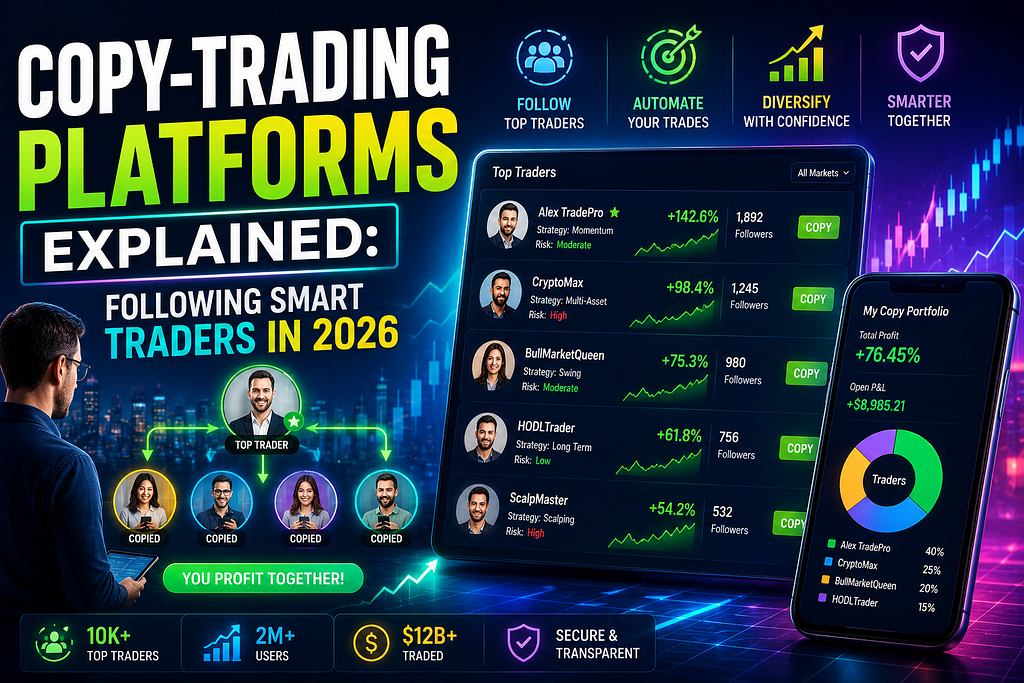
What if you could hand your trades to someone with a better track record than you — without handing over control of your money?
Copy-Trading Platforms Explained — Following Smart Traders in 2026
That’s the entire pitch behind copy trading, and in 2026 it’s no longer a niche feature buried in a broker’s settings menu. It’s one of the fastest-growing ways ordinary people are entering markets, from stocks and forex to crypto and perpetual futures. If you’ve ever watched a skilled trader’s portfolio outperform yours and thought, “I wish I could just do what they’re doing,” copy trading is the answer someone already built for you.
This guide breaks down exactly what copy trading is, which platforms dominate the space right now, how the fees actually work (they’re rarely as simple as advertised), and whether this “set it and forget it” strategy deserves a spot in your portfolio.
What Is Copy Trading (And Why Is It Also Called Social Trading)?
Copy trading — sometimes called social trading — is a system where you automatically mirror the trades of another investor, often called a “lead trader,” “elite trader,” or “Popular Investor,” depending on the platform. When they open a position, your account opens a proportional version of that same position. When they close it, yours closes too.
You’re not just watching a signal and manually clicking “buy.” The execution is automated. Once you connect your account to a trader you want to follow, the platform handles the mirroring in real time, scaling the trade size to match whatever amount of capital you’ve allocated.
The “social” label comes from the community layer most platforms build around this feature: public leaderboards, win-rate stats, follower counts, live P&L transparency, and sometimes a social feed where traders explain their reasoning. It turns investing from a solitary research project into something closer to following creators — except the “content” is real trades with real money behind them.
This isn’t new in concept. Forex and stock traders have used social trading for over a decade. What’s changed in 2026 is the sheer scale of platforms offering it, the arrival of crypto-native copy trading with far lower entry minimums, and much more sophisticated risk controls than the early versions ever had.
The Platforms Leading Copy Trading in 2026
eToro — The Original Social Trading Platform
eToro — The Original Social Trading Platform
eToro effectively invented mainstream copy trading and remains the most recognized name for stocks, ETFs, forex, and crypto CFDs. Its CopyTrader feature lets you browse trader profiles, filter by risk score, review historical performance, and allocate capital starting from a relatively low minimum copy amount.
What makes eToro appealing to beginners is the built-in safety net: you can set a Copy Stop Loss to automatically halt copying if losses hit a threshold you define, pause copying without closing existing positions, or stop entirely and choose what happens to your open trades. You stay in control even while automation runs in the background.
Bitget Copy Trading — Crypto’s Copy Trading Powerhouse
Bitget Copy Trading — Crypto’s Copy Trading Powerhouse
Bitget has built one of the largest copy trading ecosystems in crypto, with a database of verified lead traders numbering in the hundreds of thousands, spanning spot, futures, and even bot copy trading. Traders are filterable by return, drawdown, win rate, and follower count, which makes due diligence far easier than blindly picking a name off a leaderboard.
Bitget’s structure separates spot copy trading, futures copy trading, and bot copy trading, each with slightly different mechanics and fee caps, giving both cautious and aggressive investors a lane that fits their risk appetite.
FOMO — Social-First, Mobile-Native Copy Trading
FOMO represents the newer generation of copy trading apps: mobile-first, built around a live social feed showing what top traders are buying in real time, and heavily focused on Solana-based execution for speed. Rather than bolting a copy feature onto an existing exchange, FOMO was designed from the ground up around the idea of trading socially — following traders, seeing public win rates, and mirroring positions with a few taps.
Other notable names worth researching if you’re comparing platforms include Bybit Copy Trading, OKX, and BingX, all of which run similar profit-share models with varying trader pools and minimum investment thresholds.
How Copy Trading Fees Actually Work
This is where most beginners get surprised, because “free” and “low-cost” marketing language rarely tells the whole story. There are generally two fee models at play, and most platforms blend them.
1. Profit-Sharing Model
This is the dominant structure in crypto copy trading. The lead trader sets a percentage — commonly somewhere between 5% and 20% — that they earn only when a copied trade closes in profit. If the trade loses money, no profit share is charged, but you still absorb the loss itself along with any standard trading fees.
Crucially, profit share is calculated on your realized gains, not on the total capital you’ve allocated. So if you copy a trader with a 10% profit share and your copied position nets you $500, you’d owe roughly $50 to that trader, with the rest as your net gain.
2. Standard Trading Fees (Layered on Top)
Even when a platform advertises “no copy trading fee,” your mirrored trades typically still pay the same maker/taker fees, spreads, or commissions a manual trade would incur. On crypto exchanges, this usually means small percentage-based fees on entry and exit, plus funding fees if you’re copying leveraged futures positions overnight.
3. Subscription-Style Fees (Less Common Today)
Some legacy platforms and premium trader tiers still charge a flat monthly subscription instead of, or in addition to, profit sharing. This model is less common in 2026’s leading platforms but still shows up in niche signal-selling services, so always check before committing capital.
The Real Math
The takeaway: your “all-in” cost as a copier is never just the headline profit-share number. It’s profit share plus trading fees plus any spread or funding cost, compounded every time the trader you’re copying opens and closes a position. A trader who makes frequent, small trades can quietly cost you more in fees than a trader who makes fewer, larger moves — even if their win rate looks better on paper.
The Pros of Copy Trading
A genuine learning curve, without the tuition. Watching a skilled trader’s entries, exits, and position sizing in real time teaches you far more than reading a textbook ever could. You start to notice patterns: how they size positions relative to conviction, when they cut losses, how they handle volatility.
Instant diversification: Instead of putting all your capital behind your own limited strategy, you can spread allocation across multiple traders with different styles — one conservative, one aggressive, one focused on a specific sector or asset class. This diversifies your exposure to strategy risk, not just asset risk.
Lower time commitment than active trading: You don’t need to watch charts all day or research every entry yourself. Once you’ve selected a trader and set your risk parameters, the system runs largely on its own.
Transparency you don’t get with traditional fund managers: Most copy trading platforms show you real-time win rates, drawdown history, and portfolio composition. Compare that to a traditional actively-managed fund, where you might get a quarterly PDF report and little else.
Full liquidity and control: Unlike a lock-up fund, you can pause, adjust, or stop copying at any moment, and in most cases withdraw your funds whenever you choose.
The Cons of Copy Trading
You’re only as good as the trader you pick: This is the single biggest risk. Past performance is not a guarantee of future results, and a trader with a great six-month track record can still hit a losing streak, change strategies, or take on excessive risk trying to defend their leaderboard position.
Fees compound against high-frequency traders: As covered above, copying an active trader who enters and exits constantly can quietly erode your returns through fees and spreads, even when the underlying trades are profitable.
Slippage and execution lag: Your copied trade doesn’t execute at the exact same price or millisecond as the leader’s. In fast-moving markets, especially crypto, this gap can matter.
It’s not truly passive risk management: “Set it and forget it” describes the execution, not the responsibility. You still need to periodically review whether a trader’s strategy still matches your goals, whether their risk profile has drifted, and whether it’s time to reduce allocation or stop copying entirely.
Platform and custody risk: On most centralized crypto exchanges, copy trading is custodial — your funds sit with the platform, not in a wallet you control. That’s an added layer of counterparty risk worth weighing against the convenience.
Is Copy Trading a “Set It and Forget It” Strategy?
Relative to manual trading, yes — largely. You’re not placing individual orders, monitoring charts hourly, or making split-second decisions. The heavy lifting of trade execution is automated the moment you allocate capital to a trader.
But “passive” is relative, not absolute. The real work in copy trading happens upfront and periodically afterward: selecting traders with a genuine, verifiable track record, understanding their risk profile and drawdown history, setting stop-loss limits so one bad run doesn’t wipe out your allocation, and revisiting that decision every so often rather than copying blindly forever.
Think of it less like a savings account and more like hiring a portfolio manager whose work you can audit in real time, and fire the moment you’re unhappy.
Frequently Asked Questions
Is copy trading profitable?
It can be, but it’s not guaranteed. Your returns depend entirely on the trader you follow, the fees you pay, and how well you manage allocation and risk limits. Treat copy trading as a strategy that shifts effort from execution to trader selection, not a shortcut to guaranteed gains.
How much money do I need to start copy trading?
Minimums vary widely by platform, ranging from as little as $10–$50 on some crypto exchanges to $200 or more on platforms like eToro. Keep in mind that meaningful diversification across several traders usually requires more than the bare minimum per trader.
Do I need trading experience to use a copy trading platform?
No — that’s part of the appeal. Beginners can start copying experienced traders immediately. That said, a basic understanding of risk management, position sizing, and how profit-share fees work will help you make smarter allocation decisions.
What’s the difference between copy trading and a managed fund?
Copy trading gives you full liquidity and transparency — you see the trades and can exit anytime. A traditional fund often locks up capital and provides limited visibility into day-to-day decisions.
Which is better: eToro, Bitget, or FOMO?
It depends on your market. eToro suits stocks, ETFs, and forex with a highly regulated, beginner-friendly interface. Bitget offers the deepest pool of verified crypto lead traders across spot, futures, and bots. FOMO is built for fast, social, mobile-first crypto trading, especially around Solana assets.
Final Thoughts
Copy trading in 2026 isn’t a gimmick — it’s become a legitimate on-ramp for people who want market exposure without becoming a full-time trader. The technology has matured, the fee structures are more transparent than they used to be, and the range of platforms means there’s likely a fit for whatever asset class and risk tolerance you have.
But the core truth hasn’t changed: you’re still responsible for who you trust with your capital. Do the diligence on a trader’s track record, understand exactly how profit-sharing fees will eat into your gains, and use the risk controls every good platform gives you. Do that, and copy trading might just be the smartest passive strategy you add this year.
If this helped you understand copy trading platforms a little better, give it a clap and follow for more breakdowns on trading tools, platforms, and strategies in 2026.
Copy-Trading Platforms Explained: Following Smart Traders in 2026 was originally published in Coinmonks on Medium, where people are continuing the conversation by highlighting and responding to this story.