
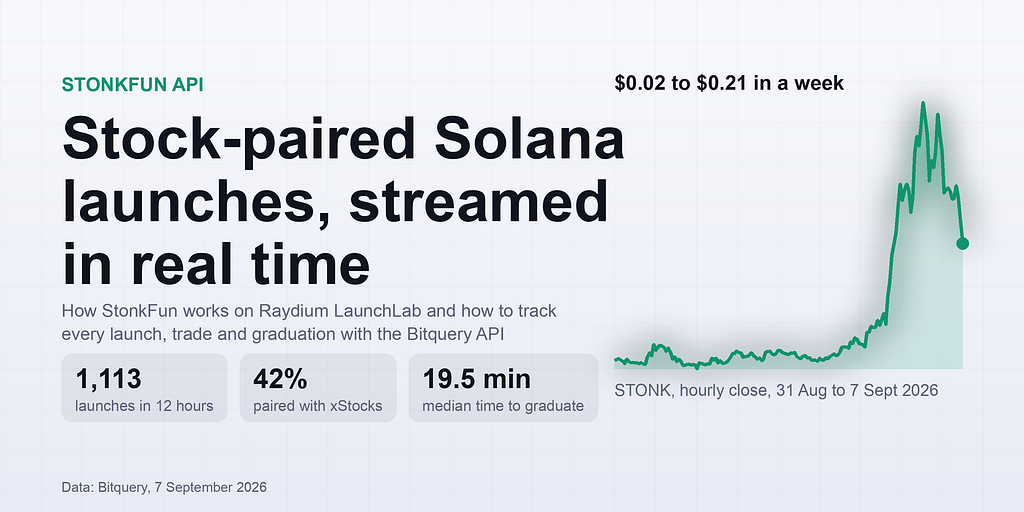
How StonkFun works on Raydium LaunchLab, what its first day of data shows, and how to stream it with the Bitquery API.
StonkFun is a Solana launchpad where a new coin is paired with a tokenized stock, a pre-IPO token, a crypto asset or SOL instead of the usual SOL or USDC pair. Over the weekend of 5 and 6 September 2026 it moved new launches onto Raydium LaunchLab, and by Sunday its bonding curves were clearing more than half a million trades a day. The numbers below were pulled on Monday 7 September, and every query is one you can run yourself.
What is StonkFun?
StonkFun (stonkfun.xyz) lets anyone launch a coin and choose what it trades against. The menu includes xStocks, the tokenized stocks issued by Backed Finance such as SPYx (S&P 500), NVDAx and QQQx; PreStocks, which are pre-IPO exposure tokens such as OPENAI and ANTHROPIC; crypto assets such as ZEC, WBTC, HYPE, TAO and even xSOL, which I compared with looping jitoSOL in May; and plain SOL.
A coin called “SPDR” paired with SPYx is priced in units of an S&P 500 token, so its chart moves with both the meme and the index. Tokenized stocks are no longer a launchpad curiosity either. In July I reviewed Arcus, the dYdX team’s 24/7 stock-token exchange.
The platform token is STONK. StonkFun sends trading fees into a program it calls Burn & Earn, which buys STONK and the platform’s largest coins and burns them. STONK’s own pool is a Raydium CLMM pool against SPYx, but most of its volume this week went through SOL pools on Orca and Meteora.
For anyone who works with on-chain data, StonkFun is awkward in two ways. The quote assets are unusual, so trackers built around SOL and USDC pairs tend to skip them. And since this weekend there are two launch paths running side by side, which means watching three Raydium programs to see everything.
How a StonkFun launch works on-chain
The bonding-curve path (Raydium LaunchLab)
Every new StonkFun launch is one initialize_with_token_2022 instruction on the Raydium LaunchLab program LanMV9sAd7wArD4vJFi2qDdfnVhFxYSUg6eADduJ3uj. StonkFun registered two platform configs with LaunchLab, and both carry the name “StonkFun” in their on-chain data. Reward launches go through 6BwHHDg3u1854jC8PDLXvR4spTcLNaoBxLJNGC4nTESt and mint the coin as a Token-2022 token with a 1% or 3% transfer fee on every transfer, which feeds StonkFun’s reward payouts. Standard launches go through 4E876qZTE9FJMrBzgVtBrSrzz2TLivB5Y5QXPjB4gZL7 with no transfer fee. Everything else is the same on both.
Each launch mints 1,000,000,000 tokens with 6 decimals and sells 793,100,000 of them (79.31%) on a constant-product curve. Every curve trade pays a 1% fee in the quote asset. Raydium’s 0.25% protocol share for RAY buybacks comes out of that 1% rather than on top of it, and the rest goes to StonkFun’s fee wallet 5CEbueQnq1Ym2uSSx2xXds3jQAqT1BDnkA59RZobSPAG. Creators get nothing from curve trades.
The graduation target lives in the launch arguments as total_quote_fund_raising. StonkFun sets it in the quote asset at launch time from a fixed dollar figure, so a SOL launch targets 85 SOL, a WBTC launch about 0.112 WBTC and a SPYx launch about 11.5 SPYx. Each of those was worth roughly $8,500 to $10,000 on 7 September. Because the conversion happens per launch, two SPYx coins launched an hour apart will show slightly different targets. Do not hard-code the number.
When the curve fills, LaunchLab runs migrate_to_cpswap. The remaining 206,900,000 tokens and the raised quote asset seed a Raydium CPMM pool on the 0.25% fee tier, and the entire LP position is locked to the platform. Raydium’s docs describe a burn or a creator share as options. StonkFun chose neither, which is how it keeps earning fees from graduated pools and, according to the platform, feeds them back into buybacks. StonkFun also says deployment now costs 0.03 SOL, down from 0.29 SOL on the old path, and that the bonding curve reduces sniper risk. What sniping is and how launchpads fight it is covered in my earlier piece on token sniping.
The direct-pool path (Raydium CLMM)
Before September, every StonkFun launch minted the token and opened a one-sided Raydium CLMM pool in a single transaction signed by the launcher wallet, with no curve and no migration. That path has not gone away. In the first twelve hours of 7 September the launcher wallet opened ten CLMM pools while LaunchLab handled 1,113 launches. The signal for it is a create_customizable_pool instruction on the CLMM program CAMMCzo5YL8w4VFF8KVHrK22GGUsp5VTaW7grrKgrWqK, signed by the launcher wallet.
So a complete StonkFun tracker follows three programs: LaunchLab for curves, CPMM for graduated coins and CLMM for direct launches and for STONK itself. If you have read my guides to the pump.fun API, the Pons launchpad on Robinhood Chain or Four.meme on BNB Chain, the shape will look familiar. One instruction stream for launches, one for graduations, and the Trading API for prices.
StonkFun by the numbers (7 September 2026)
All figures below come from Bitquery queries run on 7 September 2026 around 12:30 UTC, so treat them as a snapshot of the first full day after the LaunchLab move.
Between 00:25 and 12:12 UTC, the two StonkFun platform configs produced 1,113 LaunchLab launches, about 94 an hour. Roughly 70% were reward launches with a transfer fee and 30% were standard launches.
Creators used 98 different quote mints in those twelve hours. xStocks took 42% of launches, crypto assets and other tokens 41%, SOL 10.5% and PreStocks 6.6%. The single most popular non-SOL quote was ZEC with 98 launches, followed by SPYx (70), NVDAx (41), SPCXx (40), MCDx (40), QQQx (36), WBTC (32) and OPENAI (30).
StonkFun launches by quote asset in the first twelve hours of 7 September 2026. Source: Bitquery Solana Instructions API.
What surprised me was how few curves graduate, and how fast the ones that do get there. In the same twelve hours only 29 curves graduated, about 2.6% of launches. For the 21 graduations whose launch fell inside the sample, the median time from launch to graduation was 19.5 minutes. The fastest took 24 seconds. The slowest took 3.2 hours.
In the 24 hours to 12:25 UTC, pools quoted in xStocks on the three Raydium programs turned over $29 million: $11.6 million on 479 CLMM pools, $8.8 million on 1,984 LaunchLab curves and $8.6 million on 54 graduated CPMM pools. Across LaunchLab and CPMM, the quote assets with the most volume were TAO ($10.2 million), ZEC ($9.4 million), wXRP ($8.4 million), OPENAI ($5.0 million) and STONK itself ($3.8 million).
24-hour volume in xStocks-quoted Raydium pools by protocol. Source: Bitquery Trading API.
LaunchLab curves quoted in anything other than SOL, USDC or RAY handled 43,000 trades on 5 September, then 576,000 trades and $17.2 million on 6 September, then 222,000 trades and $6.2 million in the first half of 7 September. Almost all of that is StonkFun, since before 5 September LaunchLab curves quoted in other assets did fewer than 5,000 trades a day.
STONK closed the 7-day window at $0.097, up from $0.021 a week earlier, with a 24-hour range of $0.095 to $0.214 and $98 million of 24-hour volume across all its pools. Supply stands at 874.4 million after burns, down from the original 1 billion. Burn & Earn burned STONK 145 times in the last 24 hours, 1.36 million tokens in total, plus one-off burns of 24 other tokens.
STONK hourly close, all pools combined. Source: Bitquery Trading.Tokens.
How to get StonkFun data with the Bitquery API
Bitquery indexes Solana instructions, pool states and trades, and exposes them over GraphQL and WebSocket. The same query runs as a one-off query or as a subscription that pushes every new row. For StonkFun you need four streams: launches, curve progress, graduations and trades. Below are the versions I ran on 7 September. The full set, including candles, holders, liquidity, buyback tracking and historical queries, is on the StonkFun API docs page.
You can paste any of these into the Bitquery IDE without a key. Outside the IDE you need an OAuth token in the Authorization header.
1. Stream new StonkFun launches
Filter LaunchLab initialize instructions by the two platform configs. AccountNames labels every account, so you do not have to remember positions, and Arguments gives you the decoded mint name, symbol, curve target and transfer fee setting.
subscription StonkFunLaunchLabLaunches {
Solana {
Instructions(
where: {
Instruction: {
Program: {
Address: { is: “LanMV9sAd7wArD4vJFi2qDdfnVhFxYSUg6eADduJ3uj” }
Method: { in: [“initialize_v2”, “initialize_with_token_2022”] }
}
Accounts: {
includes: {
Address: {
in: [
“6BwHHDg3u1854jC8PDLXvR4spTcLNaoBxLJNGC4nTESt”
“4E876qZTE9FJMrBzgVtBrSrzz2TLivB5Y5QXPjB4gZL7”
]
}
}
}
}
Transaction: { Result: { Success: true } }
}
) {
Block { Time }
Transaction { Signature Signer }
Instruction {
Program {
Method
AccountNames
Arguments {
Name
Value {
… on Solana_ABI_Json_Value_Arg { json }
… on Solana_ABI_String_Value_Arg { string }
… on Solana_ABI_Integer_Value_Arg { integer }
}
}
}
Accounts { Address Token { Mint ProgramId } }
}
}
}
}
In each message, account index 5 is the bonding-curve pool, index 6 is the new token and index 7 is the quote asset. The curve_param argument holds total_quote_fund_raising, the graduation target for that launch. During my 45-second test this stream delivered four launches.
2. Stream trades with USD prices across all three programs
The Trading API returns one clean row per swap with the USD price, market cap and trader on it, and it attributes Jupiter router hops to the pool they hit. Filter by the three Raydium programs and by quote token. Market.Protocol tells you the stage of the coin: raydium_launchpad on the curve, raydium_cp_swap after graduation, amm_v3 for a direct-pool launch.
subscription StonkFunTradesSPYx {
Trading {
Trades(
where: {
Pair: {
Market: {
Network: { is: “Solana” }
Program: {
in: [
“LanMV9sAd7wArD4vJFi2qDdfnVhFxYSUg6eADduJ3uj”
“CPMMoo8L3F4NbTegBCKVNunggL7H1ZpdTHKxQB5qKP1C”
“CAMMCzo5YL8w4VFF8KVHrK22GGUsp5VTaW7grrKgrWqK”
]
}
}
QuoteToken: { Address: { is: “XsoCS1TfEyfFhfvj8EtZ528L3CaKBDBRqRapnBbDF2W” } }
}
}
) {
Block { Time }
Side
PriceInUsd
AmountsInUsd { Base Quote }
Supply { MarketCap }
Trader { Address }
Pair {
Token { Symbol Address }
QuoteToken { Symbol }
Market { Address Protocol }
}
}
}
}
Swap the quote address for NVDAx, OPENAI, ZEC or STONK to follow another segment, or drop the quote filter and keep the program filter to watch everything. In a 30-second test this stream delivered 13 SPYx-quoted trades.
3. Stream graduations
A graduation is a migrate_to_cpswap instruction that references a StonkFun platform config. Account index 5 is the new CPMM pool and index 17 is the curve that just closed, so one message gives you the mapping from the old market to the new one.
subscription StonkFunGraduations {
Solana {
Instructions(
where: {
Instruction: {
Program: {
Address: { is: “LanMV9sAd7wArD4vJFi2qDdfnVhFxYSUg6eADduJ3uj” }
Method: { is: “migrate_to_cpswap” }
}
Accounts: {
includes: {
Address: {
in: [
“6BwHHDg3u1854jC8PDLXvR4spTcLNaoBxLJNGC4nTESt”
“4E876qZTE9FJMrBzgVtBrSrzz2TLivB5Y5QXPjB4gZL7”
]
}
}
}
}
Transaction: { Result: { Success: true } }
}
) {
Block { Time }
Transaction { Signature }
Instruction {
Program { AccountNames }
Accounts { Address Token { Mint } }
}
}
}
}
4. Bonding-curve progress without knowing the quote asset
Every StonkFun curve sells 793,100,000 of 1,000,000,000 tokens, so progress can be read from the base reserve alone. Subscribe to DEXPools for the curve pool and apply:
progress % = 100 – ((Base.PostAmount – 206,900,000) * 100 / 793,100,000)
A SPYx-quoted curve I checked at 12:06 UTC held 913.8 million tokens, which puts it at 10.9% of the way to graduation. If you prefer the quote side, divide Quote.PostAmount by the launch’s total_quote_fund_raising after adjusting for decimals.
5. Historical data
The Trading API keeps about 30 days of history with candles at intervals from one second to one hour, which covers the whole LaunchLab era so far. For anything older, the DEXTradeByTokens cube on the combined dataset gives daily volume and hourly OHLC per pool. Always filter by pool address there; a token-level sum double counts aggregator hops and pools where the coin is the quote side.
What you can build with it
The obvious one is a launch feed. Stream 1 plus a filter on curve_param gives you every new coin by quote asset, with the transfer fee setting attached, so you can skip or flag reward tokens before anyone trades them.
Join stream 1 and stream 3 on the pool address and you have a graduation tracker that measures time to graduate per quote asset. That is where the 19.5-minute median above came from. Group stream 2 by QuoteToken instead and you get a stock pair dashboard showing which stocks and pre-IPO tokens attract volume hour by hour.
Buybacks are one more subscription. TokenSupplyUpdates filtered on the launcher wallet as signer shows every Burn & Earn burn as it happens, across all the coins the program buys.
If you run trading bots, the interesting part is what is visible before the first trade. The transfer fee flag, the curve target and the locked LP graduation are all in the launch instruction, and that is the moment a bot should decide whether to touch a coin. They are the same kind of checks I wired into a 24/7 Solana memecoin sniper built with Claude Code.
Caveats
Most StonkFun coins are meme tokens with a few thousand dollars of liquidity, and 97% of the curves in my sample had not graduated. Reward tokens carry a 1% or 3% transfer fee on every move, which changes what “price” means for a holder. xStocks and PreStocks give exposure to a stock or a private company without shareholder rights, and their on-chain liquidity is thinner than the underlying market. Nothing here is investment advice, and I do not hold STONK or any StonkFun coin.
The data side has its own limits. Bitquery’s Solana Instructions cube is real-time only with a short history window, so launch counts for past weeks have to be reconstructed from the first trade of each pool. The Trading API’s total supply for STONK lagged the on-chain figure on the day I checked, so I took supply from the token mint directly.
Disclosure: I work at Bitquery, which provides the API used in this post. The queries are free to run in the IDE, and the docs page linked above has the full set.
Sources: The Block, “STONK surges 250% as stock-paired Solana launchpad StonkFun pulls volume to Raydium and Jupiter” (6 September 2026); crypto.news, “Raydium LaunchLab adds support for any token pair on Solana” (7 September 2026); Raydium LaunchLab documentation; on-chain platform config and pool accounts read through a public Solana RPC; Bitquery API queries listed above.
StonkFun API: Track Stock-Paired Solana Launches in Real Time was originally published in Coinmonks on Medium, where people are continuing the conversation by highlighting and responding to this story.