
Every generation has its struggles.
Our grandparents survived wars, poverty, and social restrictions. Our parents grew up without the internet, smartphones, or the constant pressure to build a “perfect” life online.
And then there is Gen Z.
A generation that grew up with Wi-Fi, smartphones, social media, global crises, academic pressure, economic uncertainty, and an endless stream of bad news.
Yet Gen Z is often called too sensitive.
They are told to “toughen up,” stop complaining, work harder, and deal with their problems like previous generations did.
But there is a question we rarely ask:
What if Gen Z isn’t mentally weaker? What if they’re simply more willing to talk about what hurts?
The Silent Strength of Older Generations
Previous generations often had a different definition of mental strength.
Being strong meant keeping your problems to yourself.
You didn’t talk about anxiety at work. You didn’t tell your friends that you were struggling with depression. You didn’t necessarily go to therapy.
You carried your problems quietly.
That silence created resilience in some people. They learned to tolerate hardship, adapt to difficult circumstances, and keep moving forward.
But silence isn’t always strength.
Sometimes it is simply survival.
Many people from older generations experienced mental health struggles without having the vocabulary — or social permission — to discuss them.
Instead of saying, “I’m burned out,” they might have said, “I’m tired.”
Instead of saying, “I’m depressed,” they might have said, “It’s just a difficult phase.”
Instead of asking for professional help, they often told themselves:
“I’ll get through it.”
And many did.
But we shouldn’t confuse enduring pain silently with being mentally healthier.
Gen Z Lives in a Different Kind of Pressure
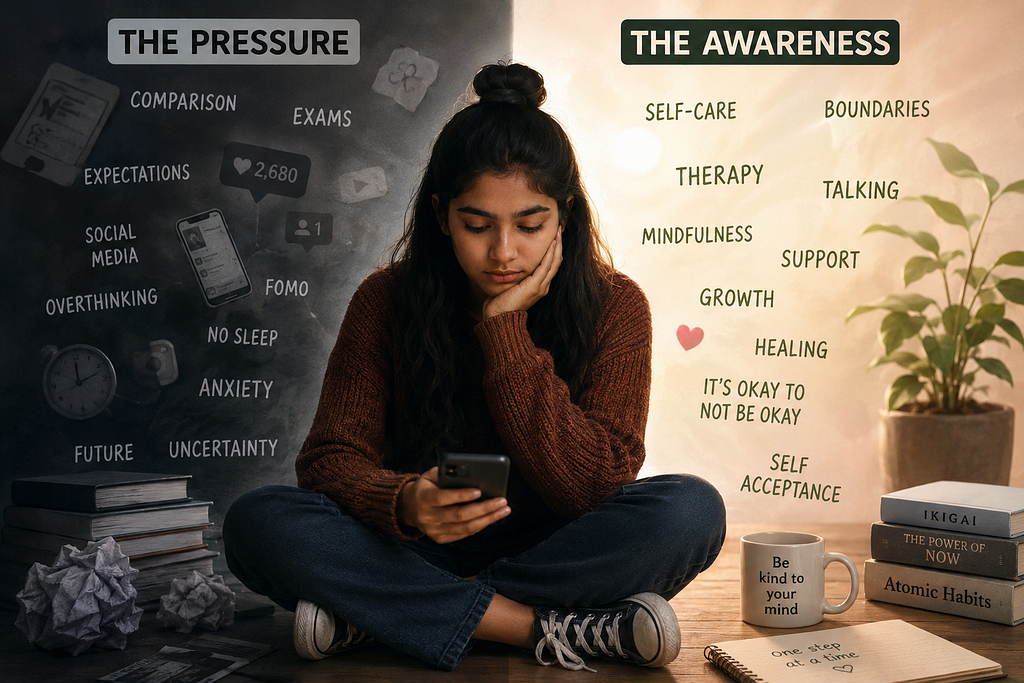
Gen Z faces problems that are difficult to escape.
Imagine waking up and immediately opening your phone.
Before breakfast, you’ve already seen someone’s vacation, someone’s promotion, someone’s relationship, someone’s new apartment, someone’s perfect body — and three international crises.
Social media turns comparison into a 24/7 activity.
You aren’t simply competing with the people in your classroom or workplace anymore.
You’re comparing yourself with millions of people.
And the internet never tells you when you’ve done enough.
There is always another skill to learn.
Another career goal.
Another achievement.
Another person who appears to be doing better.
For Gen Z, the pressure isn’t only “Can I succeed?”
It’s also:
“Am I succeeding fast enough?”
That constant comparison can create anxiety, loneliness, low self-esteem, and burnout.
But Gen Z Has Something Previous Generations Didn’t
Awareness.
Gen Z is more comfortable using words like anxiety, burnout, boundaries, therapy, and emotional exhaustion.
They talk about mental health on social media.
They encourage friends to seek help.
They question toxic workplaces.
They are more likely to say, “I need a break,” instead of pretending everything is fine.
Critics sometimes see this as weakness.
I see something else.
Self-awareness is a form of strength.
Knowing that something is wrong is the first step toward changing it.
Asking for help isn’t weakness either.
It takes courage to admit:
“I can’t handle this alone.”
So, Which Generation Is Mentally Stronger?
The honest answer is: we can’t say that one generation is universally mentally stronger.
Mental strength isn’t a competition between generations.
Older generations often developed resilience through real-world hardship, responsibility, and learning to function despite difficult circumstances.
Gen Z is developing resilience through a different environment — digital overload, uncertainty, rapid social change, and greater awareness of psychological well-being.
Both have strengths.
But they also have weaknesses.
Older generations may sometimes suppress emotions instead of processing them.
Gen Z may sometimes overanalyze emotions or become overwhelmed by information and comparison.
One generation may say, “Just get on with it.”
The other may say, “Let’s talk about how I feel.”
Perhaps the healthiest approach is somewhere between the two.
We Don’t Need a Stronger Generation. We Need a Healthier One.
Mental strength shouldn’t mean never feeling anxious.
It shouldn’t mean working through exhaustion.
It shouldn’t mean hiding sadness.
And it certainly shouldn’t mean suffering alone.
Real mental strength might look like this:
Feeling your emotions without allowing them to control your entire life.
Asking for help without feeling ashamed.
Knowing when to push yourself and when to rest.
Accepting failure without believing you are a failure.
Being able to say “I’m not okay” and then taking steps toward becoming okay.
Maybe Gen Z isn’t becoming weaker.
Maybe we’re simply witnessing a generation that refuses to pretend that everything is fine.
And perhaps older generations have something to teach Gen Z about resilience, while Gen Z has something equally important to teach them about vulnerability.
Because the goal shouldn’t be to decide who suffered more.
The goal should be to make sure the next generation doesn’t have to suffer in silence.
Mental strength isn’t about carrying the heaviest weight.
It’s about knowing when to carry it, when to put it down, and when to ask someone to help you carry it.
Is Gen Z Mentally Stronger or Just More Honest About Mental Health? was originally published in Coinmonks on Medium, where people are continuing the conversation by highlighting and responding to this story.