
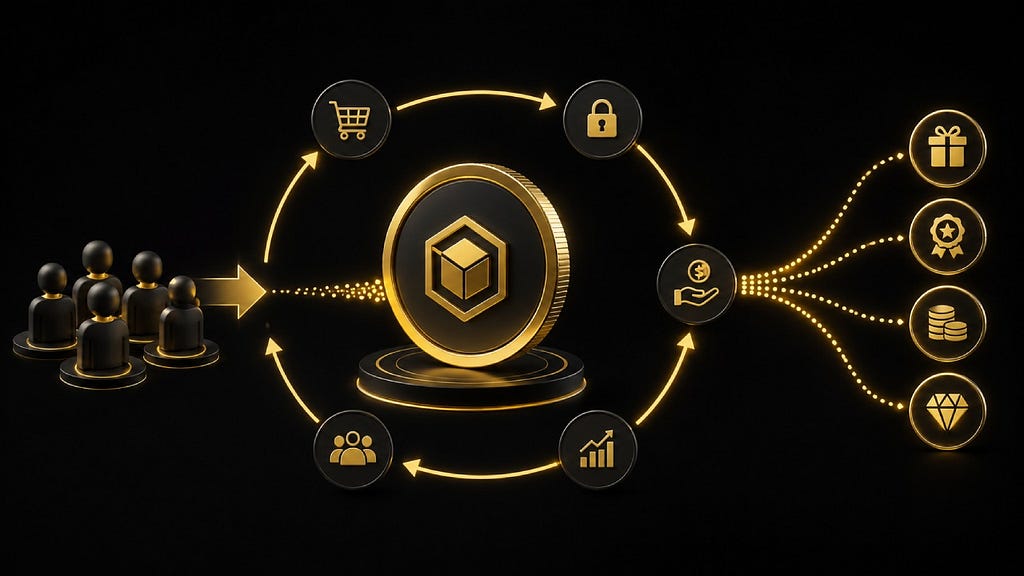
Image created by Quinn Donovan
A crypto token can attract attention at launch, but attention alone does not create a sustainable token economy. Projects that want long-term adoption need a stronger foundation: recurring user demand.
When users repeatedly return to a product, consume a service, pay for functionality, access infrastructure, participate in a marketplace, or require digital resources, that recurring activity can become an important driver of token demand. The challenge for token developers is designing an economic system where the token is connected to genuine product usage rather than speculation alone.
This is why token design should begin with a fundamental question:
What will make users need this token repeatedly after the initial launch?
A well-designed token economy connects user behavior, product utility, token circulation, supply mechanics, and incentives. Instead of creating artificial demand through temporary rewards, projects can build mechanisms that make token usage a natural part of recurring customer activity.
For businesses working with a crypto token development company, this approach can also help create token models that are better aligned with product-market fit, sustainable liquidity, and long-term ecosystem growth.
What Is Recurring User Demand in a Token Economy?
Recurring user demand occurs when users need to repeatedly acquire, spend, hold, stake, or interact with a token to access a product or service.
For example, consider a decentralized storage network. A user who needs additional storage every month may repeatedly purchase storage credits. If the network uses a token as part of that payment mechanism, recurring storage consumption can generate ongoing token utility.
The same concept can apply to:
Decentralized computingAI agent marketplacesGaming ecosystemsDeFi protocolsCreator platformsWeb3 subscriptionsToken-gated servicesDigital infrastructureRWA platformsDecentralized marketplacesBlockchain-based payment systems
The key distinction is between temporary demand and structural demand.
Temporary demand may come from an airdrop, speculation, exchange listing, or promotional campaign. Structural demand comes from users repeatedly needing the token because it performs a meaningful function inside a product.
Why Recurring Demand Matters for Crypto Tokens
Many token economies struggle because the token is introduced before there is a clear reason for users to continue using it.
A project might distribute millions of tokens to attract users, but if those users have no reason to spend or acquire the token after receiving incentives, demand can decline quickly.
Recurring demand changes the equation.
When product activity repeatedly requires token interaction, token demand can potentially become connected to ecosystem growth.
For example:
More users → more product usage → more transactions → greater token utility → recurring demand
This does not guarantee price appreciation. Token price depends on many factors, including supply, liquidity, market conditions, speculation, regulations, and investor behavior. However, recurring product demand can create a stronger economic foundation than a token whose primary purpose is speculation.
Start With the Product, Not the Token
One of the biggest mistakes in token development is starting with tokenomics instead of the product.
Instead of asking:
“What token should we launch?”
Start by asking:
“What recurring problem does our product solve?”
Then identify where blockchain and the token can provide meaningful value.
Suppose a platform provides decentralized GPU computing. Users may need computing resources repeatedly. The token could potentially function as a payment mechanism for computing workloads, depending on the platform’s architecture and applicable legal requirements.
The product creates the demand.
The token facilitates part of the activity.
This creates a more logical relationship between utility and usage.
A strong token design therefore follows this sequence:
User problem → Product utility → Recurring behavior → Token interaction → Economic model
Not:
Token → Incentives → Hope for adoption
Identify the Recurring User Action
The next step is identifying the behavior that happens repeatedly.
Ask questions such as:
What do users do every day?What do they do every week?What do they pay for every month?What resources do they continuously consume?What features require repeated access?What causes users to return?Which actions create measurable economic activity?
For a decentralized AI marketplace, for example, users may repeatedly purchase AI inference, data processing, model access, or autonomous agent services.
For a gaming ecosystem, recurring activity may involve asset upgrades, tournament participation, marketplace transactions, or access to premium experiences.
For an RWA platform, users may repeatedly interact with investment, settlement, servicing, reporting, or redemption infrastructure.
The token should be connected to one or more of these recurring behaviors only when doing so creates genuine utility.
Create Multiple Utility Touchpoints
A token becomes more deeply integrated into an ecosystem when it has several legitimate utility touchpoints.
Instead of designing a token that performs one function, developers can evaluate whether it can support multiple complementary activities.
For example, a token might be used for:
Access
Users spend tokens to access premium infrastructure or services.
Payments
Tokens can facilitate transactions within the ecosystem.
Staking
Participants lock tokens to support network functions or qualify for specific utility.
Governance
Eligible holders participate in protocol decisions where governance is appropriate.
Collateral
In certain decentralized financial applications, tokens may serve as collateral subject to protocol design and risk controls.
Incentives
Tokens can reward valuable ecosystem contributions.
However, adding utility simply to create a longer feature list is not effective.
Every utility should answer a basic question:
Would users actually perform this action if they were not speculating on the token price?
If the answer is no, the utility may not generate sustainable demand.
Design for Consumption, Not Just Holding
Token holding can create demand, but long-term ecosystems should also consider token consumption.
A token economy becomes more interesting when tokens move through recurring product activity.
Consider a decentralized service platform.
Users purchase tokens.
They spend tokens to access services.
Service providers receive tokens.
Providers may use tokens for platform fees, staking, or other ecosystem functions.
This creates a circulation loop.
The objective is not necessarily to make every token disappear through burning. Instead, developers should determine how tokens move between ecosystem participants and whether those flows support sustainable activity.
A simplified model could look like:
Users acquire tokens → users consume services → service providers receive tokens → providers use tokens within ecosystem → new users acquire tokens
This is fundamentally different from a model where users simply buy tokens and wait for the price to increase.
Avoid Artificial Demand
One of the most important principles of sustainable token design is avoiding artificial demand mechanisms.
Artificial demand can include excessive rewards, unsustainable staking yields, forced holding requirements, or incentives that attract users without creating meaningful product usage.
These mechanisms can generate activity temporarily, but they may disappear when incentives decline.
For example, suppose a platform offers extremely high token rewards to users for locking assets. Users may participate because of the reward rather than because they need the platform.
When the rewards decrease, participation can collapse.
A better model connects incentives to useful behavior.
Instead of rewarding users simply for holding tokens, a project could potentially reward measurable contributions such as providing liquidity, supplying infrastructure, creating content, validating data, or completing productive tasks, depending on the ecosystem.
Build a Demand Loop
A recurring demand loop connects multiple user actions.
A simplified token demand loop could be:
Product usage → Token requirement → Token acquisition → Service consumption → Ecosystem contribution → Continued usage
The stronger the connection between these stages, the more closely token demand is tied to actual product activity.
For example, an AI agent marketplace could require payment for agent execution.
A user requests an AI agent.
The agent performs a task.
The user pays for the service.
The payment creates token utility if the token is genuinely part of the payment architecture.
More successful agents attract more users.
More users generate more service consumption.
More service consumption can create additional token interactions.
This is a product-led token economy rather than an incentive-led economy.
Consider Token Velocity
Token velocity describes how frequently tokens circulate within an ecosystem.
Very low velocity can occur when users primarily hold tokens.
Very high velocity can occur when users immediately acquire and spend tokens without retaining them.
Neither extreme is automatically ideal.
The appropriate token velocity depends on the product.
A payment-focused ecosystem may naturally have high token circulation.
A staking-oriented protocol may require participants to lock tokens.
A governance system may encourage longer-term holding.
The important point is to design token flows intentionally.
Developers should model:
How tokens enter the ecosystemWhere tokens are spentWho receives themWhether recipients sell themWhether tokens are recycledHow much supply is liquidHow much supply is lockedHow demand changes as users increase
This economic modeling should happen before token deployment.
Match Token Supply With Expected Demand
Recurring demand does not exist independently of supply.
A project can generate substantial user activity while still creating economic pressure if token issuance significantly exceeds productive demand.
Developers should therefore model different supply scenarios.
For example:
Scenario A: 10,000 active users
Scenario B: 100,000 active users
Scenario C: 1 million active users
Then estimate:
Average user transactionsAverage token requirementToken turnoverNew token issuanceToken unlocksTreasury emissionsStaking participationCirculating supplyExpected liquidity requirements
This helps identify whether the token economy remains functional as adoption increases.
Design Demand Around User Growth
One of the strongest approaches is making token utility scale with product usage.
Imagine a platform where each active user generates an average amount of token-denominated economic activity.
As users increase, the amount of token utility required by the ecosystem can increase as well.
For example:
1,000 users → 100,000 monthly transactions
10,000 users → 1 million monthly transactions
100,000 users → 10 million monthly transactions
The exact token requirements will depend on the business model, but the principle remains valuable:
Demand should have a logical relationship with usage.
This allows developers to build tokenomics around measurable business metrics rather than arbitrary assumptions.
Use Dynamic Token Requirements Carefully
Some ecosystems may benefit from dynamic pricing or token requirements.
For example, a decentralized computing platform could adjust token-denominated service pricing according to resource demand.
However, dynamic mechanisms introduce complexity.
If token requirements change too dramatically, users may find the system difficult to understand.
Therefore, token developers should prioritize predictability where possible.
Users should understand:
What they need to payWhy they need the tokenHow pricing is calculatedWhat happens during demand spikesWhether fees are fixed or variable
Good token design should simplify the user experience rather than force every customer to become a tokenomics expert.
Make the Token Invisible When Appropriate
Ironically, a successful token economy may not always feel like a crypto product to the end user.
Mainstream users may not want to constantly think about gas fees, token prices, wallet management, or exchange rates.
Projects can consider account abstraction, embedded wallets, automated token conversion, or other user-experience mechanisms where technically and legally appropriate.
For example, a user could pay $10 for a service while the infrastructure handles the underlying token transaction automatically.
This can preserve token utility while reducing friction.
The goal should be:
Complex token infrastructure underneath, simple user experience on top.
Design Incentives Around Retention
Acquisition incentives can bring users into an ecosystem. Retention mechanisms can give them a reason to stay.
Token incentives should therefore be evaluated against retention metrics.
Instead of asking:
“How many tokens should we distribute?”
Ask:
“What user behavior are we trying to encourage?”
Possible objectives include:
Repeated purchasesLonger platform engagementService contributionsLiquidity provisionGovernance participationReferralsContent creationInfrastructure support
The incentive should be proportional to the economic value generated by the behavior.
If a user receives $50 worth of incentives for generating only $2 of sustainable value, the model may be difficult to maintain.
Measure Real Token Demand
A crypto token development strategy should include measurable demand indicators.
Useful metrics can include:
Active token users: How many unique users interact with the token?
Transaction frequency: How often is the token used?
Utility transactions: How many transactions are connected to actual product activity?
Repeat usage: How many users return and use the token again?
Token acquisition for utility: How many users acquire tokens specifically to use the product?
Incentive dependency: What percentage of activity disappears when rewards decrease?
Token velocity: How frequently does the token circulate?
User retention: Do token users continue using the product?
These metrics can reveal whether demand is genuinely product-driven.
Test the Token Economy Before Launch
Token economics should be tested before deployment rather than adjusted after problems emerge.
Developers can model different conditions, including:
Low user adoptionRapid user groMarket downturnsHigh token volatilityLarge token unlocksReduced incentivesLiquidity shortagesIncreased transaction activityChanges in user behavior
Stress testing can reveal vulnerabilities before they affect real users.
For example, what happens if the token price falls by 80%?
Does the platform still function?
What happens if demand doubles?
Does token supply support the increased activity?
What happens when early investors become eligible to sell?
Does the ecosystem experience excessive sell pressure?
These questions should be addressed during token design.
Recurring Demand and Token Development Architecture
The economic model also affects technical architecture.
A token development company may need to determine:
Blockchain selectionToken standardSmart contract architecturePayment mechanismsTreasury managementStaking contractsVesting contractsGovernance infrastructureOracle integrationWallet architectureCross-chain functionalitySecurity controlsUpgrade mechanisms
The technical implementation should reflect the economic model.
For example, a token intended for high-frequency microtransactions may require a different architecture from a governance-focused asset.
Similarly, a multichain token requires careful supply synchronization and bridge architecture to avoid inconsistencies.
Security Is Part of Demand Design
Users will not repeatedly interact with an ecosystem they do not trust.
Smart contract vulnerabilities, manipulated price feeds, compromised wallets, and poorly designed upgrade mechanisms can undermine token demand.
Security should therefore be considered part of the token’s economic infrastructure.
Important considerations include:
Smart contract auditsAccess-control designMultisignature treasury managementOracle securityRate limitsEmergency controlsUpgrade governanceToken transfer restrictions where legally requiredMonitoring and incident response
A token can have excellent economics on paper and still fail if the underlying infrastructure is insecure.
Compliance Should Be Considered Early
Token design can have legal and regulatory implications depending on jurisdiction, token characteristics, marketing, governance structure, rights attached to the token, and how it is offered or distributed.
Projects should therefore obtain qualified legal advice before launch.
This is especially important for tokens connected to:
RevenueReal-world assetsInvestment rightsProfit participationGovernanceFinancial servicesStable-value mechanismsSecurities-like features
Compliance should not be treated as something added after the token has already been built.
It should inform the architecture from the beginning.
The Future of Demand-Driven Token Design
The next generation of crypto tokens is likely to move further away from purely speculative narratives and toward measurable utility.
AI agents may use tokens to pay for computing, data, APIs, and autonomous services.
RWA platforms may use tokens within settlement and ownership infrastructure.
Decentralized physical infrastructure may use tokens to coordinate resources.
Gaming ecosystems may connect tokens to recurring digital economies.
DeFi protocols may experiment with more sophisticated mechanisms for capturing and distributing economic value.
Across these categories, the central question remains the same:
Why does someone need this token repeatedly?
If a project can answer that question clearly, it has a stronger starting point for token design.
Conclusion
Designing a crypto token around recurring user demand requires more than creating utility features or attractive tokenomics. It requires connecting the token directly to repeatable economic activity.
The strongest models begin with a real product, identify recurring user behavior, determine where a token can provide genuine utility, and then build sustainable circulation, incentives, supply mechanics, and infrastructure around that behavior.
The objective is not to manufacture demand.
It is to build an ecosystem where demand naturally emerges from repeated product usage.
For businesses planning a new token, this approach can make token development more strategic. Instead of launching an asset and searching for utility afterward, projects can build the product and token economy together.
That is where a specialized crypto token development company can add value: from tokenomics architecture and smart contract development to multichain deployment, security, wallet integration, and ecosystem design.
A successful token should not only answer “Why would someone buy it?”
It should answer the more important question:
“Why would a user return to use it regularly?”
How to Design Tokens Around Recurring User Demand was originally published in Coinmonks on Medium, where people are continuing the conversation by highlighting and responding to this story.