
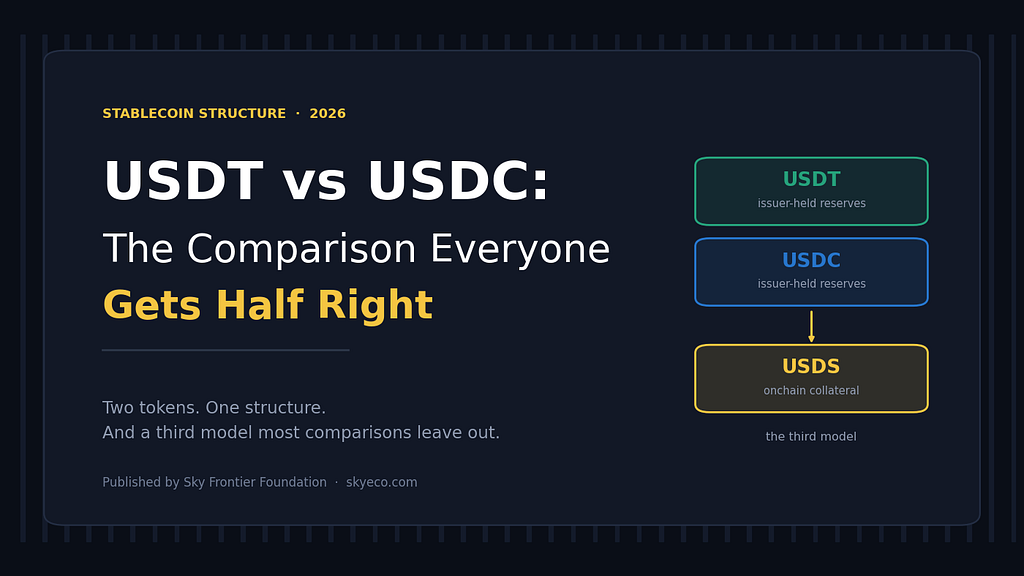
Two tokens. One structure. And a third model most comparisons never put in the table.
Two tokens dominate the market. Only one comparison column tells you where the yield goes.
Search “usdt vs usdc” and you will get roughly the same answer eleven times in a row.
USDT for liquidity. USDC for regulation. Hold both. Done.
That answer is not wrong. It is just half of one.
The half everyone gets right is the surface layer: market share, order book depth, which ticker your compliance lead nods at.
The half almost nobody writes about is structural. And in 2026, it is the half that decides what your dollars are actually doing while you hold them.
Here is the part that keeps getting skipped.
The USDT vs USDC scoreboard, in thirty seconds
USDT and USDC hold about 83% of all stablecoin supply between them. The concentration matters more than the ranking.
The raw stablecoin comparison is not complicated:
USDT: roughly $184B in circulating supply, about 59% of the marketUSDC: roughly $75B, about 24%Together: around 83% of every stablecoin dollar in existenceTotal stablecoin market cap: hovering between $303B and $308B through mid-2026, up from $27B at the end of 2020Settlement volume: stablecoin transactions hit a record $33T across all tokens in 2025, up 72% on the prior year
One number is worth pausing on. USDT holds about 59% of supply but drives closer to 74% of onchain trading volume. It is not just bigger. It moves harder.
Concentration, not the ranking, is the real story. Liquidity, exchange support and payout coverage all cluster around the top two, which is why almost every integration starts with one of them.
Tether vs USD Coin: the divergence nobody called in 2023
For the first time on record, the two largest dollar tokens are moving in opposite directions.
USDC supply grew 72% year over year in 2025. USDT grew 36%.USDC has cleared $2.55T in transactions so far in 2026, against USDT’s $1.49T. That is the first time it has led on adjusted volume.USDT is still 2.4x larger by market cap, and still wins outright on order book depth.In Morgan Stanley’s survey work, 77% of institutional firms reported using USDC against 59% for USDT.
Then add MiCA. Several major exchanges trimmed or dropped USDT support for EEA users. That is a distribution fact, not an opinion, and it explains a good chunk of the growth gap.
The two issuers are also drifting apart in what they are building toward. Circle keeps wiring itself into regulated finance, clearing $68M across eight entities in under 30 minutes in March 2026.
Tether keeps building payment rails where the banking system is thin. Same peg, two different futures.
USDT won distribution. USDC won the paperwork. Neither of them won the thing most holders quietly want.
The half everyone gets right: which stablecoin to use, and when
The standard advice holds up. Keep it.
Active trading, emerging market corridors, deepest pairs: USDTRegulated rails, EEA and US fintech stacks, enterprise settlement: USDCMost desks running both: hold both, and stop agonising over it
Nothing above is controversial. That is the problem. A comparison that ends there assumes the two tokens are structurally different. They are not.
Both are fiat-backed. Both hold reserves off-chain. Both publish attestations rather than live proof. Both retain a freeze function. USDT and USDC are two configurations of one model.
The half everyone misses: neither one pays you, and neither one legally can
This is where the conversation stops being about branding.
The GENIUS Act was signed into law on July 18, 2025. Section 4(a)(11) is blunt: no permitted payment stablecoin issuer may pay a holder any form of interest or yield, whether in cash, tokens or other consideration, solely for holding the token.
The Federal Register rulemaking and the Richmond Fed summary both restate it the same way.
Meanwhile, the reserves behind those tokens are extremely productive:
Tether’s U.S. Treasury holdings exceed $122B, placing it around 17th among all holders worldwideCircle reported $770M in revenue for Q4 2025, with EBITDA up 412%
Read those together. The collateral behind your stablecoin earns every day. You do not. Under a payment stablecoin framework, that is the design, not a loophole.
Exchange “rewards” programmes exist as a workaround. The OCC has proposed extending the prohibition to affiliates and third parties, which turns that workaround into a live policy question rather than a settled product feature.
The reserves behind your stablecoin generate a return every single day. The only open question is who collects it.
The comparison column nobody adds: the freeze function
Two issuers, two enforcement philosophies. The freeze function is a live feature of both contracts.
Every centralised stablecoin contract ships with a blacklist function. It is used, and the two issuers use it very differently.
Tether has blacklisted 9,597 addresses and frozen roughly $4.2B in USDTCircle has blacklisted about 372 addresses and frozen roughly $109M in USDCThe largest single action on record: about $344M frozen in April 2026, coordinated with OFAC before the sanctions designation was publishedIn 2025, only 3.6% of blacklisted USDT addresses were later unfrozen
One January morning in 2026, Tether froze around $182M across five Tron wallets. That single day exceeded every dollar of USDC Circle has ever frozen.
Speed cuts the other way too: when a North Korea-linked group drained a Solana protocol in April 2026, Circle drew criticism for taking more than six hours to freeze roughly $232M in stolen USDC.
Circle acts mostly on court orders. Tether acts on law enforcement requests, often faster. Neither philosophy is wrong.
Both are worth knowing before you pick a settlement token, and the full onchain audit of every freeze is public reading.
USDT vs USDC vs USDS: the third structural model
USDT and USDC are two variants of one model. The structural fork is who can verify the backing, and who receives the yield it produces.
USDS is not a third fiat-backed token with a different logo. It is a different answer to the same question.
Backing is onchain and overcollateralised. You verify Protocol Collateral yourself, at any hour, without waiting for a monthly reportRisk parameters are set in public through Sky Governance, by SKY token holders, on the recordYield does not stop upstream. Supply USDS to sUSDS and the position accrues through the Sky Savings RateYou do not have to choose sides. Convert USDC or USDT into USDS at a strict 1:1 ratio through the Peg Stability Module, with zero fees and no slippageThe yield has a visible source. It comes from the Sky Agent Network: independent capital allocators that draw USDS liquidity under governance-set limits and pay for that access
That last point is the whole argument. In the fiat-backed model, the return on the reserves is the issuer’s business model.
In this one, the return routes back through Sky Protocol to holders of the yield-generating token.
The trade-offs are real and worth stating plainly. Overcollateralised means capital efficiency is lower by design.
Onchain means smart contract risk is a genuine line item, which is why the contracts are audited on a rolling basis by firms including ChainSecurity, Cantina and ABDK.
And the Sky Savings Rate is variable, calibrated by governance rather than fixed by anyone’s promise.
What the third model looks like at scale
The third model, at scale. Every figure is checkable against the live dashboards at skyeco.com.
Structure is easy to claim. Here is the audited version, from the Q2 2026 quarterly report published by Sky Frontier Foundation on July 23, 2026:
$107.35M in Gross Protocol Revenue for the three months to June 30, up 10.5% year over year$33.29M in Protocol Surplus, the fifth consecutive positive quarter$5.52B in sUSDS supply at quarter end, up 149% year over year, the largest rate-bearing stablecoin by supply$250M+ in cumulative Sky Savings Rate distributions, a milestone crossed on June 29, 2026$14.15B in Total Protocol Collateral and $11.48B in stablecoin supply on the live dashboard today
Every one of those figures is checkable. That is the point of the model. If you want the plain-language version first, start here.
Three questions that beat any stablecoin comparison table
Forget the ticker for a second and ask:
Can I verify the backing myself, right now, without waiting for a report?Who receives the yield that backing produces?What happens to my balance if someone I have never met files a request?
USDT and USDC answer question one with an attestation, question two with “the issuer”, and question three with a freeze function. Those are legitimate answers. They are just answers, not defaults.
So which stablecoin should you actually use in 2026?
Honestly? Probably both, for the jobs they are good at. USDT for depth. USDC for regulated rails. That advice has survived three cycles.
But if a dollar of yours is sitting still rather than moving, “which centralised issuer do I trust more” is the wrong question. The better one is whether it needs to sit idle at all.
Two tokens dominate the market. Only one comparison column tells you where the yield goes.
Now your turn. Which column actually decides it for you: liquidity, regulation, freeze risk, or where the yield lands? Drop it in the responses. I read every one, and the disagreements are usually more useful than the agreements.
This piece is published by Sky Frontier Foundation for educational purposes. Nothing here is financial advice. Protocol figures should be verified against the live dashboards before use.
USDT vs USDC: The Comparison Everyone Gets Half Right was originally published in Coinmonks on Medium, where people are continuing the conversation by highlighting and responding to this story.