
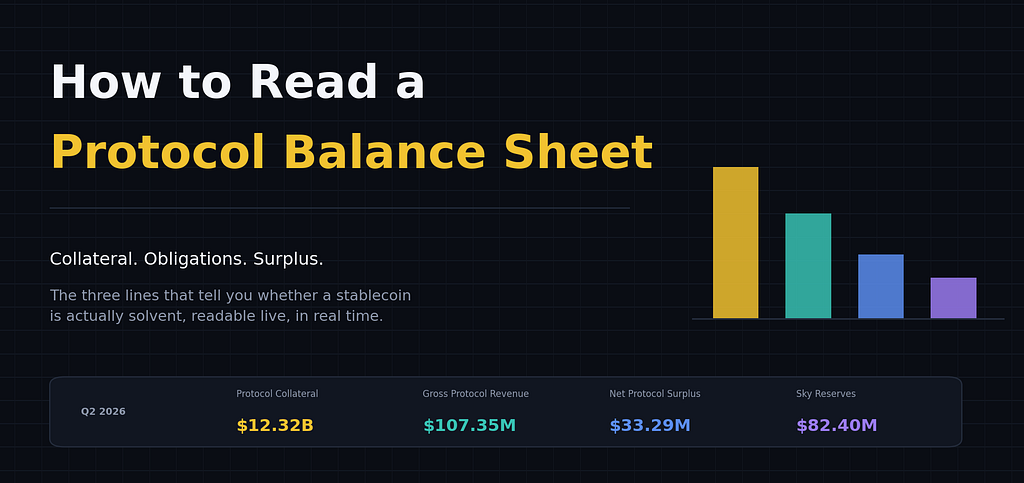
Collateral, obligations, surplus. Three lines that tell you whether a stablecoin is actually solvent.
Sky Protocol Q2 2026, published by Sky Frontier Foundation. Verify live at financial.skyeco.com
In July 2026, the Protocol Collateral backing USDS and DAI fell by $1.34 billion in a single month.
Nothing broke.
No emergency vote. No depeg. No pause. No thread.
If you only read that headline number, you would have panicked. If you read the protocol balance sheet, you would have shrugged and gone back to work.
That gap is the whole skill. And almost nobody in onchain capital markets has bothered to learn it.
Here is how to close it in about ten minutes.
Why the Protocol Balance Sheet Became the Most Important Page in Crypto
For most of the last decade, stablecoin due diligence meant waiting.
Wait for the monthly attestation. Wait for the quarterly letter. Wait for an accounting firm to confirm what was true forty-five days ago.
That model is being retired in real time:
The GENIUS Act made monthly reserve reporting, examined by a registered public accounting firm, the US baseline for payment stablecoin issuers.The AICPA published stablecoin controls criteria in January 2026, lifting the floor on what issuers must evidence beyond a simple balance confirmation.Research desks now cover protocols the way they cover listed companies: line items, margins, retention, cash flow. See ARK Invest’s analyst work on multi-collateral stablecoins or the Wharton Stablecoin Toolkit.Monthly is becoming the floor. Continuous is the ceiling.
Sky Protocol sits at the continuous end. Its balance sheet, income statement, collateral composition and capital allocations publish live on the Sky Protocol Financial Dashboard, built and maintained by BA Labs.
Any figure quoted anywhere can be checked against it, at any hour, by anyone.
Which means the bottleneck has moved. It is no longer disclosure. It is literacy.
Line One: Protocol Collateral, or What Actually Backs USDS
The three-line structure of a protocol balance sheet.
Start on the left side of the ledger. Protocol Collateral is everything standing behind every USDS and DAI in circulation.
On Sky Protocol it breaks into four categories plus a buffer, per the Sky Ecosystem Insights documentation:
Sky Agent Vaults. Capital deployed through Spark, Grove, Obex and other governance-approved members of the Sky Agent Network into lending, credit and yield strategies. The largest category by a wide margin.PSM Vaults. USDC held in the Peg Stability Module, enabling instant 1:1 USDC-to-USDS conversion with zero slippage.Crypto Vaults. ETH, wBTC and stETH posted by borrowers. Each vault independently overcollateralized with automated liquidation.RWA Vaults. Legacy real-world asset positions being transitioned to Sky Agents.Sky Reserves. The solvency buffer, funded through the treasury waterfall before any surplus reaches buybacks or distributions.
The Q2 2026 figures published by Sky Frontier Foundation in its Q2 2026 Quarterly Report: Protocol Collateral of $12.32B, up 45.5% year over year from $8.47B.
Prime Agent Vaults closed the quarter at $6.84B, with roughly $2.58B deployed across six institutional counterparties including Janus Henderson, BlackRock, Anchorage, PayPal, Securitize and Galaxy.
Reading tip: look at concentration before you look at size. A $12B collateral base parked in one strategy is more fragile than a $6B base spread across six.
Now Back to That $1.34B Drop
Protocol Collateral: $8.47B in Q2 2025, $12.32B in Q2 2026, $10.98B in July 2026.
In July, Protocol Collateral moved from $12.32B down to $10.98B. Prime Agent Vaults accounted for $1.21B of the decline, falling from $6.84B to $5.63B.
Year over year, the same line was still up 23.2%.
The reason nobody sounded an alarm is simple. The other side of the ledger moved with it.
Line Two: Protocol Obligations, or What the Protocol Owes
Every stablecoin ever minted is a redeemable claim. That makes it an obligation on the books:
Circulating USDSUSDS Savings, held as sUSDS. Usually the single largest obligation.USDS Staking, held as stUSDSCirculating DAI and legacy DAI SavingsProtocol Treasury and operating Cash Balance
sUSDS closed Q2 2026 at $5.52B, up 149% year over year, holding its position as the largest rate-bearing stablecoin by supply. By the end of July it had eased to $4.33B.
There it is. When savings supply contracts, the collateral deployed against it contracts too.
A shrinking balance sheet with intact coverage is a protocol breathing. A growing balance sheet with thinning coverage is a protocol borrowing trouble.
Reading tip: never read the asset side alone. Coverage is a ratio, not a headline.
Line Three: Protocol Surplus, the Number That Ends the Argument
Protocol Collateral minus Protocol Obligations. That is the entire calculation.
Positive and growing: the protocol holds more than it owes, and the cushion is widening.Positive and shrinking: still solvent, but running a deficit.Negative: there is nothing left to discuss.
Sky Protocol recorded Net Protocol Surplus of $33.29M in Q2 2026, its fifth consecutive positive quarter.
Across the first half of 2026 the protocol generated $231.66M in Gross Protocol Revenue at a 43.5% net margin.
The P&L: Where Gross Protocol Revenue Comes From, and Where It Goes
The Sky Savings Rate accounted for roughly 80% of Sky Protocol’s Q2 2026 expenses: $53.91M paid to sUSDS holders.
Revenue enters from four places:
Sky Agents. Fees from capital deployed into credit and yield strategies. Currently the largest source.PSM. Yield earned on USDC reserves in the Peg Stability Module.Crypto Vaults. Fees from borrowers posting ETH, wBTC and stETH.Other. RWA vaults and SKY staking collateral. Cross-check the aggregate on DefiLlama.
It leaves through four more: the Sky Savings Rate paid to sUSDS holders, integration expenses shared with Sky Agents and partners, operating costs for security and oracles, and governance overhead for the Core Council and Aligned Delegates.
Now the stat most people get backwards.
In Q2 2026, $53.91M went to sUSDS holders through the Sky Savings Rate. That is roughly 80% of every dollar of protocol expense for the quarter.
Cumulative Sky Savings Rate distributions have crossed $250M since inception.
The yield is not a marketing line. It is the protocol’s cost of capital, booked as an expense, settled onchain.
Watch what governance does to that line. In July, Sky Governance cut the Sky Spread from 0.1% to zero through the weekly Atlas Edit cycle, ratified onchain on July 23.
The 0.2% Distribution Reward Fee is now the only spread between the Sky Savings Rate and the Base Rate.
The same cycle moved the reference rate for subsidized borrowing from the Treasury Bill Rate to SOFR.
Edits that small reshape the expense line two months later.
Sky Reserves: The Line Institutional Allocators Check First
Sky Reserves closed Q2 2026 at $82.40M against a $150M Solvency Reserve target, roughly 55% funded.
Sky Reserves sit ahead of every other claim. They absorb losses before anyone else feels them.
Q2 2026 contribution: $29.87M, the largest since the March 14 capital restructuringClosing balance: $82.40MGovernance target: a $150M Solvency ReserveProgress: roughly 55% funded
Under Stage 2 of the SKY Staking Rewards framework, Net Protocol Surplus now splits four ways: 50% to the Surplus Buffer, 22.5% to SKY buybacks, 22.5% to USDS rewards, and 5% to buy and burn.
Reading tip: a protocol that distributes everything it earns has no buffer. Track retention, not just distribution.
The 30-Day Settlement Lag Almost Everyone Misreads
Sky Protocol settles revenue through Monthly Settlement Cycles. Each cycle covers one calendar month of economic activity, then settles onchain roughly thirty days after that period closes.
A concrete example: revenue earned by Sky Agents during January 2026 was calculated, independently verified, approved by executive governance vote, and settled onchain on March 2, 2026.
So the revenue shown for any given month describes an earlier period. Two independent teams calculate the amounts. Core GovOps reconciles the difference. An executive vote authorizes the transfer.
Slow by design. Which is exactly why the number holds up when it lands.
Reading tip: ask what period a figure describes, not what date it was published.
The Stress Test Nobody Scheduled
April 2026 delivered one anyway. A roughly $292M exploit hit the Kelp DAO rsETH bridge, followed by a multi-billion-dollar collateral contraction across Aave.
Sky Protocol’s operations ran uninterrupted. No losses.
You cannot see that in a TVL chart. You can see it on a balance sheet, where the collateral base held and the surplus stayed positive through the week.
Your Five-Minute Protocol Balance Sheet Check
A repeatable five-question read for any protocol balance sheet.
Run this against any protocol, not just this one:
Is collateral above obligations, and by how much? Protocol Surplus is the answer. Everything else is narrative.What is the collateral made of? Agent vaults, PSM stablecoins, crypto, RWAs. Concentration is the risk.Is the yield funded by revenue or by reserves? Compare the savings expense against Gross Protocol Revenue.How big is the loss-absorbing buffer? And is it growing or being spent?When was this number last true? Settlement lags. Know the reporting date before you quote the figure.
The Part That Matters
A protocol balance sheet is not a scoreboard. It is a story about who gets paid, in what order, when something goes wrong.
Sky Protocol publishes that story continuously rather than quarterly. Collateral, obligations, surplus, revenue, reserves, agent-level allocations. Refreshed live, verifiable by anyone with a browser.
Go pull one up. Find the surplus line. Check whether it is growing.
Which protocol did you check, and did the balance sheet match the narrative you had in your head?
Tell me in the comments. I read every reply.
Published by Sky Frontier Foundation. All protocol figures sourced from financial.skyeco.com and SFF quarterly and monthly reporting. Figures are as of the periods stated and change continuously. Nothing here is financial, legal or tax advice.
How to Read a Protocol Balance Sheet was originally published in Coinmonks on Medium, where people are continuing the conversation by highlighting and responding to this story.