
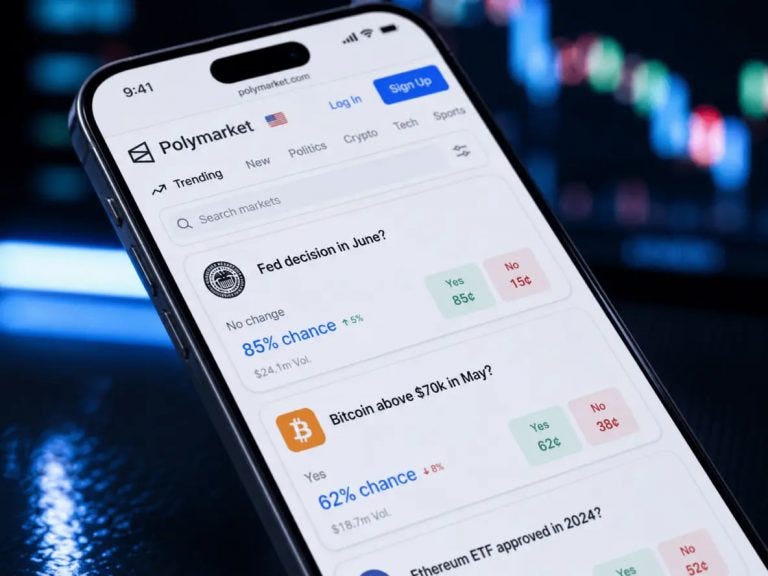
Everyone tells you to use a VPN on Polymarket. Here’s why that’s the wrong advice.
I spent an evening testing VPN advice from three different forums before realizing I was solving the wrong problem. The international Polymarket exchange geoblocks US IPs — a VPN masks your location, sure, but you’re still violating the platform’s own terms, and results were inconsistent server to server. Meanwhile there’s a second, completely legal option most VPN guides don’t even mention, and it changes what the right advice actually is depending on what you’re trying to do.
Here’s the number that changed how I think about this: a standard sportsbook prices 1.95/1.85 odds at roughly 5.3% built-in margin. The terminal I use on Polymarket’s liquidity charges a flat 1% of volume instead — visible before you confirm, not something a VPN changes either way.
How to use Polymarket: there are now two separate platforms
This is the detail most guides get wrong by treating “Polymarket” as one thing. The international exchange (polymarket.com) remains geoblocked for US IPs — no signups, no new positions from a US IP. Separately, a CFTC-regulated “Polymarket US” exchange launched in December 2025 after Polymarket acquired a licensed derivatives exchange, giving it Designated Contract Market status — the same regulatory tier as major traditional futures exchanges. That’s a real, legal, US-accessible platform — just a different product from the one most content assumes you’re asking about when it recommends a VPN.
The distinction matters because the advice for each is completely different. For the international exchange, a VPN is a workaround for a platform-level restriction, and it’s against that platform’s own terms regardless of whether it technically works. For Polymarket US, there’s nothing to work around — it’s built specifically to be accessible from the US, at the cost of requiring full identity verification.
Polymarket waitlist: what actually happened with it
Polymarket US ran invite-only behind a waitlist for about six months after its December 2025 launch. The waitlist was dropped in May 2026 — the iOS app is now open to US users without an invite code. Android and web versions hadn’t shipped as of this writing, which is worth checking before you assume full access on your device.
How to bet on Polymarket in US: the legal path most people skip
Signing up directly for Polymarket US requires full KYC — identity verification, the opposite of the no-passport model the international exchange (or a gateway to it) offers. State restrictions add another layer: Minnesota banned prediction markets outright as of August 2026, and more than a dozen states have issued cease-and-desist orders against various operators in this category. Check your specific state before assuming access, because “US-legal” doesn’t automatically mean legal in your particular state — the two lists don’t fully overlap.
There’s also a device gap worth knowing about: as of this writing, Polymarket US is live on iOS but Android and web versions haven’t shipped yet. If your device isn’t iOS, the “just sign up for the legal one” advice doesn’t actually work for you yet, regardless of which state you’re in.
VPN for Polymarket: why it solves the wrong layer
The instinct behind “use a VPN” is understandable — it’s the standard advice for any geoblocked service, and it works for plenty of them. The problem is that it treats the international exchange’s restriction as purely technical, when part of it is contractual. Even a VPN that successfully masks your IP doesn’t change what you agreed to in the platform’s terms of service, and enforcement isn’t limited to IP detection alone.
Best VPN for Polymarket: a question with no good answer
There isn’t a “best” VPN for this because the problem isn’t really about hiding your IP — it’s about which product you’re trying to access and under what terms. A VPN pointed at the international exchange still puts you in breach of that platform’s own terms of service, and detection methods change without notice, so what worked last month may not work today.
Polymarket US launch: the part that makes VPN advice outdated
The whole premise of “use a VPN” assumed there was no legal alternative — that’s no longer accurate. Polymarket US exists, is CFTC-regulated, and is legally open to US residents in supported states. The honest advice now splits in two: go through KYC for the regulated US product, or use a gateway built specifically to route around the international exchange’s geoblock without pretending to be somewhere you’re not.
What I actually use
For sports and esports markets specifically, without full KYC, a terminal on the international exchange’s liquidity is the option — not a VPN, a purpose-built gateway.
Access — no signup form, wallet created automatically.Deposit — USDT, network fee shown as its own line.Trade — pricing from the same order book, live markets update in real time, including NFL specifically.Fee — flat 1% of volume, shown before confirming.
overdog.bet is what I use day to day. My trade history is on the proof page — public.
Canada
Canada doesn’t have a nationwide restriction — it varies by province. BC, Ontario, Alberta, and Quebec apply close-only mode on the international exchange, the same soft restriction the US used to have exclusively before Polymarket US launched. Other provinces currently have none. There’s no separate “Polymarket Canada” regulated product the way there now is for the US — Canadians are still dealing with the single-platform situation the US moved past.
Australia
Australia’s restriction works differently from both the US and Canada — ACMA blocked access at the ISP level in August 2025, which means the block happens before the site even loads, not at the platform’s own discretion. A VPN changes what an ISP-level check sees; whether that’s a good idea depends on the same terms-of-service question as everywhere else.
FAQ
Can you use Polymarket with a VPN? Technically the site may load, but you’re still violating the international exchange’s terms, and results vary — some connections still get flagged despite a VPN. It solves the wrong layer of the problem for most people; a gateway or the regulated US product both address it more directly.
Responsible gambling isn’t a line to skip. If trading stops being a deliberate decision and starts being a way to cover a budget gap, that’s a reason to pause, not size up.
How to Use Polymarket in the US in 2026: VPNs, Geoblocks and What Actually Routes was originally published in Coinmonks on Medium, where people are continuing the conversation by highlighting and responding to this story.