
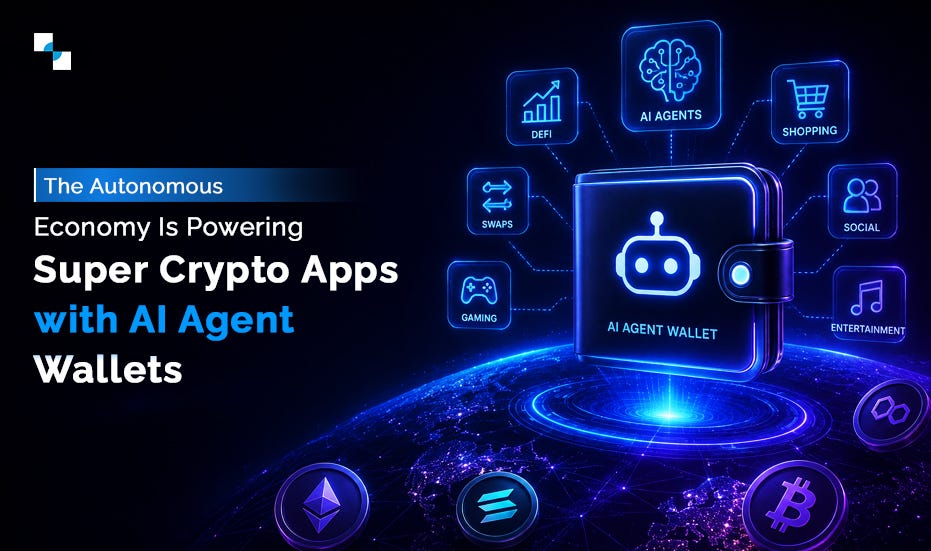
The modern Web3 user no longer wants to manually bridge assets across layer-2 networks, navigate clunky decentralized exchanges, or sign every single micro-transaction. As decentralization matures, users demand simplicity, speed, and intelligence. Enter the intersection of artificial intelligence and blockchain architecture: autonomous AI agents.
Today, these digital entities are evolving past simple chat assistants to become active financial participants. They manage treasuries, optimize yields, and execute complex cross-chain trades. At the center of this transformation lies a massive paradigm shift: AI agent wallets are rapidly becoming the core operating system powering super crypto app development.
The New Frontier: Why Super Crypto Apps Need an Upgrade
For years, the crypto industry has chased the “super app” model popularized in Web2 by platforms like WeChat — applications that bundle payments, social features, marketplaces, and financial services into a single interface. However, Web3 super apps face unique friction points. Managing multi-chain liquidity, navigating volatile gas fees, and executing security checks create a steep learning curve for everyday users.
Traditional self-custodial wallets were built as static storage vaults for human signers. They were never designed to support autonomous, high-frequency machine interactions. As the market leans heavily toward automated yield generation, programmatic compliance, and real-time portfolio management, a structural gap has opened.
To bridge this gap, modern ecosystems require sophisticated Super Crypto Wallet app development strategies. Wallets must evolve from passive key-storage utilities into active, rule-bound execution engines.
Anatomy of an AI Agent Wallet
An AI agent wallet is a programmable blockchain account governed by large language models (LLMs) and advanced machine learning guardrails. Unlike standard externally owned accounts (EOAs), these smart wallets utilize account abstraction (such as ERC-4337 and EIP-7702 upgrades) to operate autonomously under strict user-defined parameters.
Core Architectural Pillars
Session Keys & Scoped Permissions: Instead of exposing master private keys, users grant time-bound, task-specific keys to AI agents to execute specific actions like rebalancing or paying API fees.Programmatic Guardrails: Hard-coded spending caps, velocity limits, and merchant whitelists ensure that autonomous agents stay within safe operational boundaries.Gas Sponsorship (Paymasters): Agents can operate smoothly across multi-chain environments without needing native gas tokens on every single network, thanks to abstract fee-payment mechanisms.
Market Opportunities for Web3 Founders and Fintech Pioneers
The convergence of artificial intelligence and decentralized finance represents a multi-billion-dollar market expansion. Industry projections indicate that a substantial majority of next-generation wallets will incorporate agentic AI capabilities to handle routine transactions and optimize security.
For blockchain startups and fintech enterprises, investing in Super crypto App development services opens up lucrative avenues:
Autonomous Asset Management: Providing retail and institutional users with 24/7 AI portfolio managers that adapt instantly to market volatility.Agent-to-Agent Commerce: Equipping software agents with stablecoin wallets and virtual credentials to purchase APIs, computing power, or physical goods autonomously.Unified Cross-Chain Liquidity: Eliminating user friction by letting AI orchestrate bridging, swapping, and staking under the hood.
Key Challenges in Agentic Wallet Architecture
While the upside is immense, engineering an operating system for super apps comes with distinct engineering hurdles. Technology decision-makers must navigate several critical obstacles:
Security Vulnerabilities: Autonomous execution expands the attack surface. If an AI model experiences prompt injection or logic drift, poorly guarded treasuries could be compromised.Regulatory Compliance: As autonomous agents cross international borders to execute trades or settle payments, ensuring real-time Know Your Customer (KYC) and Anti-Money Laundering (AML) compliance is complex.Latency and Reliability: Decentralized applications require high-speed execution. Orchestrating off-chain AI reasoning with on-chain settlement without introducing unacceptable latency remains a technical balancing act.
Collaborating with an experienced Super Crypto Wallet app development company helps startups mitigate these risks by implementing multi-party computation (MPC), Trusted Execution Environments (TEEs), and rigorous automated security testing frameworks.
Real-World Applications Transforming the Ecosystem
AI agent wallets are already moving out of theory and into production across several key verticals:
DeFi Yield Farming: Automated bots equipped with smart wallets continuously monitor lending pools across Ethereum, Arbitrum, and Solana, shifting capital dynamically to maximize APY.Automated Corporate Treasuries: Web3 enterprises utilize policy-driven AI wallets to disburse contributor grants, pay recurring SaaS subscriptions, and handle payroll via stablecoins.Consumer Super Apps: Emerging consumer applications integrate conversational AI interfaces where users simply type commands like “Find the highest stablecoin yield and invest $500”- leaving the wallet to execute the multi-step transaction seamlessly.
Organizations looking to scale these architectures often leverage modular frameworks provided by established ecosystem builders like Antier, streamlining the path from conceptual design to secure mainnet deployment.
Conclusion
The evolution of AI agent wallets marks a fundamental turning point for the digital asset landscape. By transforming crypto wallets into intelligent operating systems, developers can finally deliver on the promise of frictionless, consumer-friendly super apps that abstract away blockchain complexity entirely.
As Web3 adoption accelerates, businesses that invest in scalable blockchain infrastructure today will be better positioned to capitalize on tomorrow’s digital economy.
AI Agent Wallets: The Operating System of Super Crypto Apps was originally published in Coinmonks on Medium, where people are continuing the conversation by highlighting and responding to this story.