
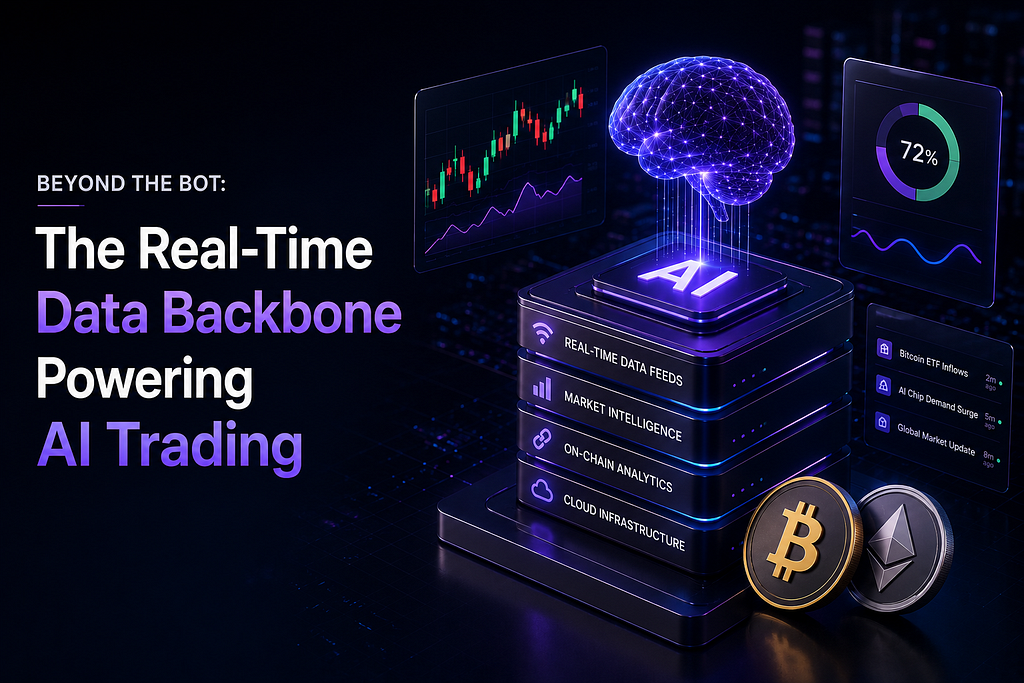
Why the AI trading revolution isn’t really about the model it’s about the milliseconds behind it
AI Trading Intelligence
The part of “AI trading” nobody puts in the pitch deck
Every trading platform launch this year has led with the same word: AI. Smarter entries, adaptive strategies, predictive signals, autonomous execution. It’s the feature that sells.
It’s also not where the actual competitive advantage lives.
A trading model no matter how sophisticated is only as good as the data arriving in front of it, and only as useful as the speed at which it can act on that data.
Two platforms can run the exact same model and produce completely different results if one is reacting to information that’s three seconds old and the other is reacting to information that’s three hundred milliseconds old. In markets that never close, that gap isn’t a technical footnote. It’s the entire game.
This is the part of AI trading infrastructure that rarely gets explained in plain language: the real-time data backbone underneath the model. So let’s actually walk through it.
What “AI market intelligence” means, precisely
AI market intelligence is the system that continuously ingests market data price ticks, order book depth, volume, news, on-chain activity, macro releases filters it down to what’s actually relevant to a given position or strategy, and surfaces that as a signal a trader or an automated system can act on, all within a latency window small enough to still be useful when it arrives.
Notice what’s doing the work in that sentence: ingests, filters, surfaces, within a latency window.
Take any one of those out and “AI market intelligence” collapses into either a slow analytics dashboard or a noisy alert firehose. Neither is intelligence. Both are common failure modes.
The data pipeline underneath every serious trading signal
Strip away the marketing language and a real-time trading intelligence system looks like this:
Market data feeds (exchange APIs, order books, news, on-chain data)
│
▼
Ingestion layer (streaming, not polling)
│
▼
Event stream (Kafka-style backbone — decouples producers from consumers)
│
▼
Stream processing (enrichment, correlation, anomaly detection)
│
▼
Relevance filtering (this position, this strategy, this risk profile — not everything)
│
▼
Signal delivery → Human trader dashboard or Automated execution engine
Every layer here exists to solve one of two problems: freshness (how fast does new information become usable) or relevance (how much of that information actually matters to the decision at hand). Most platforms are decent at one. The ones worth paying attention to are built to be good at both simultaneously.
Why polling loses and streaming wins
Older-generation trading tools pulled data on a schedule check the price every second, check the order book every five seconds. That worked when markets moved in minutes, not milliseconds.
It doesn’t work now. Streaming architectures push changes the instant they happen, using change-data-capture and event-log patterns instead of asking “anything new?” on a timer. The difference sounds small. In a fast-moving order book, it’s the difference between catching a move and reading about it after the fact.
Why execution has to sit next to intelligence, not behind it
The final failure mode is architectural distance. If insight lives in one system and execution lives in another, a human or worse, a delayed API call has to bridge them.
Every millisecond in that bridge is alpha decaying in real time. The platforms built for 2026’s market conditions are collapsing that gap: intelligence and execution as one continuous pipeline, not two tools stitched together after the fact.
The trust layer: why explainability isn’t optional
Here’s where a lot of “AI trading bot” products quietly fall apart. Automation only earns the right to touch real capital when a trader can understand why the system flagged something not just that it did. A black-box signal that’s right 70% of the time is still a hard sell if nobody can explain the other 30%, especially the first time it fails during a volatile session.
The architectures that hold up long-term treat explainability as infrastructure, not a UI afterthought: surfacing the actual signals behind a recommendation, giving traders instant override control, and behaving predictably whether the market is calm or chaotic. Speed without transparency doesn’t build a trading platform. It builds a liability.
What this means if you’re evaluating an AI trading platform
Strip away the feature list and ask three questions instead:
Is the data streamed or polled? Polling intervals even short ones are a latency tax that compounds during volatility.Is relevance filtered before it reaches you, or are you still doing the filtering yourself? If you’re scrolling through alerts to find the one that matters, the “intelligence” part hasn’t actually happened yet.How far apart are insight and execution? If acting on a signal means leaving the platform, copying a number, and placing a trade elsewhere, the architecture not the model is the bottleneck.
Frequently asked questions
What is real-time market intelligence in trading?
It’s a data architecture that continuously captures market information prices, order flow, news, on-chain activity and filters it down to relevant, actionable signals within a latency window small enough to still be useful, typically sub-second for fast-moving assets.
Why does data latency matter more than model accuracy in some cases?
Because a highly accurate signal delivered too late produces the same outcome as an inaccurate one: a missed or mistimed trade. In markets that move in milliseconds, latency and accuracy are both prerequisites, not trade-offs a platform needs both to be useful.
What’s the difference between an AI trading bot and AI market intelligence?
A trading bot typically refers to an automated execution system acting on predefined or model-driven rules. Market intelligence refers to the broader system that gathers, filters, and contextualizes data before any decision human or automated is made. A bot without strong intelligence underneath it is reacting to noise; intelligence without execution is just a dashboard.
The bottom line
“AI trading” is the headline. Real-time data architecture is the actual product. The platforms that will matter over the next few years won’t win because they have a model most competitors will eventually have a comparable one. They’ll win because the pipeline underneath it is fast enough, filtered enough, and transparent enough for a trader to actually trust it with real capital.
Where do you draw the line between “AI-assisted” and “AI-automated” trading and how much of the decision are you comfortable handing off? Drop your take in the comments.
Beyond the Bot: The Real-Time Data Backbone Powering AI Trading was originally published in Coinmonks on Medium, where people are continuing the conversation by highlighting and responding to this story.