
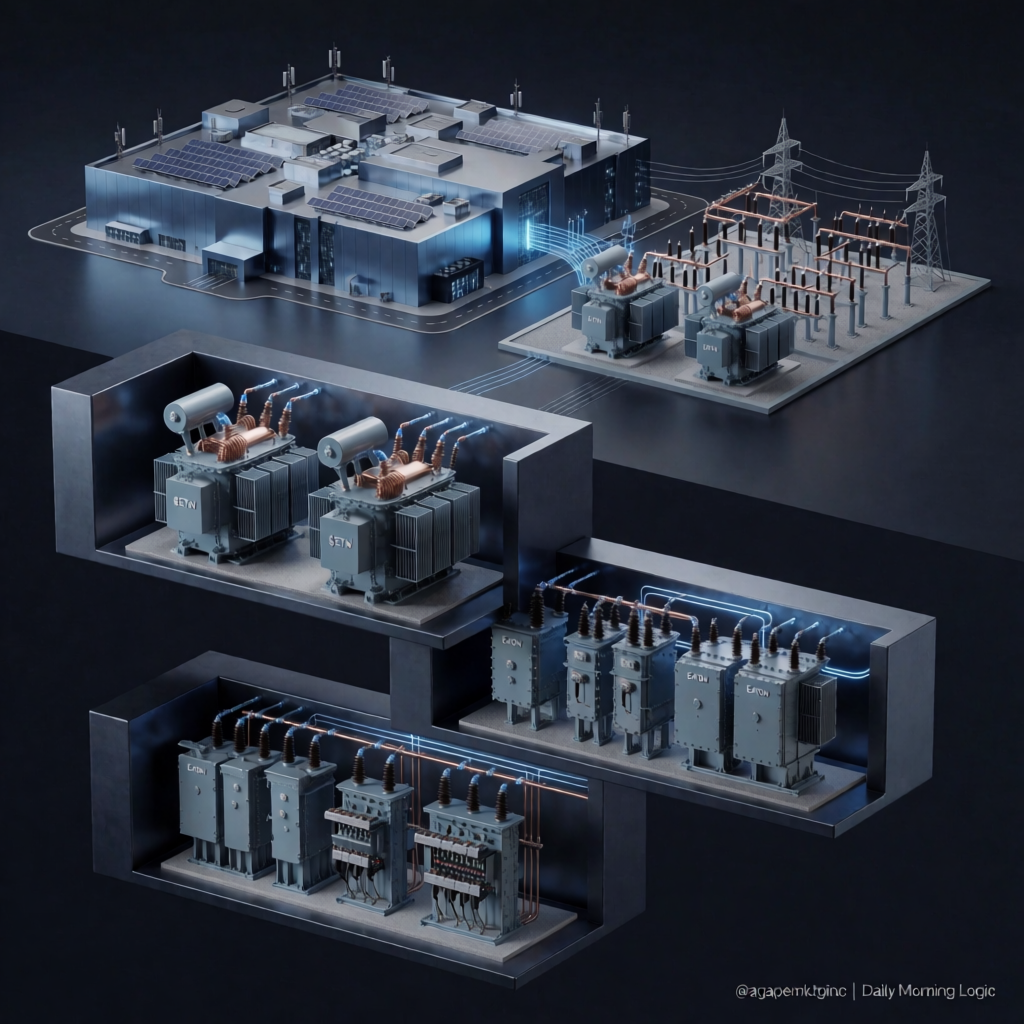
Why Eaton Corporation ($ETN) Captures Tech Expansion Expenditure
by Sheni Ogunmola.
Executive Summary
While global capital focuses on artificial intelligence application layers and hardware designer multiples, the physical constraints of computing expansion remain tied to basic electrical infrastructure. Advanced data center clusters require unprecedented amounts of electricity, shifting critical operational focus toward high-voltage equipment suppliers. Eaton Corporation ($ETN) stands as a primary beneficiary of this transition, operating as a dominant supplier of electrical distribution, protection, and transformation hardware.
Eaton’s core advantage stems from its direct integration into high-voltage power networks. Hardware systems built by Nvidia or cloud infrastructure designed by Microsoft cannot operate without primary transformers, switchgear, and liquid-cooled power distribution units. This analysis explores Eaton’s long-term backlog visibility, its essential utility role, and why its physical moat remains durable regardless of which software model leads the market.
The Physical Utility Moat: Transformers and Switchgear Demand
Computer servers process data using low-voltage direct current, but power generation and transmission occur at ultra-high voltages across utility grids. Bridging this gap requires specialized electrical hardware capable of handling massive power loads safely and continuously.
High-Voltage Transformation: Eaton manufactures step-down transformers required to bring grid-level electricity down to usable facility levels.Circuit Protection & Switchgear: As power loads increase, fault protection becomes critical. Eaton switchgear isolates electrical faults to prevent catastrophic hardware destruction.Uninterruptible Power Systems (UPS): Hyper-scale facilities require industrial-grade battery backup and power conditioning units to prevent voltage fluctuations from corrupting active compute cycles.
Because utility providers and data center developers operate under strict regulatory and safety standards, switching hardware vendors introduces massive operational risk. This creates substantial customer retention and multi-year hardware standardization across enterprise campuses.
Contract Backlog and Long-Term Capital Visibility
A critical metric for evaluating electrical infrastructure providers is order backlog longevity. The lead time for heavy electrical transformers currently spans multiple years due to raw material processing schedules and manufacturing capacity limits.
Multi-Year Order Books: Eaton continues to report record backlogs within its Electrical Americas and Electrical Global segments, driven by multi-billion dollar multi-year commitments from major cloud providers.Pricing Power: High demand relative to global manufacturing capacity allows Eaton to maintain strong operating margins even during inflationary cycles for copper and electrical steel.Execution Moat: Constructing new heavy electrical manufacturing facilities requires specialized engineering expertise and years of capital setup, preventing quick competitive disruption from low-cost market entrants.
Technology companies can iterate software in weeks, but expanding physical electrical manufacturing facilities takes years. This dynamic guarantees Eaton extended visibility into future revenue streams.
Competitive Benchmarking and Strategic Positioning
Eaton operates in an oligopolistic market alongside competitors such as Schneider Electric and Siemens. However, Eaton holds distinct structural advantages within North American commercial and industrial footprint expansion.
North American Distribution Dominance: Eaton holds deep, entrenched contractor and distributor networks across North America, making its equipment the default specification for municipal utilities and enterprise developers.Custom Engineering Capability: Data center power architectures are moving toward custom modular designs. Eaton’s ability to engineer integrated power skids reduces onsite installation times for hyperscalers.Energy Transition Exposure: Beyond compute facilities, Eaton benefits directly from grid modernization, industrial electrification, and renewable energy integration projects across global markets.
Risk Assessment and Market Realities
Investors evaluating Eaton must weigh specific operational realities alongside its growth trajectory.
Cyclical Industrial Risk: While data center demand remains high, broader industrial or commercial construction downturns can weigh on traditional electrical product lines.Supply Chain Sensitivities: Manufacturing heavy electrical equipment depends on stable supplies of specialized electrical steel, copper, and specialized components.Execution Constraints: High demand requires Eaton to scale manufacturing efficiency without incurring severe cost overruns or quality control lapses.
Despite these factors, Eaton’s positioning at the nexus of cloud expansion and power grid modernization makes it an essential anchor in physical infrastructure development.
Legal Notice: I am not a licensed financial advisor. This analysis is compiled strictly for educational and informational purposes. All market investments carry substantial risk of capital loss, and individuals must perform independent research before deploying capital.
The Physical Power Layer was originally published in Coinmonks on Medium, where people are continuing the conversation by highlighting and responding to this story.