
Naked Market breaks down macro finance, blockchain infrastructure, AI systems, and automated trading to help readers understand the future of global finance before the mainstream catches up
One woman sells mangoes for fourteen hours a day. Another man owns the tree they came from and never leaves his house. Both make money. Only one of them is free. Here’s what changed this year.
Somewhere near you, right now, there is a woman selling fruit.
Lets call her Grace. Pick whatever market you know — Lagos, Jakarta, Lima, a car park in Manchester on a Saturday. It genuinely doesnt matter. Grace exists in all of them.
Grace is up at five. She buys her stock, she carries it, she sets up her table, and she sells mangoes until the light goes. On a good day she does well, better than plenty of people with office jobs and lanyards. She is good at this.
Now heres the question I want you to sit with.
Where do Grace’s mangoes come from?
They come from trees. And somebody owns those trees.
That person does not get up at five. He is not at the market. He may not have been to that market in years. The tree grows fruit, someone collects it, and money reaches him whether he showed up or not.
Grace works. He owns.
And this exact difference is the thing almost nobody explains properly.
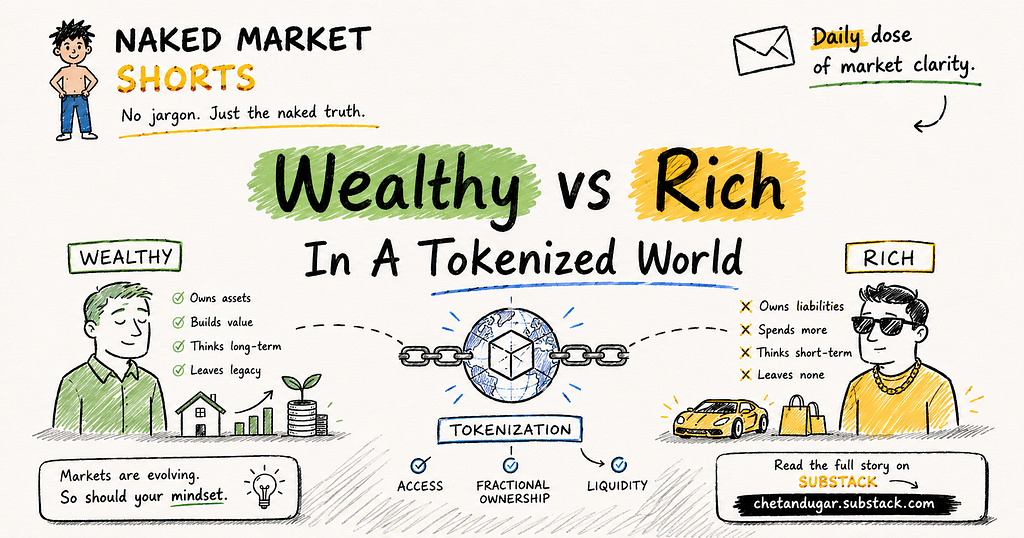
Rich is a mango. Wealthy is a tree.
Most people use “rich” and “wealthy” like theyre the same word. They arent even related.
Rich is the mango. You get it, its wonderful, you consume it, its gone. Then you need another one. Rich is money that arrives and leaves. Your salary is a mango. A good sales month is a mango. A bonus is a very large mango.
The trouble with mangoes is that they stop the day you do. Get sick, get old, get replaced and next week theres nothing on the table.
Wealthy is the tree. A tree is a thing you own that produces something on its own. It doesnt care if youre unwell. It doesnt care if you slept in. It just keeps fruiting.
A shop that runs without you. A flat with a tenant in it. A slice of a business. Money lent out that pays interest back. Those are all trees.
In one line
Rich is what you earn. Wealthy is what you own. You can be extremely rich and own nothing at all and millions of people are exactly that.
And this isnt me being clever. In December, the World Inequality Report put a hard number on it: the wealthiest people on earth are not the highest earners. Theyre two different crowds. The report found the richest tenth of the world owns about three quarters of everything while the poorer half of humanity takes home roughly 8% of global income.
Owning and earning. Two completely separate games.
Rich is what shows up this month. Wealthy is what shows up when you cant.
So why doesnt Grace just buy a tree?
This is the part where most money advice insults people.
It says: she should save. She should budget. She should skip small treats and buy assets instead. As if the only thing between Grace and a mango tree is willpower.
Thats a lie, and I want to be blunt about it.
For most of the last century, Grace was not allowed to buy a tree. Not “found it hard.” Was not permitted.
Because trees were never sold one at a time. They were sold by the orchard.
Want a piece of a commercial building? The smallest ticket is often a few hundred thousand. Not negotiable.Want into the funds that lend money to businesses? In most countries, thats legally restricted to people who are already rich. Read that twice. The rule says you may buy the good thing once you no longer need it.Live in Lagos and want to own a slice of a company in Tokyo? Historically that meant a broker, a bank, a currency headache, and fees that ate the gain before it started.
So when someone tells you the wealth gap is a discipline gap, theyre pointing at a fence and calling it a character flaw.
It was never discipline. It was access.
What actually changed
Now the interesting part, and I promise to keep this plain, because this is where finance writing usually disappears into fog.
You’ve heard the word tokenization. It sounds technical. It isnt.
Tokenization means: take a real thing, cut it into very small pieces, and keep the list of who owns which piece in a shared notebook that nobody can quietly rewrite.
Thats it. Thats the whole thing.
The shared notebook is the blockchain, I broke down how that notebook actually works in this piece on ledgers, if you want the mechanics. But for today, all you need is: a list everyone can see and no one can secretly edit.
Two things fall out of that, and both matter enormously for Grace.
One: the price of entry collapses. A thing that cost $500,000 to touch can be cut into pieces worth $50. The fence doesnt get climbed. It gets divided.
Two: the geography stops mattering. The notebook doesnt ask which passport you hold or whether an office in another city happens to be open.
And this is no longer a nice theory. Its where the biggest money on earth is walking.
Larry Fink — the man who runs BlackRock, the largest investment firm in the world built his whole letter to investors this year around it. His line was simple: “Half the world’s population carries a digital wallet on their phone.” His point being that the same phone should be able to hold a slice of a bond or a building as easily as it holds a payment.
When the biggest firm on the planet says that, its not a prediction. Its them telling you what theyre already building.
The size of it: real assets living on these shared notebooks went from a few billion dollars in early 2025 to roughly six times that by the middle of this year. And the digital dollars that move between them settled more value in a single month this February than America’s main banking transfer system did.
That is not a crypto story. Thats plumbing being replaced while everyone argues about coin prices.
Now the part you’re not being told
Heres where Id normally lose you, because most newsletters end on the good news and let you find out the rest with your own money.
So, plainly: the fence is not gone.
The uncomfortable bit
A Forbes analysis this month went through the tokenized asset market and found that more than $32 billion of it across 910 different assets had zero trading activity in a week. Not quiet. Zero.
They described it as a waiting room, and estimated roughly 97% of people who might want in still have no real way in.
Most of those slices were built for big institutions to pass between themselves. Same guest list. Nicer lobby.
And theres a second problem that can genuinely cost you money.
A lot of what gets sold to ordinary people as “tokenized shares” is not ownership at all. Its a side bet that copies the price. Which means no vote, no share of the profits, and often none of the protections a real owner has.
In tree terms: somebody sold you a photograph of a tree.
A photo of a tree can even go up in value. People trade photos. But a photo has never once dropped a mango, and it never will, and in a bad month you find out very fast which one you were holding.
Every time finance opens a door, someone sets up a stall next to it selling pictures of the room.
The Tree Test
So how do you tell? Fast, without a finance degree?
Four questions. I run everything through these now — shares, property, crypto, a friend’s business idea, all of it. It takes under a minute and it has saved me from things I would be embarrassed to admit.
Your keepable tool
The Tree Test
Ask these four before you own anything.
1. Where is the tree?
Point at the actual real thing underneath. A building. A business. Money lent to someone who pays it back. If the honest answer is “the token is the thing” you are holding a photo. Thats allowed. Just dont call it ownership.
2. Does it drop fruit?
Does it pay you anything if the price never moves at all? Rent, interest, a cut of profits. If the only way you ever win is a stranger paying more than you did, thats a bet, not a tree.
3. Would you keep it for ten years?
Not “will it go up.” Would you be calm holding it, untouched, for a decade. If a bad month would make you panic, youre not an owner, youre doing a stressful second job.
4. Who waters it?
Somebody real is holding the actual thing. A company, a bank, a custodian. Find out who. Then ask: if they vanished tomorrow, would I still own anything? This one question separates real ownership from a screenshot of it.
Scoring: four clear answers and youre looking at a tree. Any blanks, and youre making a bet which is fine, as long as you size it like a bet instead of calling it your retirement.
Why every orchard is moving to the same field
One last thing, and this is the bit that made me start writing this newsletter in the first place.
A slice of a building in Poland. A slice of a loan book in Brazil. A slice of a fund in Japan. Dollars moving between all of them. Every one of those gets reported as its own separate news story.
But theyre all quietly moving onto the same shared notebook.
Thats what I mean by One Earth, One Currency and it gets misunderstood constantly, so let me be exact.
It does not mean one coin takes over the world. It does not mean the dollar dies. Currencies will keep competing, loudly, forever.
It means the ground underneath them is merging. One shared field that every orchard can plant in, owned by no single country, the same way the internet became one shared layer that everybody’s different websites sit on top of. I laid out the mechanics properly in what a settlement layer really means.
And why should Grace care about any of that?
Because a shared field means where you were born stops deciding what youre allowed to own.
Thats the prize. Not a price going up. The quiet deletion of geography as a permission slip.
The number I care most about
Let me finish on the least exciting figure in this whole piece, because I think its the one that actually changes lives.
Sending money across a border still costs about 6.5% on average worldwide. On some routes into Africa its closer to 9%. On these new rails, its under 1%.
On $200 sent home, thats around fifteen dollars that stays in the family instead of going to a middleman. Once a month. For twenty years.
Nobody makes an exciting video about that. But thats the difference between a basket that leaks and a basket that fills which is, when you strip away every clever word in finance, the actual difference between rich and wealthy.
Grace is still at her stall this morning. The fence around the orchard is finally coming apart slowly, unevenly, with a lot of people standing nearby selling photographs.
She doesnt need the orchard. She never did.
She needs one tree, bought honestly, held quietly, for a long time. And for the first time in a hundred years, that is actually becoming possible for her.
Rich buys the mango.
Wealthy owns the tree.
Ask where the tree is
and whether it drops fruit.
If this made something click
Naked Market exists to make big shifts visible while theyre still boring before they become obvious, and long before they become expensive. If you want to understand where money is going before the crowd does, subscribe.Read Naked Market
Keep going
One Planet, 180 Currencies, Something’s Wrong — start here. The idea this whole newsletter is built on.Tokenization: The $16 Trillion Shift — how real things actually get cut into slices.Stablecoins: How A Casino Chip Became Infrastructure — where the photo-versus-tree problem first showed up.What Is A Blockchain Ledger, Really? — the shared notebook, explained from scratch.
-More soon
Wealthy vs Rich In A Tokenized World: The Mango Tree Test was originally published in Coinmonks on Medium, where people are continuing the conversation by highlighting and responding to this story.