
Before Bitcoin vs. After Bitcoin: How the Lightning Network Is Quietly Revolutionizing Everyday Payments
Imagine sending money to a friend or buying a coffee.
In the old world, it was never truly simple. Banks took their cut, payment processors added fees, and the whole process felt slow and clunky. Then Bitcoin and especially its Lightning Network changed the game.
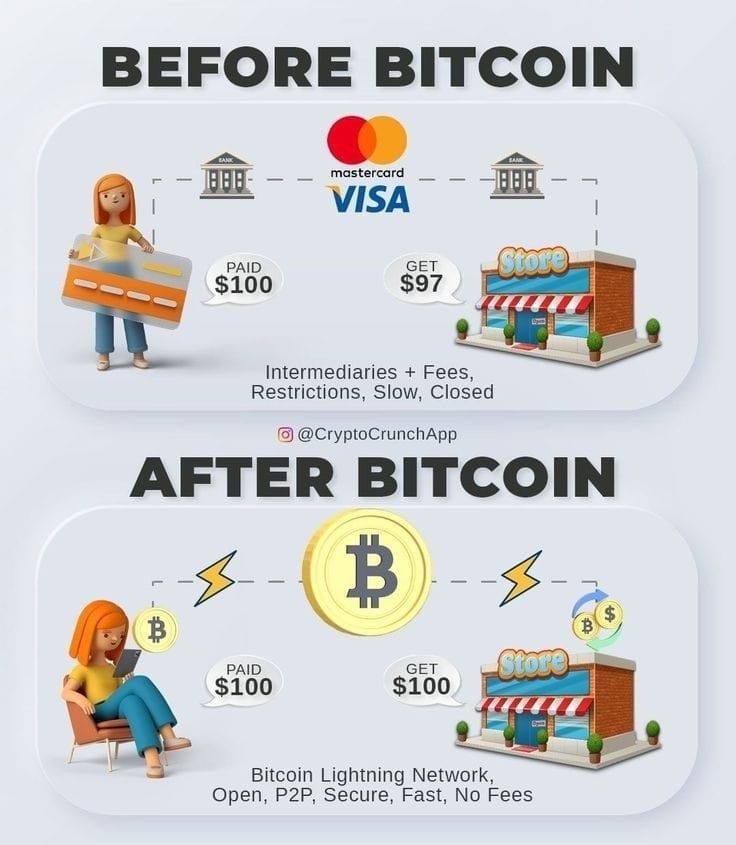
This visual comparison between “Before Bitcoin” and “After Bitcoin” perfectly captures one of the most important shifts happening in finance today. Let’s break it down, explore what it really means, and see why this matters for all of us.
Generative AI
The Old Way: Paying with Intermediaries
Picture this. You want to buy something worth $100 from a local store. You hand over your card (backed by Visa or Mastercard), and the magic or rather, the bureaucracy begins.
Your bank talks to the store’s bank through multiple intermediaries. By the time the transaction settles, the merchant might only receive $97. Those 3% fees add up fast especially for small businesses operating on thin margins.
The process is slow. International transfers can take days. There are strict banking hours, geographic restrictions, and plenty of rules about what you can and cannot do with your own money. If you’ve ever had a payment declined while traveling or waited for a wire transfer to clear, you know the frustration.
In the “Before Bitcoin” world, money movement depends on trust in big institutions. You don’t actually control your funds the bank does. And they charge you for the privilege.
Enter Bitcoin: A New Financial Rail
Now fast-forward to the “After Bitcoin” scenario shown in the image. You’re relaxed on your couch, phone or laptop in hand. With a few taps, you send $100 worth of Bitcoin directly to the merchant. They receive the full $100 instantly.
No banks. No card networks. No middlemen skimming off the top.
This isn’t science fiction. It’s the power of Bitcoin’s Lightning Network.
Lightning is a second-layer solution built on top of Bitcoin. It enables near-instant, extremely low-cost (often nearly free) transactions while inheriting Bitcoin’s rock-solid security. Transactions happen off chain in payment channels and only settle on the Bitcoin blockchain when needed. The result? Lightning-fast speed with the same decentralization and censorship resistance that made Bitcoin famous.
Why This Shift Matters More Than You Think
The difference isn’t just about saving a few dollars on fees. It’s about control, speed, and access.
1. True Peer-to-Peer Money
In the traditional system, you’re not sending money directly to the recipient. You’re sending instructions to your bank, which then coordinates with other institutions. With Lightning, it’s like handing cash to someone but digitally, globally, and without physical limits.
2. Lower Costs = Bigger Opportunities
Small businesses, freelancers, and creators benefit enormously. A content creator in Nigeria can now receive payments from fans in Brazil with almost zero friction. Remittance-dependent families in developing countries save billions in fees every year.
3. Speed That Matches the Internet Era
We live in an instant-everything world instant messages, instant delivery, instant entertainment. Yet money has lagged behind. Lightning brings money up to internet speed. Payments settle in seconds, not days.
4. Financial Inclusion
Hundreds of millions of people worldwide are unbanked or underbanked. They can’t easily open accounts or get cards. With just a smartphone and an internet connection, they can participate in the global economy using Bitcoin and Lightning.
Real-World Lightning Network Adoption
Lightning isn’t some niche experiment anymore. Major companies and apps have integrated it:
Strike and Cash App make Lightning payments seamless for everyday users.El Salvador made Bitcoin legal tender and heavily uses Lightning for daily transactions.Lightning-enabled apps let you stream satoshis (tiny Bitcoin fractions) while watching videos or listening to music paying creators in real time.Merchants from coffee shops to online stores are accepting Lightning payments because of the dramatically lower fees.
The network’s capacity continues to grow, and new developments like Ark, BitVM, and other scaling innovations promise even more functionality.
Addressing the Criticisms (Honestly)
No technology is perfect. Bitcoin still faces challenges:
Volatility (though this decreases over time as adoption grows)Learning curve for new usersRegulatory uncertainty in some countries
However, the Lightning Network dramatically improves the user experience. Wallets are becoming simpler, and “just works” solutions are emerging. Many people now use Bitcoin and Lightning without ever thinking about the underlying tech just like we use the internet without understanding TCP/IP.
The Bigger Picture: Money as Software
Satoshi Nakamoto’s original vision was to create “peer-to-peer electronic cash.” For years, Bitcoin was seen mainly as a store of value (digital gold). Lightning completes the picture by making it excellent money for everyday use too.
We’re watching the evolution of money itself from physical coins to banknotes, to digital entries in bank databases, to decentralized, programmable money.
This shift empowers individuals. It reduces dependence on any single institution. It creates more efficient markets and opens doors for innovation we haven’t even imagined yet.
What Comes Next?
The transition won’t happen overnight. Traditional finance isn’t going away it will likely integrate with these new rails. But the direction is clear: money is becoming more open, more global, and more user-friendly.
Whether you’re a business owner tired of high fees, a freelancer wanting faster payments, or simply someone who values financial sovereignty, Bitcoin and Lightning offer compelling alternatives.
The image at the beginning of this article isn’t just a cute illustration. It represents a fundamental change in how value moves around the world from closed, expensive, and slow to open, cheap, and instant.
Ready to Explore?
If you’re curious, start small. Download a Lightning wallet (like Wallet of Satoshi, Muun, or Phoenix), buy a tiny amount of Bitcoin, and try sending it to a friend or merchant that accepts it. The experience is often eye-opening.
The future of money isn’t coming. It’s already here one Lightning payment at a time.
What do you think? Has Bitcoin or Lightning changed how you think about money? Share your experiences in the comments below.
Follow for more insights on Bitcoin, fintech, and the future of money. Let’s discuss how these technologies are reshaping our world.
Before Bitcoin vs. was originally published in Coinmonks on Medium, where people are continuing the conversation by highlighting and responding to this story.