
We help beginners earn with crypto that’s the promise you see everywhere.
But if you’ve ever felt overwhelmed diving into cryptocurrency, you’re not alone. Most people only see the shiny tip: Bitcoin prices exploding, flashy altcoins, and decentralized finance (DeFi) platforms promising passive income.
The reality? There’s an entire massive structure underwater that makes it all work. Understanding these hidden parts isn’t just for tech nerds it’s essential if you want to navigate crypto confidently and avoid costly mistakes.
Generative AI
Think of the crypto world like an iceberg. The visible part grabs headlines. The submerged bulk keeps everything afloat. Today, we’re diving deep into that iceberg.
The Visible Tip: What Everyone Talks About
At the surface, crypto looks straightforward and exciting:
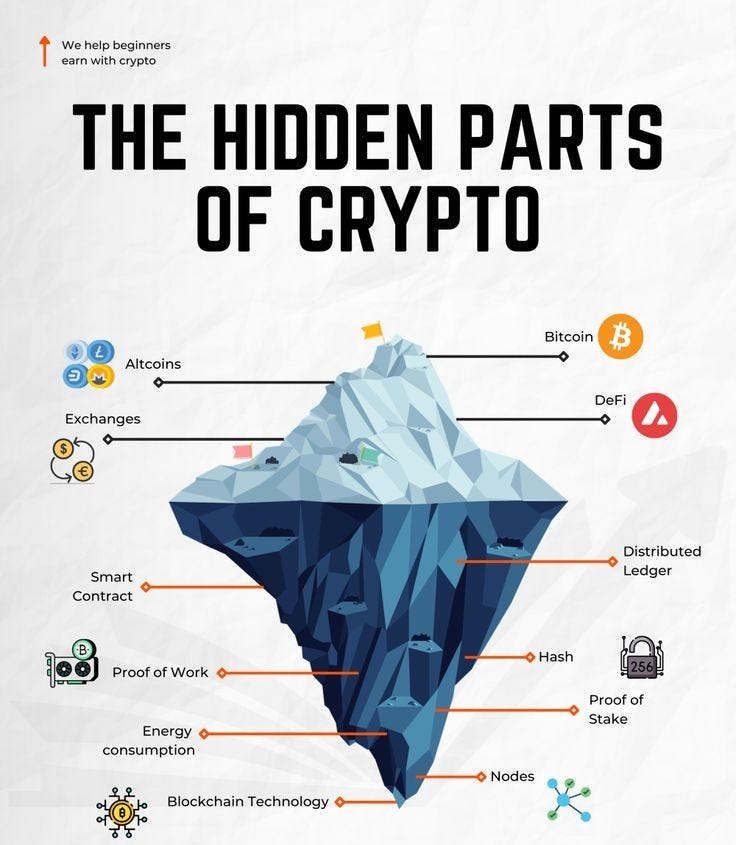
Bitcoin: The digital gold standard. Created in 2009 by the mysterious Satoshi Nakamoto, it remains the most recognized and valuable cryptocurrency. Its orange logo and simple narrative as “sound money” make it approachable.Altcoins: Everything else Ethereum, Solana, Cardano, and thousands of smaller tokens. Many promise faster transactions, smarter features, or niche utilities.Exchanges: Platforms like Binance, Coinbase, or Kraken where people buy, sell, and trade. This is where most beginners first interact with crypto.DeFi: Decentralized finance apps that let you lend, borrow, and earn interest without traditional banks. Yield farming, liquidity pools, and flash loans sound futuristic and they are.
These elements are what draw millions in. They’re easy to see, market, and (sometimes) understand. But they rest on something much larger and more complex.
Going Deeper: The Hidden Foundations of Crypto
Most of the real magic and risk happens below the surface. Here’s what the infographic beautifully illustrates.
Blockchain Technology This is the bedrock. A blockchain is essentially a decentralized, immutable digital ledger. Imagine a giant Google Sheet that no single person controls, where every transaction is recorded permanently and visible to everyone. Blocks of data are chained together using cryptography, making tampering nearly impossible. Without blockchain, there is no crypto.
Distributed Ledger Closely related to blockchain, this technology spreads data across thousands of computers (nodes) worldwide. No central authority like a bank holds the master copy. This distribution is what makes crypto “trustless” you don’t need to trust a company; you trust the math and network consensus.
Nodes These are the computers running the blockchain software. They validate transactions, store the full history, and keep the network alive. The more nodes, the more decentralized and resilient the system becomes. Think of them as the unsung heroes working 24/7 in the background.
Proof of Work (PoW) vs Proof of Stake (PoS) These are the two main consensus mechanisms how networks agree on what’s true.
Proof of Work: Bitcoin’s method. Miners compete to solve complex mathematical puzzles (using massive computing power) to add new blocks. It’s energy-intensive but battle-tested for security.Proof of Stake: Ethereum’s current approach (and many newer chains). Validators “stake” their coins as collateral. The system randomly selects them to propose blocks. It’s far more energy-efficient and accessible.
Hash Functions & Energy Consumption Every transaction gets processed through a “hash” a unique digital fingerprint. Change one tiny detail, and the entire hash changes, alerting the network. This cryptographic security is powerful but comes with a cost: Proof of Work mining consumes enormous electricity, sparking environmental debates. Newer networks and Layer-2 solutions are working hard to reduce this footprint.
Smart Contracts The real game-changer introduced by Ethereum. These are self-executing contracts with code that automatically enforces agreements. No lawyers, no middlemen. Want to release funds only when both parties confirm delivery? A smart contract can handle it. This technology powers most DeFi applications, NFTs, and decentralized apps (dApps).
Why These Hidden Parts Matter for Beginners
Understanding the submerged part of the crypto iceberg helps you in several practical ways:
Better Investment Decisions: Knowing that not all blockchains are equal (some are more decentralized, others faster but more centralized) helps you evaluate projects beyond hype.Risk Awareness: Smart contract bugs have led to millions in losses (remember the DAO hack?). Energy concerns can affect regulation and public perception.Long-term Perspective: Bitcoin’s Proof of Work has secured trillions in value for over 15 years. That resilience comes from the hidden infrastructure.Practical Participation: Once you grasp nodes and staking, you can move beyond just buying and holding to actually securing the network and earning rewards.
The Future Below the Surface
As crypto matures, innovation is happening mostly underwater. Layer-2 scaling solutions, zero-knowledge proofs for privacy, cross-chain bridges, and sustainable consensus models are addressing current limitations. Regulatory clarity will likely focus on these foundational elements too energy use, smart contract security, and decentralized governance.
For beginners, the message is clear: Don’t just chase pumps on the surface. Spend time learning the fundamentals. Start with Bitcoin and Ethereum whitepapers (yes, they’re surprisingly readable), experiment with small amounts on testnets, and join communities that explain concepts without jargon.
Getting Started Without Drowning
Educate gradually: Use resources like Khan Academy’s crypto sections, official project documentation, and beginner-friendly books like “The Bitcoin Standard.”Prioritize security: Hardware wallets, seed phrase protection, and understanding self-custody are non-negotiable.Stay curious: The hidden parts evolve fast. What seems complex today becomes intuitive with time.
Crypto isn’t just digital money it’s a fundamental shift in how we handle trust, value, and coordination at a global scale. The visible tip gets you excited. The hidden parts give you the confidence to stay.
The next time you see Bitcoin hitting new highs or a hot new DeFi protocol, remember the massive structure underneath. That’s where the real revolution is happening.
Ready to explore deeper? Drop your biggest crypto questions in the comments. What part of the iceberg confuses you most? Let’s learn together.
The Hidden Parts of Crypto: What Lies Beneath the Bitcoin Hype was originally published in Coinmonks on Medium, where people are continuing the conversation by highlighting and responding to this story.