
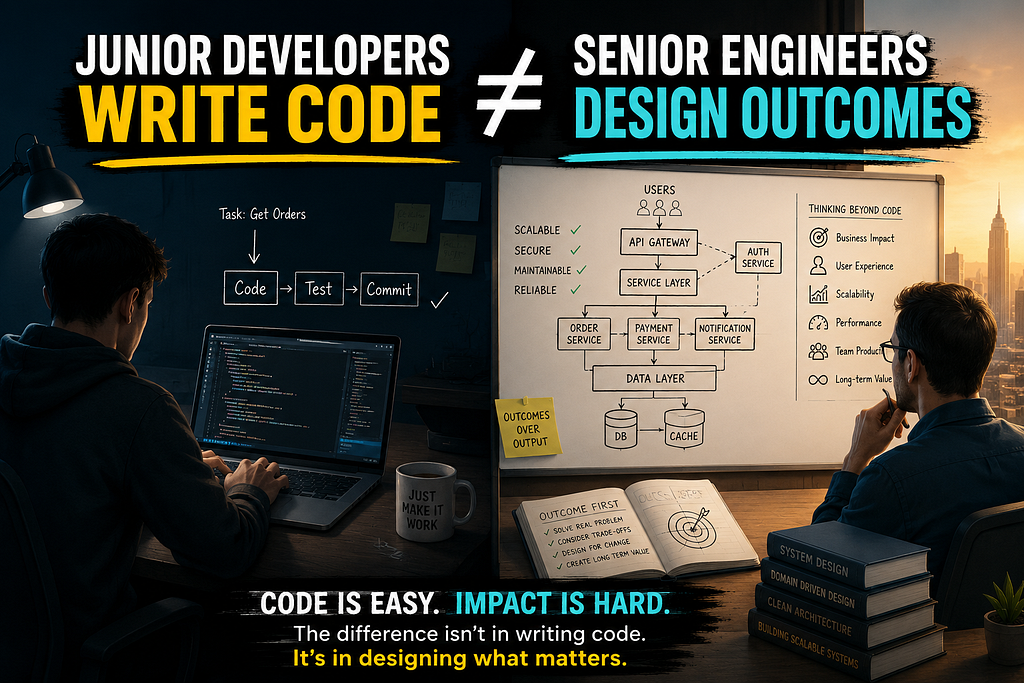
Your code works.
That is the problem.
It runs. It passes tests. It gets merged. And yet, three months later, someone rewrites it. Six months later, it becomes a production issue. One year later, nobody wants to touch it.
This is the uncomfortable truth no one tells early in a developer career.
Writing code is not the job.
Designing outcomes is.
Early in a career, success feels simple. A ticket comes in. You write a function. You fix a bug. You see green checks. You feel productive.
That feeling is addictive.
But it is also misleading.
Because the real world does not reward code. It rewards impact.
A junior developer asks:
“What should I write?”
A senior engineer asks:
“What problem are we actually solving?”
That one shift changes everything.
Take a simple example.
A junior developer might implement an API like this:
@GetMapping(“/user/{id}”)
public User getUser(int id) {
return repo.findById(id).get();
}
It works. It returns data. Done.
A senior engineer looks at the same requirement and sees something else entirely.
What happens if the user does not exist?
What about latency?
What about caching?
What about abuse?
What about future scale?
The code becomes:
@GetMapping(“/user/{id}”)
public ResponseEntity<User> getUser(int id) {
User u = cache.get(id);
if (u == null) {
u = repo.findById(id).orElse(null);
if (u != null) cache.put(id, u);
}
return (u != null) ? ok(u) : notFound();
}
Still simple. Still readable.
But now it reflects thought.
That is the difference. Not complexity. Not cleverness. Thought.
Junior developers optimize for completion.
Senior engineers optimize for consequences.
Before writing a single line, a senior engineer maps the system in their head.
Something like this:
Client
|
v
API Layer
|
v
Service Logic
|
v
Database
|
v
External Services
But they do not stop there.
They ask:
Where will this break?
Where will this slow down?
Where will this be abused?
Where will this need to evolve?
That is how outcomes are designed.
There is also a hard truth that stings a bit.
More code does not mean more value.
In fact, the best engineers often write less code.
Because they remove unnecessary work before it begins.
A junior developer might build a feature in five days.
A senior engineer might spend two days questioning it, then solve it in one.
Or decide it should not be built at all.
That is not laziness. That is leverage.
Another difference shows up during incidents.
When production breaks, junior developers search for the bug.
Senior engineers search for the system failure.
A null pointer is not the problem.
The absence of validation is.
A timeout is not the problem.
The lack of retries, backoff, or circuit breaking is.
A crash is not the problem.
The lack of observability is.
Senior engineers think in layers.
They design systems that fail gracefully, not systems that hope to never fail.
Let us talk about ownership.
Junior developers often feel ownership over code.
Senior engineers feel ownership over outcomes.
If a feature fails in production, it does not matter who wrote it.
It matters that it failed.
This mindset changes behavior.
Documentation improves.
Monitoring gets added.
Edge cases are considered.
Communication becomes clearer.
Because the goal is no longer to finish work.
The goal is to make things work in the real world.
So how does someone make this shift?
Not by learning another framework.
Not by memorizing more syntax.
But by asking better questions.
Before writing code, pause and ask:
What happens if this grows 10x?
What happens if this fails at midnight?
Who depends on this?
What is the simplest version that solves the real problem?
And most importantly:
Is this even the right problem to solve?
There is a moment in every developer’s journey where things click.
You stop thinking in methods.
You start thinking in systems.
You stop chasing tickets.
You start shaping outcomes.
That is when growth accelerates.
That is when people trust your decisions, not just your code.
Writing code is a skill.
Designing outcomes is a responsibility.
One gets you started.
The other makes you indispensable.
If your code works, that is good.
If your system works under pressure, that is engineering.
And that is the difference that separates a developer from an engineer.
Junior Developers Write Code — Senior Engineers Design Outcomes was originally published in Coinmonks on Medium, where people are continuing the conversation by highlighting and responding to this story.